All civilised peoples have a responsibility
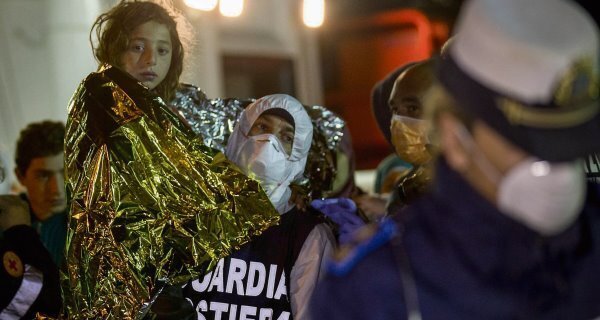
‘WHEN children are put on board a boat and sent a drift no civilised people can just watch — we need to save these children. We cannot allow a boat loaded with children simply to sink.”
That was almost a year ago when the Italian prime minister, Matteo Renzi, appealed to the EU to support and extend the Italian navy’s Mare Nostrum programme.
But within months it was wound up, replaced by a few boats under Frontex, the EU’s quasi-border patrol body that depends on countries volunteering transport and people.
READ MORE: Up to 950 migrants die as boat capsizes .
Since then thousands more have died in the Mediterranean, mostly crossing from North Africa to the nearest European piece of land, the tiny island of Lampedusa, or Malta for those coming from further east.
“The problems of migration are not just for Italy, Greece, Malta or Spain. They are for Europe. We need to address this issue collectively,” he said last July.
He is repeating this appeal now, and called for an emergency EU summit following the latest tragedy of at least 800 deaths, many of women and children locked in the hold of the smugglers boat.
Mare Nostrum — “Our Sea” — operated by the Italian Navy for a year to last October saved 140,000 lives in that time according to the European Council on Refugees and Exiles. It warned that ending the project without replacing it with a well-resourced operation whose priority was to save lives would mean more deaths.
But the Frontex “Triton” operation was launched in November as a deterrent rather than to save lives, and operates only within 30 miles off the Italian coast with a budget of €2.9m, a third of Mare Nostrum.
Vincent Cochetel, director of UNHCR Europe, warned too that the EU needed to create legal alternatives to these crossings, otherwise people would continue to risk their lives in the hands of smugglers.
In just nine months last year, 3,000 people drowned crossing the Mediterranean, the majority in Libyan waters where Mare Nostrum was not operating. So far this year, about 2,000 are believed to have died. But whether these new figures will convince EU leaders to change their approach is far from certain.
Several countries were critical of the Italian operation, describing it as a “pull factor”, encouraging smugglers and their clients to undertake the journey.
The anti-foreigner sentiment sweeping through Europe also has complicated any attempt to do anything. The rise of the far right — with its anti-foreigner and anti-Islam nationalist agendas — has pushed governments to adopt more restrictive practices also.
While Mare Nostrum was in operation the Italians placed those they rescued in accommodation. But shortly after they reverted to allowing migrants to quickly move to other EU countries.
The agreement — known as the Dublin Convention — means migrants are dealt with in the first country they enter, registered and looked after and their request for refugee or other status investigated and either granted or rejected and returned to where they came from.
Italy caused a furore some years ago when the numbers crossing into France had the French reintroduce border checks. Spain granted citizenship to thousands of migrants, allowing them to travel the EU freely in search of family and work.
Sweden has taken proportionally, per head of population, more refugees than any European country while Germany is the country most favoured in the world for asylum seekers. Germany did not experience an unemployment crisis and has filled many of its job vacancies with non-Germans, mostly from other EU countries. But while there is little sign of xenophobia in most of Germany, the federal government is very much against having EU structures to resolve the influx.
So the burden continues to fall on the countries around the Mediterranean. Up to recently, Greece was the main access point with thousands from the Middle East, the war-torn countries of Afghanistan and Iraq pouring through the long border with Turkey. EU funds helped build fences and pay for patrols reducing illegal crossings to a trickle.
The upsurge of violence in Syria and Libya means most migrants come from these countries with people fleeing for their lives, along with others from Somalia and sub-saharan Africa.
War and poverty are the main reasons people flee their homes as the UN’s figures show — with Syrians taking over from Afghans in recent years, making up a quarter of refugees globally, followed by Afghanis and Somalians. Ireland adopts a careful approach, taking what the authorities see as manageable numbers of refugees — including 200 Syrians recently.
The EU had a policy to treat the problem at its source a few years ago, but resolving conflict and poverty in countries outside your jurisdiction is at best a long-term strategy. The other solution was to work with frontier countries, helping them tighten borders, set up refugee camps and train their people to deal with asylum requests.
It led to a cynical operation when Libya’s former leader Muammar Gaddafi set up essentially prison camps, unfit for human habitation, detaining those who crossed into Libya. The country did not have an office to deal with asylum or refugee requests. Others were, and continue to be, hounded back into the desert. Libya is not alone in this approach. Human Rights Watch reported that this week Somalia forcibly evicted 21,000 displaced people near the capital, leaving them without food or water.
Foreign ministers held a minute’s silence at the start of their meeting in Luxembourg yesterday, and the EU’s head of foreign affairs, Federica Mogherini, called a special joint meeting of foreign and justice ministers as reports continued to come in of further deaths in the Mediterranean.
On her way into the meeting she said: “The main issue here is to build together a common sense of European responsibility on what is happening in the Mediterranean, knowing that there is no easy solution, no magic solution, but there is a responsibility that we have to exercise together, as Europeans, in a consistent and coherent way.”
Ireland’s Foreign Minister Charlie Flanagan said he hoped that every country would “accept a measure of responsibility”, because the current situation could not continue.
Ms Mogherini acknowledged it would require a range of measures from fighting the traffickers to working for peace, to patrolling borders to rescuing unfortunates. “We have no more excuses. The European Union has no more excuses. All member states have no more excuses.”
DISCOVER MORE CONTENT LIKE THIS
CONNECT WITH US TODAY



Be the first to know the latest news and updates