Bomb threat at Intel brings terrorist threat closer to home
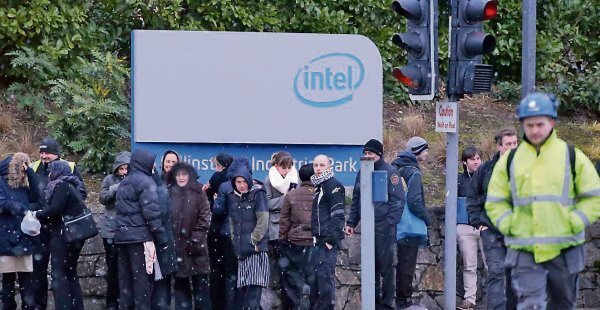
Coming less than a week after the Paris terror attack, investigators are under pressure to find out who was behind the incident at one of Ireland’s best known workplaces, reports Cormac O’Keeffe

Bomb threat at Intel brings terrorist threat closer to home

JUST last weekend, Garda Commissioner Nóirín O’Sullivan said watching the terrorist attacks in Paris had brought home to her the “havoc and mayhem” three determined people can inflict on a nation.

Now she and her senior officers are scrambling to determine whether or not that threat has literally been brought home with the bomb scare at the US computer giant Intel in Kildare by someone citing the name Islamic State.

While no devices were found at the sprawling Leixlip plant, a massive manhunt is under way to find the caller.

A key part of the investigation will be to try and establish: a) was this a juvenile prank; b) was it a disgruntled former or current employee; c) was it a real threat from an Islamic extremist; or d) was it a malicious attempt by a racist to stir up hostility towards the Muslim community.

It will form part of a wider, high-level intelligence analysis that is being conducted in the wake of the terrorist attacks in Paris on the security threat posed by radical Islamists.

A senior security source said last night: “There’s an urgency to getting to the bottom of this. Any threat like that, particularly in the space we are in now, is taken very seriously.”

Last Saturday, at an event marking the murders of 10 journalists and two police officers at Charlie Hebdo offices, Ms O’Sullivan said: “Watching the events in Paris, what it brings home is the havoc and the mayhem that a very small, but a very determined number of people can create. It’s something that we’re very mindful of.”

Since the attack, directions were issued from Garda HQ to local divisions directing officers to pay attention to various vulnerable people and places, including the Israeli ambassador and the Israeli embassy, synagogues, and the French embassy.

The Special Detective Unit — which combats terrorist groups — has also been in contact with Garda divisions since the Paris attacks seeking an update on local people who are, or who have been, fighting in Syria and Iraq.

It is understood the SDU carried out a similar review last September. It is thought the review is being conducted under the directions of Crime and Security Branch at Garda HQ, which is the security service arm of the force.

“The biggest threat is fellas that have gone out and come back,” said one experienced source from a Garda division. “We can see from the footage in Paris that they had military training. The fear is they might come back and set up a little cell. That’s the fear; but there’s no evidence of that having happened.” He pointed out that it was “very hard” to know if there were people in his division who had travelled to Syria: “This is a very difficult area to infiltrate, to get information. We don’t really know who has gone out.”

The chair of the Oireachtas justice committee David Stanton said last June that following a briefing with Justice Minister Frances Fitzgerald that the number of foreign fighters was in the “mid 20s”. Another Garda source said this number only reflected those who they know about and that there could well be other people they are simply not aware of.

The source pointed out that many of those who go to Syria to do for humanitarian or medical reasons: “They go to warzones for many reasons. We never just label them as jihadists, or whatever, just because they go abroad. Far more analysis is conducted on them.”

Ms Fitzgerald said last Saturday said there were “increasing concerns” among EU justice ministers about foreign fighters and that “hundreds of people were going and coming back radicalised”. She said Ireland was “not immune” to this.

The Garda Commissioner said it was this issue and the threat posed by so-called lone wolves — radicalised individuals who act on their own without foreign direction — which concern her.

“You would be concerned about lone wolves, people self-radicalised by some event overseas or elsewhere and then also trigger events, something that could happen that nobody has any control over, that can actually spark off a reaction,” she said. “They’re the type of things we would monitor.”

Both she and the minister stressed that suspects can’t be monitored around-the-clock — a problem evident in Paris.

“You can’t keep surveillance 24 hours a day,” said Ms O’Sullivan. “You have to be realistic. You have to be very vigilant. You have to monitor for any indications that may be there and that’s what we do. But we do need to work closely with the community and people need to feel confident and can have the trust to come forward and raise any concern.”

The burning issue investigators will firstly try and clarify is who was behind the bomb threat. And why.

x

More in this section

Revoiced

Newsletter

Sign up to the best reads of the week from irishexaminer.com selected just for you.

Cookie Policy Privacy Policy Brand Safety FAQ Help Contact Us Terms and Conditions

© Examiner Echo Group Limited