Jackie Healy-Rae: A unique voice in Irish politics
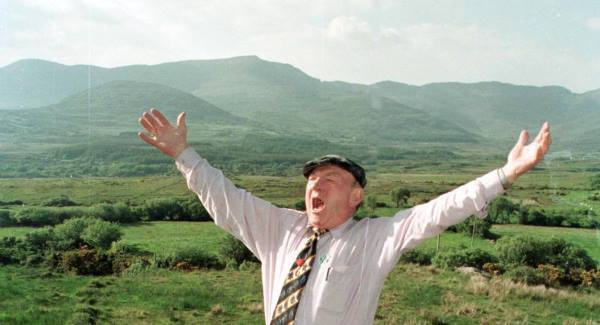
Jackie Healy-Rae rarely spoke in the Dáil, but was heard loud and clear in the corridors of power, says Donal Hickey <

Jackie Healy-Rae: A unique voice in Irish politics

JACKIE HEALY-RAE could have opted to draw the old- age pension and take life easy. He was 66 when he burst onto the national political stage and was, in his own words, “mad for road”.

And a long road it was. He had been in Fianna Fáil since the 1960’s and had spent many years as a county councillor and constituency director of elections for the party before he made an acrimonious break and stood as an Independent in the 1997 general election.

A colourful personality with a rolling Kerry accent and a quaint turn of phrase, he became a media draw and could play the celebrity card when it suited, while all the time remaining grounded among the so-called plain people of Ireland.

He could have followed a number of careers. Long before he sat in Dáil Éireann, he had been a successful farmer, agricultural and civil engineering contractor, musician, sportsman, and publican. All his life, he was an exceptionally hard worker, no matter what pursuit he took on.

Four to six hours sleep a night was plenty — he said he wouldn’t “waste” time in bed — while he drank but little, maybe a couple of whiskeys or a glass of beer with friends on a Saturday night.

Whenever he wanted to escape from the political maelstrom, he would return to the family farm in the foothills of Mangerton mountain, where he relaxed driving tractors and mechanical diggers.

Born in 1931, he was the eldest of six children brought up on a small holding at Reacaisleach (rough grazing land near the little ford), about 5km from Kilgarvan in the Kerry South constituency. The double-barreled name didn’t result from any delusions of grandeur — the “Rae” part of the surname derived from the townland and was used to distinguish the family from other Healys in the area.

When Jackie was about eight years old, his father became seriously disabled. Consequently, his mother had to do much of the heavy work on the farm as well as caring for her young family, all of whom became accustomed to hard work.

Jackie walked, or ran, to and from school in Kilgarvan, which he left at the age of 13. He didn’t go to second level and instead set about earning money while still in his teens. It was in the “university of the world” that he received much of his education. A lifetime of bargaining and cut and thrust stood to him in later life.

In his spare time, he played hurling, winning two county championships with Kilgarvan. In 1953, he emigrated briefly to New York and, on returning, bought a tractor, with which he did work for local farmers.

Music was in his blood. He played accordion and saxophone and was a member of Kilgarvan Dance Band in the 1950s and ’60s. In 1969, he bought a public house in Kilgarvan, currently run by his son Danny and family.

It was the 1960s that he was blooded politically, being actively involved in organising torch-lit parades for Fianna Fáil in a series of by-elections around the country. His career in representative politics began in 1973 when he was co-opted to Kerry County Council for Fianna Fáil, and he retained the seat in several elections thereafter.

For many years, he had ambitions to become a TD, but the party preferred to have him as director of elections. In several elections, he delivered two seats for Fianna Fáil in three-seat Kerry South with astute vote management and an encyclopaedic knowledge of a scattered rural constituency.

Prior to the 1997 election, he believed it was time he himself stood for the Dáil. He put his name before a Fianna Fáil convention to select candidates, but was not nominated. It was a serious blow to his ambitions and he set about making a strong case to party leader Bertie Ahern and other leading Fianna Fáil figures to be added to the ticket.

However, the party stuck with the decision of the convention to have two candidates — outgoing TD John O’Donoghue and Brian O’Leary, a son of long-serving Fianna Fáil TD John O’Leary, who had retired.

That left Healy-Rae with just one option — to break from Fianna Fáil and stand as an Independent. He ran an old-style barnstorming campaign, with plenty of razzmatazz and visits to nightclubs in Killarney where he cajoled younger voters.

Fianna Fáil lost its second seat in Kerry South. Healy-Rae not only took that seat but also thousands of Fianna Fáil votes, which the Healy-Rae organisation has managed to retain ever since. As well as topping the poll, there was an added bonus for the new TD, who found himself holding the balance of power with a number of other Independents. He was one of four Independents who did deals with Ahern to prop up the Fianna Fáil/Progressive Democrats government from 1997 to 2002.

His deal included access to cabinet ministers, more money for roads and piers, and grants for small farmers and other services in Kerry South.

With his trademark tartan cap, rural demeanour, and phrases that Dublin folk sometimes found hard to decode, Healy-Rae attracted national attention. While he played to the gallery, he resented being portrayed as a gombeen man caricature.

Indeed, he and his politically astute family have turned the attitudes of people “above in Dublin” to their advantage at constituency level.

He vowed his voice would be heard in “that big house above in Dublin”, but in fact, he was one of the TDs that spoke least in the chamber.

When criticised at the end of the five-year term for his virtual silence, he declared: “I wasn’t sent up to Dublin to be roaring and shouting around the place, but the people of South Kerry asked me to deliver for them and I did that.”

Political opponents questioned his work for the constituency, but he was adamant that Mr Ahern was honourable and had delivered on the package that had been agreed.

Despite bouts of bluster and veiled threats that he would withdraw his support for the government, he and the other Independents — Harry Blaney, Mildred Fox, and Tom Gildea — voted with the Government through the full term.

After the 2002 election, Fianna Fáil and the Progressive Democrats formed an administration with a comfortable majority, which greatly diminished the influence of Healy-Rae and other Independents.

In 2007, he agreed to support a FF/PD/Green coalition in return for a €71m package for roads in his constituency. The crash of 2008 scuppered some of that deal, but he hung on until 2011 when his son Michael, for long the heir apparent, succeeded him.

Donal Hickey is the author of the biography The Mighty Healy-Rae

Best-known political dynasty initiated by Healy-Rae

By Donal Hickey

Spanning five decades and now into a third generation, one of Ireland’s best-known political dynasties is Jackie Healy-Rae’s legacy.

The template is not based on any ideology, but on pure populism — hard work and service to the people; giving people what they look for, be it planning permission for one-off houses in rural areas, better roads, grants, and health services.

The Healy-Rae political organisation is acknowledged as one of the most effective in the country. It is tightly controlled by the family and run by a network of loyal key people in every parish and village throughout South Kerry.

With two Independent county councillors and a TD bearing the family name, there’s virtually 24/7 availability, a serious work ethic and at least one Healy-Rae will turn up at every public meeting, funeral, football match or any event at all.

By the time Jackie Healy-Rae retired in 2011, his son, Michael had been well groomed to take over and he duly won a Dáil seat.

And when Michael subsequently gave up his Kerry County Council seat, his nephew, Johnny Healy-Rae, was co-opted to it.

Johnny’s father, Danny, had already been a councillor for several years. In last May’s local elections, both father and son were returned with huge poll-topping votes in their electoral areas.

Between them they had four quotas, a base which puts Michael Healy-Rae in a strong position facing the next general election for which Kerry will be one five-seat constituency.

The well-oiled political machine is already moving into the northern side of the constituency where the Healy-Raes are laying the foundations for another election campaign.

“We’re nothing special. We’re ourselves. We don’t make ourselves out to be anything that we’re not,’’ he said. ‘’Primarily, we’re machine drivers. I’ve a shop and we’re also publicans and farmers.”

His constituency was his paramount, even sole, focus

By Donal Hickey

In his maiden speech to the Dáil in June 1997, Jackie Healy-Rae spoke of a “list’’ he wanted delivered to his constituency during the lifetime of the Government he pledged to support.

However, he did not reveal details of the secret deal he, like other Independents, hammered out with Taoiseach Bertie Ahern in return for support.

At the end of the five-year term, he said “98% to 99%” of what he had been promised had been delivered.

Healy-Rae became a major irritant to the Fianna Fáil TD for Kerry South, Justice Minister John O’Donoghue — fierce competition grew between them to be the first to announce “goodies” for the constituency.

There has been controversy over credits up to recent times, including the Castleisland bypass and a new community hospital in Kenmare, with Jackie Healy-Rae claiming that he had delivered both under his deals with Fianna Fáil-led administrations. Other politicians also claimed the credit.

In what might be termed the Healy-Rae mission statement, the constituency is paramount, even the sole focus.

Ahern also secured Healy-Rae’s support for the FF/PD/Green coalition in 2007 in return for €71m for road projects in Kerry South, not all of which were delivered because of the economic collapse.

More in this section

Revoiced

Newsletter

Sign up to the best reads of the week from irishexaminer.com selected just for you.

Cookie Policy Privacy Policy Brand Safety FAQ Help Contact Us Terms and Conditions

© Examiner Echo Group Limited