As party leaders drop like flies, Kenny has the edge over Adams
Michael McDowell was the first to go (ironically along with his nemesis Joe Higgins). Having lost his seat and led his party to its worst ever performance, he had no choice. Many, probably most, believed the PDs had gone past the point of no return. Their leadership contest was being conducted under most people’s radar.
But what’s this? A faint glimmer of hope? When others were performing the ostrich manoeuvre over the evidence being presented at Dublin Castle, a small voice cried “Enough”. Could Fiona have inherited some of the O’Malley magic? We shall see.
Trevor Sargent was next. He had promised not to lead his party into government with Fianna Fáil. Some would say, ungenerously, that a more skilful politician wouldn’t have painted himself into such a corner — but he was true to his word, which was refreshing. The slogan “principles before politics” has life in it yet.
No one was actively seeking Pat Rabbitte’s head. He took responsibility for an electoral strategy he had closely identified with but hadn’t paid off for Labour. At 58, he probably calculated that he didn’t have another general election in him and was only standing in someone else’s way. Again, he acted out of the best of interests. So far, so chivalrous.
Across the border, it was another matter. Ian Paisley was as good as forced out. A poor local council by-election brought simmering discontents about his style of co-leadership of the Stormont assembly to a head. One day, his wife and mentor was saying he must stay because “Ulster needed him”; the next, he, too, was gone, his bitter legacy only partially redeemed.
And now, the biggest beast of them all has hung up his boots. He did so with some style, showing just a little of that famous Ahern cunning, wrong-footing his opponents in the process.
History might well recall he prevented 26 other EU heads of government from blaming him and his bizarre financial arrangements for the loss of the Lisbon treaty. Quite a few prime ministers have invested substantial political capital in preventing popular votes on the treaty-cum-constitution.
They would have reacted angrily if it had been scuppered because one man’s personal past dealings distorted the unavoidable Irish referendum campaign. (That is not the same as saying some EU leaders don’t secretly hope the electorate here will put the document out of its misery because it’s a bad document. It’s just that if Ahern and his Mahon difficulties were still around, the treaty’s proponents could credibly say the voters really meant Yes when they said No. It’s an argument we have heard before in France and Holland.)
If there is one person, even more than the independents, who will be sorry to see the back of Bertie Ahern, it’s the president of Sinn Féin. For one thing, Gerry Adams believed — or liked to pretend — he had secured private assurances from the outgoing Taoiseach a decade ago this week, regarding Northern representation in the Oireachtas and the release of Detective Garda Jerry McCabe’s murderers.
Such promises were never worth very much but they are worth even less now. Why should Brian Cowen feel beholden to such side deals? He wasn’t even at Castle Buildings in Holy Week 1998. Interestingly — and again to Adams’s certain annoyance — Bertie Ahern said on RTÉ radio on Sunday that national unity is a very long-term project and people will have to tolerate the fact it might never happen.
More immediately, though, now the Lisbon treaty’s chances have improved, Sinn Féin’s prospects of a recovery have deteriorated. Adams might have been deprived of a propaganda coup. With Strasbourg elections looming next year and the Dublin Euro constituency being reduced from a four-seater to a three-seater, Mary Lou McDonald was already looking vulnerable. No wonder Sinn Féin has been putting more effort into this referendum than previous ones. A bad Lisbon poll could dent even further Sinn Féin’s claim to speak for the (southern) Irish people on the world stage.
With just one issue — police devolution — standing in the way of the full implementation of the Good Friday Agreement, Adams must question why his halo doesn’t shine more brightly. Dreams of taking up residence in Phoenix Park are but memories.
Not only does the much-vaunted ‘southern strategy’ appear tattered but grumbles are emerging even from impeccably republican quarters in his west Belfast base. True, the SDLP has been well and truly eclipsed but what’s left to achieve? What is Adams for any more? If it weren’t for the lack of an obvious successor, who would blame him if he retired to his Donegal ranch to write more fiction?
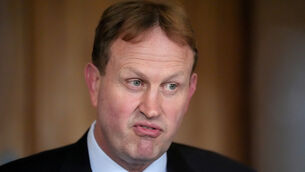
Which leaves Enda Kenny. He is right not to let one poor opinion poll score put him off his stride — 28% is precisely what Fine Gael achieved last year, after all. Yes, he faces — again — the prospect of a general election a long way hence against an opponent with vastly more ministerial experience (if perhaps fewer concrete achievements). But the economic backdrop will, few doubt, be less favourable to Fianna Fáil. And it is just months since Kenny brought home another 20 TDs.
THERE were complaints last week that Kenny had misread the public mood — or the public mood as defined by some in the media. Hadn’t Bertie done as Fine Gael required, commentators complained? Has Kenny no tact, no discretion? Hadn’t a great guy poured his own whiskey and reached for his own revolver rather than wait for it to be handed to him? Actually, though, a politician resigned because he was unable to dispel the impression of low standards in high places. The Fine Gael leader was within his rights to call for a general election (even if one is never granted in these circumstances).
The duty of the opposition, never forget, is to oppose. It wasn’t so long ago nearly a million people voted Fianna Fáil, imagining they would be getting Bertie Ahern as their Taoiseach for a few more years. Political scientists would argue people vote Fianna Fáil because it’s Fianna Fáil, not because of who the leader is, but Kenny had a point. Nobody, not the Fianna Fáil members, nor even the TDs, let alone the voters, has had a say in the change at the top.
That probably suits Brian Cowen just fine for now: he owes everyone and no one. But there is an unfortunate recent parallel not so far away. In Britain, the finance minister replaced a class act who became mired in financial allegations. He too warded off any potential contest. A year later, he is 15 points down in the polls. Cowen must be hoping he is a Sean Lemass taking over from an Eamon de Valera, not a Gordon Brown taking over from a Tony Blair.
CONNECT WITH US TODAY



Be the first to know the latest news and updates