Colin Sheridan: Back-slapping group of sycophants looks more like the Coalition of the Shilling with every eaten canapé
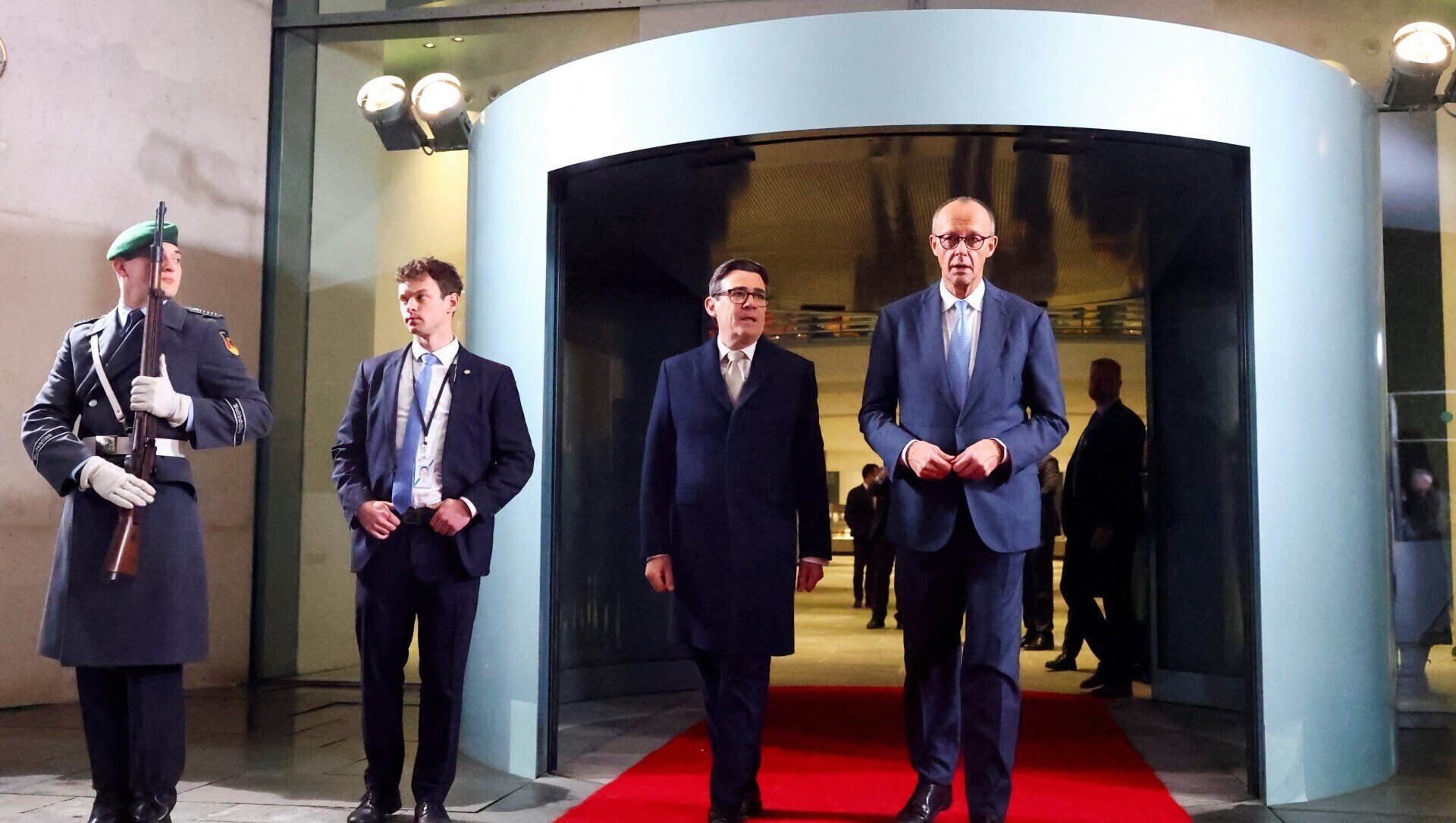
Britain's prime minister Andy Burnham and German chancellor Friedrich Merz leave the Chancellery following the 'Coalition of the Willing' meeting in Berlin, Germany. Picture: Hannah McKay/PA

The Coalition of the Willing sounds like a really shit band from the early 90s. From somewhere three hours outside Seattle, where the drummer’s mother let them practise in the garage on condition they were finished before .
Thirty years later, one of them is a successful actor. He’s on Graham Norton promoting a film about grief when somebody produces the tape. He says he only played bass on two tracks. You can see him calculating whether that makes it better or worse.
It also sounds like an underground movement whose members have all been told they’re the only one with a key. A breakaway faction of the residents’ association. A men’s retreat where somebody takes your phone and asks you to name the last time you cried.
A five-minute TED Talk that opens with a photograph of a goose putting its feathered wing around a stricken otter. A wedding WhatsApp group set up after the groom has asked for volunteers to stay behind and search for the best man's integrity.
And it sounds like what it is. Or, supposed to be. A name governments give themselves when they want their notion of moral readiness to count as an achievement in itself.
The last time the name enjoyed this kind of prominence, the United States and Britain were using it to sell the 2003 invasion of Iraq. Kofi Annan, then secretary general of the United Nations, said the invasion was illegal under the UN Charter. You would think that might have taken the name out of circulation for a while longer.
Apparently, the people responsible for naming these things work on the same principle as the people who keep bringing back Ukraine as a sovereign country defending itself against a Russian invasion.
It has every right to ask for help and every reason to want guarantees that will hold when Moscow next decides a border is a matter of opinion. That is a good cause with a nefarious name. It also matters enough to ask what the people gathered under that name are actually proposing.
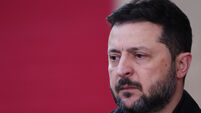
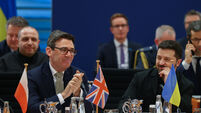
On Thursday, German chancellor Friedrich Merz hosted the coalition’s 17th meeting. More than 40 participants joined in person or online. Alongside Volodymyr Zelenskyy were France's Emmanuel Macron, Britain’s Andy Burnham, Poland’s Donald Tusk, Italy’s Giorgia Meloni, and our own Micheál Martin. Steve Witkoff and Jared Kushner were there for the Americans.
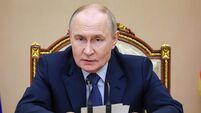
Donald Trump[/url] rang in from his plane after meeting Vladimir Putin and Xi Jinping in Shenzhen. As team-building exercises go, I imagine that put an end to the trust falls.
I’d love to see the lunch menu. I picture sandwiches cut into country-sized shapes so everybody can take as much as their national procedures permit. In the breakout rooms, one group would be asked to define robust. The other would have five minutes to agree what it was willing to guarantee.
The public record is more substantial than the name suggests. Zelenskyy put air defence high on the agenda, with winter coming and Russia attacking civilian infrastructure. Germany, France, Britain, and Ukraine issued a joint statement backing direct Ukraine-Russia talks with American and European participation, further pressure on Russian revenues, and a winter pause in attacks on energy infrastructure.
The European Commission’s proposed €45bn for Ukraine’s military and budgetary needs next year was still for EU leaders to approve. By yesterday morning, Russia had struck Kyiv again.
As Elaine Loughlin wrote in this paper last week, Israel struck Nasser hospital in Gaza just hours before European leaders gathered in Dublin.
Martin said Europe should be at the table for talks on Ukraine. Asked about sanctions on Israel, he said there would be no outcome from the summit and pointed to divisions among the 27 EU members.
The European Commission is preparing its 22nd sanctions package against Russia. On Israel, Europe is still preparing to agree with itself. The back-slapping group of sycophants is undeniably looking far more like the Coalition of the Shilling with every eaten canapé.
Ireland has ‘pushed’ for action, while Britain and France say they’ll bring forward bans on goods from Israeli settlements. Yet a commission proposal to suspend some of Israel’s trade privileges has stalled. We know how quickly governments act when a principle is worth political capital. Palestinians get told how hard it is to find a date.
The part of the Berlin statement worth reading twice concerns what happens after a ceasefire in Ukraine. It envisages legally binding security guarantees.
Among the options are US-led monitoring, a European-led multinational force backed by the Americans, and a binding commitment, subject to each country’s own procedures, to act if Russia attacks again.
A ceasefire monitor and a soldier sent to help enforce a guarantee may both work in the service of peace. Their jobs can look very different the morning the ceasefire breaks.
Martin will claim good reason to be in Berlin. Ireland holds the EU presidency, supports Ukraine’s EU membership and wants sanctions on Russia to bite. The public statement came from Germany, France, Britain and Ukraine.
Martin has signalled Ireland could consider a peacekeeping or monitoring role with the necessary approvals, and has drawn a distinction between that and joining a force meant to deter Russia.
It was in Berlin, after that meeting, that Martin also addressed the Government’s plans to remove the UN mandate requirement for larger overseas deployments of Irish troops.
He said he was open to the thrust of a Fianna Fáil amendment that would give UN resolutions a place in the process, while making clear he did not want deployments to depend on one.
The Government’s argument about a Russian veto has force. So does the question of whose authority we would rely on once we dispense with the requirement.
This week, a group of governments was discussing precisely the sort of mission an Irish government could one day be asked to join.
So put it under Any Other Business. What mandate would Ireland require before sending monitors? If asked to back a binding guarantee, what would we be prepared to do the day Russia broke the ceasefire?
I’d like to hear the answers while the Taoiseach can still give them without having to explain what our partners have come to expect, and how hard they are “pushing” for peace and justice elsewhere.
We’ve seen the group photo. Let’s see the small print.

BLACK FRIDAY
Already a subscriber? Sign in

CONNECT WITH US TODAY



Be the first to know the latest news and updates