Sarah Harte: If we don't stand up and use our cúpla focal, the Irish language will not survive
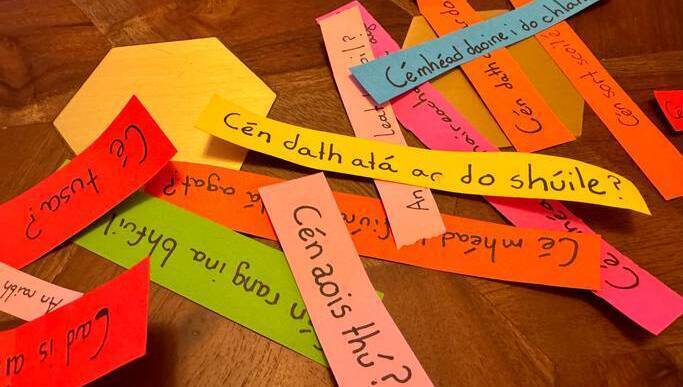
The Department of Education needs to overhaul how we teach Irish... Less rote learning, less of an modh coinníollach. More comhrá agus craic in an environment that encourages people to speak without fear of making mistakes.

What’s your attitude to our national language?
Do you have recurring nightmares about being forced to bellow ‘Beidh Aonach Amárach i gContae an Chláir’?
Or are you what the economist David McWilliam calls a "Hibernian Cosmopolitan", choosing Irish-medium education for your children primarily for its educational benefits and social appeal?
Or maybe you are younger and love Irish like a cailín or buachaill maith, enthusiastically quoting Kneecap on the importance of our national language. Or maybe you recoil at the mention of Irish.
Regardless, last week’s budget raised issues about how the State is translating its stated commitment to Irish into practice.
TG4 says demand for Irish-language content is stronger than ever, while the Government has frozen its funding at about €65m for 2027. Ard-Stiúrthóir/director-general Deirdre Ní Choistín said the decision was "disappointing" and could "have consequences for what TG4 can deliver in 2027".
From where I’m standing, is mór an trua é sin.
TG4 plays an important role in protecting the Irish language, promoting Irish culture, and giving Irish-speaking communities access to television in their own language, while giving the rest of us a different lens on life.
Read More
At this point, tá mo chuid Gaeilge féin measartha. I clam up in public because tá náire orm Gaeilge a labhairt. I’m not alone. In a March interview with the Irish Examiner, the presenters of , the hugely popular bilingual podcast, spoke about the many people who have Irish but lack the confidence to use it.
At times, it feels like the State’s unofficial policy is to treat Irish not as a living language, but as a badge of honour that politicians sentimentally trot out at big State occasions, often with the cúpla focal mangled.
You strongly suspect some politicians overlook the cultural and personal value of learning Irish, seeing it as economically valueless and therefore a waste of time.
The beleaguered minister for culture Patrick O’Donovan recently said Coimisiún na Meán shouldn’t have been given an Irish name because it causes international confusion, which is unfortunate.
We should take a leaf out of the confident French state’s book. English words, and in particular Americanisms, invade their culture, but the Délégation générale à la langue française et aux langues de France protects the language institutionally.
We sell Ireland as a gateway to Europe, educated, English-speaking, outward-looking and comfortable in the world. But we risk treating Irish as a secondary concern rather than recognising it as part of what gives us a deep-seated, distinctive cultural identity.
When we reduce our language to a question of utility, we expose the poverty of our thinking. When somebody denigrates Irish using the logic of ‘where will it get you’, you know you’re speaking to a colonised mind.
There’s something, yes sir, no sir, three bags full sir, about ambition that jettisons the rich tapestry of a national language. A country that measures everything by its economic return will eventually become rich in foreign investment but poor in the things that make it culturally distinctive.
In some quarters of the citizenry, hostility to the language remains barely hidden. A South Dublin senior counsel once loudly berated me at a dinner party for sending my offspring to a Gaelscoil.
He said: "So you’re seriously sending your child to a training ground for the IRA?" I pushed the water towards him, thinking: ‘Beam me up, Scotty.’ That reaction was hardly unthinkable in a State where some still viewed Irish-language education as a political statement rather than an educational choice. Hopefully that attitude is waning.
A survey, 'Generation Gaeilge’, published in March this year measuring interest in learning Irish, for Údarás na Gaeltachta and Gaelchultúr found 68% of adults surveyed wanted to improve their Irish. This rose to 73% of people under 35, which is heartening.
This growing interest in learning Irish surely highlights TG4’s role in promoting and preserving the language.
So why freeze its funding? We must distinguish between aspiring to preserve Irish and taking practical steps to ensure it. On that note, it’s time to revisit our exemption policy for Irish.
New research published in June before the Joint Oireachtas Committee on Irish, the Gaeltacht and the Irish Language Community, carried out by Pádraig Ó Duibhir of DCU, revealed secondary-school exemptions rose by 109% since 2017.
In 2024/2025, 14.3% of post-primary students, or 60,946 students, held an exemption, up from 9.4% or 33,476 in 2017.
For context, in 1999, only 2.5% of secondary school students held exemptions.
However, of the 37,974 post-primary pupils exempted in 2024 due to a learning disability, over half or 19,404, studied a foreign language.
This doesn’t mean all exemptions are unjustified, but the figure suggests the exemption system warrants scrutiny and raises questions about how exemptions are assessed and whether pupils receive enough support before being excused from Irish.
Ireland has become increasingly more diverse.
Migration has brought people from so many different backgrounds, including linguistic ones. Their children enter the Irish educational system. This means supporting newcomers in learning the language but also having the confidence to say that learning Irish is a condition of moving through our schooling system. If we don’t, those exemption statistics will rise even further.
To be clear, the problematic attitude about Irish doesn’t come from migrants; rather, it comes from within.
If you’ve ever stood at a school gate, you’ll know some parents game the system, helping children secure exemptions so they can focus on other Leaving Cert subjects, based on expensive private psychological reports.
The Department of Education also needs to overhaul how we teach Irish because otherwise, to butcher Yeats’s words, it may end up "with O’Leary in the grave", Less rote learning, less of an modh coinníollach. More comhrá agus craic in an environment that encourages people to speak without fear of making mistakes. Beatha teanga í a labhairt.
The goal shouldn’t be solely to pass an Irish exam. We should make children want to speak their own language and to leave school without hating it. Mol an óige agus tiocfaidh sí.
Doing that wouldn’t eradicate the self-hating ‘Irish is no use’ sensibility of some members of my generation, who continue to see Irish as socially threatening.
The hope is this seoinín mentality will die with us.
We need to rein in the exemptions, pony up to TG4 to support high-quality Irish language programming, and meaningfully consider how we teach Irish from infancy to leaving school.
Because Irish won’t survive on sentiment and lip service.


CONNECT WITH US TODAY



Be the first to know the latest news and updates