Colin Sheridan: Sweeping condemnation of Hamas should not be admission price for discussing Israel and Palestine
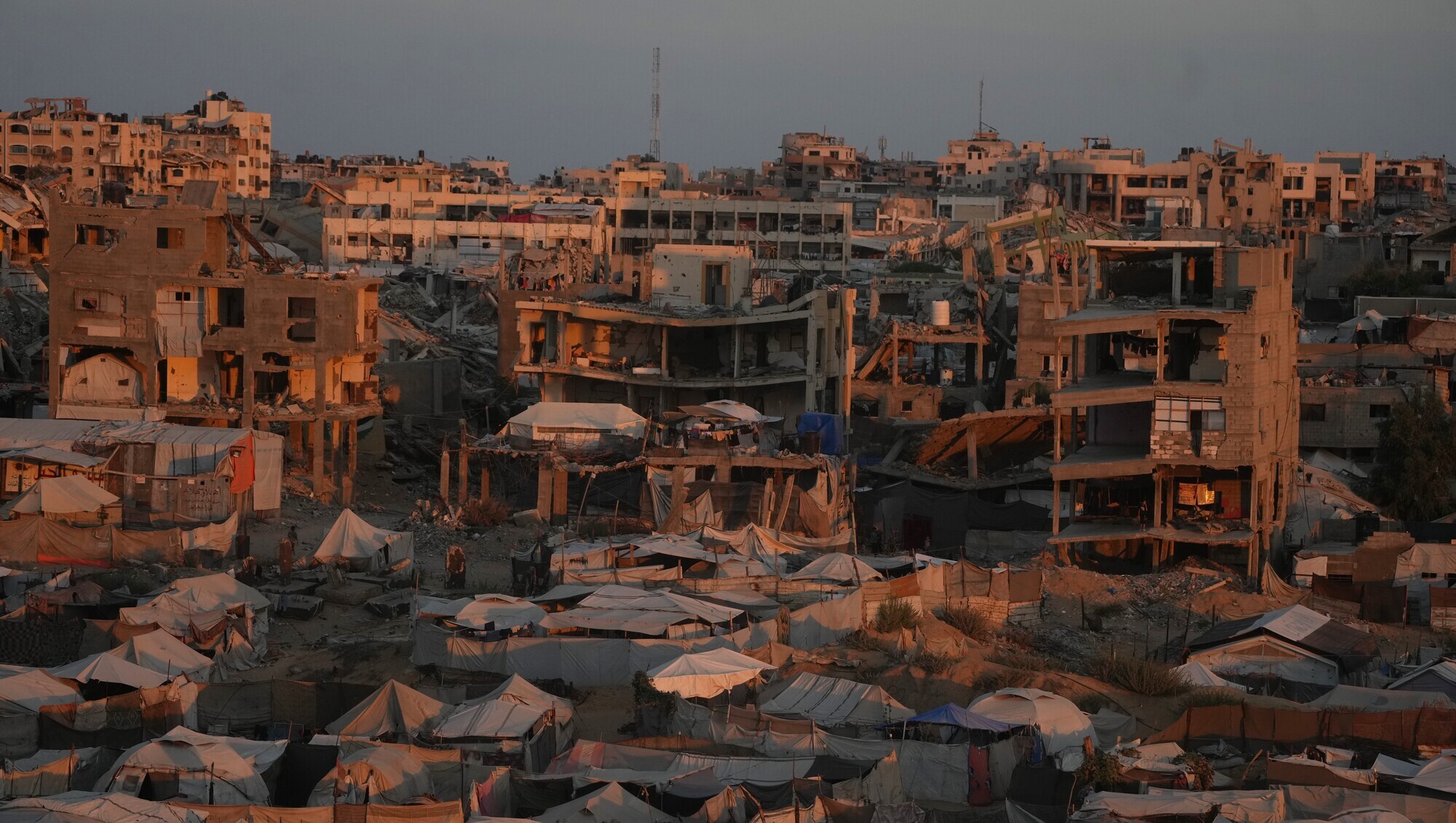
Tents sheltering displaced Palestinians amid war-damaged buildings in Gaza City on September 26, 2026. Picture: Jehad Alshrafi/AP
In December 1982, the United Nations General Assembly reaffirmed the legitimacy of struggles against colonial domination and foreign occupation by “all available means, including armed struggle”. Its resolution explicitly recognised the Palestinian people’s right to self-determination. In Ireland, this should be intelligible. We name railway stations after revolutionaries. We sing songs about rebels. Our commemorations invite us to revere people who refused to accept that another country could determine how they lived.
We understand resistance. Or we understand it once its participants are safely dead.
Three years after October 7, that distinction deserves honest examination. Historical distance allows us to celebrate liberation while smoothing away the choices through which it was pursued. Contemporary resistance arrives without that convenience. It is frightening, contradictory and sometimes capable of terrible crimes.
The UN resolution is a political affirmation, not a binding licence for violence. International humanitarian law governs armed groups as well as state militaries. Civilians cannot deliberately be targeted. Hostage-taking is prohibited. Attacks must distinguish between civilians and combatants, and comply with proportionality and precautions.
A cause — however justified — does not exempt its adherents from those obligations. Neither does a uniform. This ought to clarify the conversation. Instead, we repeatedly encounter another demand: Do you condemn Hamas?
What is disguised as a moral referendum is really an unashamed attempt at a gotcha, a loyalty test administered before discussion can begin. Respondents must recite the required words before being permitted to speak about occupation, dispossession, or Palestinian freedom.
I condemn the deliberate killing of civilians and the taking of hostages, but decline to make a sweeping condemnation of Hamas as the admission price for honestly discussing Palestine. That refusal expresses no allegiance, but surely reflects a reluctance to substitute a declaration about an organisation for an examination of the people and the extraordinary circumstances involved.
I have never lived as a Palestinian, nor been forced to endure the evils of occupation. That does not prevent moral reasoning. It should encourage humility about what I understand, and curiosity about what I do not. Irish history should make us better at asking questions. Resistance can contain bravery, cruelty, conviction, and political ambition. We know how selectively those characteristics enter the national story.
Did Algerians deserve independence? Were they supposed to trust that continued French rule would peacefully deliver it? Did Irish people deserve independence? How long should they have waited for British consent?
Were the Jews who rose in the Warsaw ghetto in 1943 justified in taking up arms against German forces seeking to deport and/or murder them? We recognise their resistance to annihilation as legitimate, even though military victory was scarcely conceivable.
These histories differ profoundly. They demonstrate our ability to understand why people take up arms when submission offers no tolerable future. Can we extend that understanding to people whose struggle is still unfolding?
Consider Nat Turner. In August 1831, Turner, an enslaved preacher in Virginia, led a rebellion in which approximately 55 white people were killed, including women and children. The revolt was suppressed. Turner was captured and executed. Black people, including those uninvolved, were killed in retaliation. The immediate aftermath brought greater repression. The rebellion also profoundly challenged a society determined to regard enslaved people as property rather than human beings with wills of their own.
Calling Turner simply a murderer tells us something about the rebellion and nothing about slavery. Calling him simply a liberator can obscure the people his followers killed.
The difficult work is to confront both.
Slavery’s horrific violence preceded Turner’s rebellion. It had laws, commercial arrangements, and “respectable” defenders. Those benefiting from it could perceive rebellion as introducing violence into an otherwise orderly world. That habit survives. The violence maintaining an unequal order becomes background; the violence challenging it becomes the event requiring explanation.
If October 7 had happened in 1823, what would our account contain? Would we describe the preceding decades more truthfully? Distinguish between attacks on military positions and civilians? Would examining the perpetrators’ circumstances seem less suspicious?
Time would not change the humanity of those murdered. It might change our willingness to examine history. But why can't we be honest about it now, in real time?
Any serious account must examine what came before, whose suffering was ignored, and which possibilities for political change had already been shut down. An occupied people’s claim to freedom survives crimes committed by those claiming to represent it. Otherwise, liberation becomes conditional on collective virtue demanded of no established state.
Civilian protection cannot depend on somebody’s assessment of innocence. Attending a music festival on the doorstep of Gaza does not make someone a legitimate target. Neither does living in Gaza beneath a government others despise. Protection must hold precisely when anger makes withdrawing it tempting.
Parts of southern Lebanon remain under illegal Israeli occupation. Armed organisations can draw legitimacy, and recruits from that reality. Hezbollah’s claim to resistance does not encompass Lebanese political life or entitle it to speak for everyone.
Demanding its disappearance while treating occupation as secondary evades the conditions in which that claim acquires force.
Those watching from safety have another evasion available: Romanticising resistance.
A flag, slogan, or image of a fighter can offer satisfying solidarity. The person represented may want something less cinematic: To get home, educate a child, keep a livelihood, survive.
The occupied have disagreements. Some support armed struggle. Some oppose the organisations conducting it. Some resent supplying courage for an audience that will never bear the consequences.
Listening means hearing those voices too. Otherwise, solidarity becomes another way of deciding what somebody else’s life should mean.
Resistance is a foreseeable and obvious response to violent oppression and domination. Its methods and consequences require scrutiny. Anyone seeking peace must ask what routes to freedom remain available, and what happens when they are repeatedly closed.
We cannot demand indefinite patience from people whose lives are consumed by the arrangement we ask them to endure.
Ireland’s history gives us no monopoly on understanding this. It gives us reason to try.
We commemorate those who refused our subordination. We should recognise that defiant refusal in others.
If we want people to put down their weapons, freedom must become something they can reach without them.


CONNECT WITH US TODAY



Be the first to know the latest news and updates