Michael Moynihan: Having four different Irish translations of Bishop Lucey Park is ludicrous
For a different take on on signage, come with me to Bishop Lucey Park in Cork City, where the Irish language is truly being put through the wringer. Picture: Chani Anderson.

Back in the day — which is to say, the Cretaceous Era of the 80s — all the pretentious kids were fond of the high performative style.
Friends of your columnist might have been spotted sitting around in Mary Rose’s in the Queen’s Old Castle with a white coffee and Milan Kundera book on the table, front page very much visible. Or Umberto Eco, because for some reason pompous translation was a big part of the pantomime.
The Eco book was usually , though the author had another life as an academic specialising in semiotics, the science of signs.
“A sign is not only something which stands for something else,” was a typical Eco side-splitter. “It is also something that can and must be interpreted.”
The great man’s line came to mind because of a reminder I got recently on social media — the 12-month anniversary of something I posted online, a photograph of one of the signs down by Páirc Uí Chaoimh. It read: Blackpool Terrace Chéimeanna Carraige Duibhe.
For anyone not familiar with the locality, Blackpool is just over three miles away from the venue. Even some tortured pun about the two Downeys owning all the real estate around the half-back line in the páirc wouldn’t excuse this: it’s a mistake, pure and simple.
There are other errors to be found on our signs, of course, but in this instance the Irish looks on point, at least.
That isn’t always a given when it comes to official signs, where Irish translations can be variable in accuracy and quality.
Read More
Sinéad Ní Ghuidhir of Ollscoil na Gaillimhe has summed this up for RTÉ in the past: “Has misspelling signage in the official language of the country become a national pastime? Why does it happen with such frequency? Is it carelessness or ignorance? Is it arrogance?
“... It is common practice to spellcheck the written word. However, it seems that the standard practice for the Irish language is to simply use Google Translate and hope for the best.”
Good point. This occurred in Limerick last year, for instance, when there were complaints about the Irish language used on new way-finding signs installed by Limerick City and County Council.
“An Dr Síle Ní Choincheannain, who is a lecturer in education with expertise in Gaeilge at Mary Immaculate College, has pointed out several flaws in the Irish language translations on the signs,” reported local radio station Live95.
Also last year, an Aontú councillor in Dublin criticised Fingal County Council for its work as Gaeilge: “This is local government and some of the translations are absolutely bizarre. The expression ‘lost in translation’ was never so apt. One sign actually read the ‘angry Hotel’ for a local business, which is way off”.
And just last week, the reported Irish Rail had “apologised for a spelling mistake in Irish language signage at new turnstiles installed at its revamped Ceannt Station in Galway city.
“The national rail operator said the incorrect spelling of the word “Ceannaigh” — the Irish for buy — on new turnstiles at the station was due to an “administrative error by a supplier”.
“An Irish Rail spokesperson said the signs erected at the train station in the Republic’s first official bilingual city will be corrected “as soon as possible”.”
Well, the fact Galway is Ireland’s ‘first official bilingual city’ compounds the error, because you’d imagine there’s no shortage of people to point it out.
Could you argue, though, that the error in question — ‘ceannaig’ instead of ‘ceannaigh’ — is also just a typo? A misspelling of the kind that can occur and be missed in proof-reading? That is not to excuse the mistake in the first place, but these things happen, and at least Irish Rail vowed to correct the situation as soon as possible.
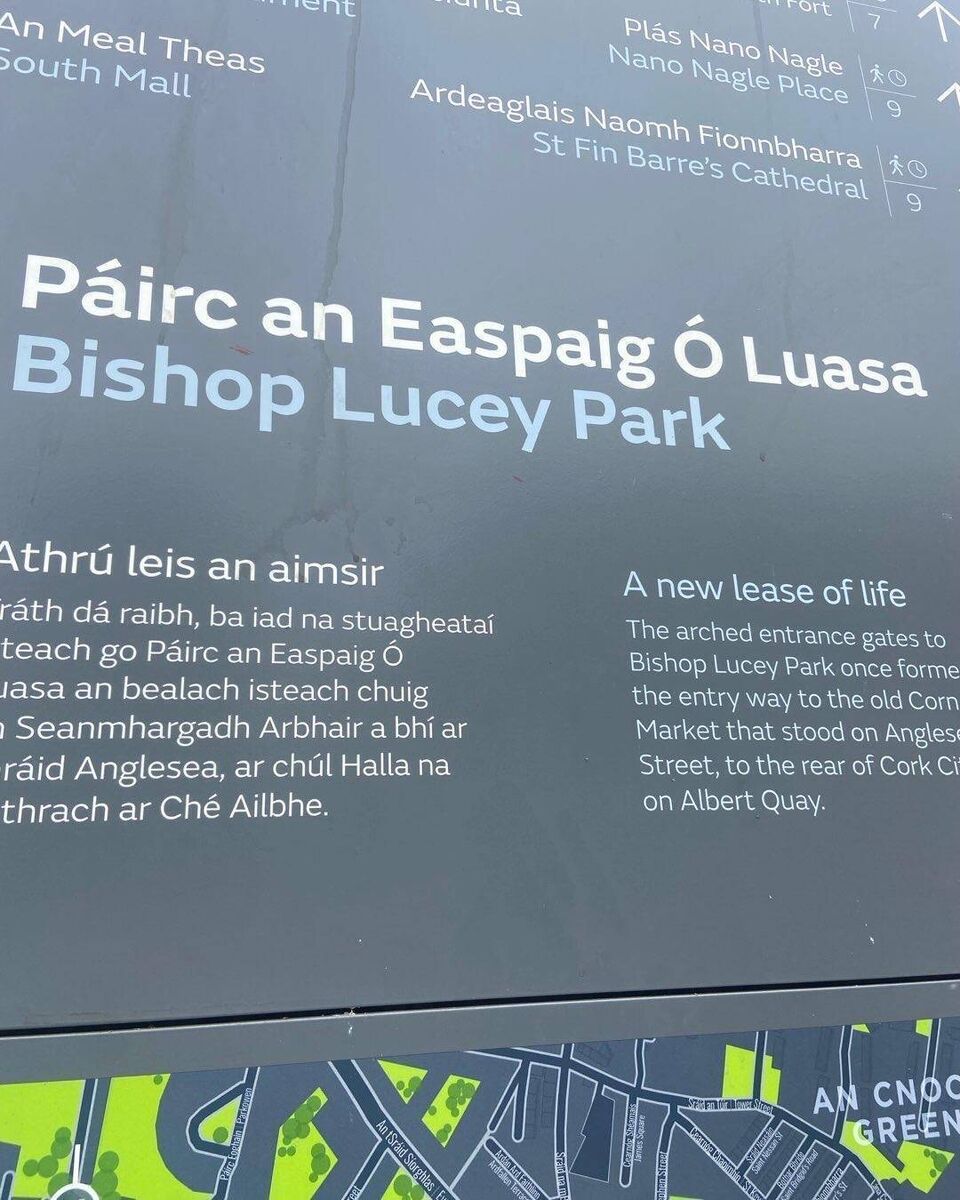
Approaching the park from the Grand Parade, you first encounter a large way-finding post near the entrance. The Irish-language writing on the post describes the facility nearby as Páirc an Easpaig Ó Luasa, but that is far from the only option available.
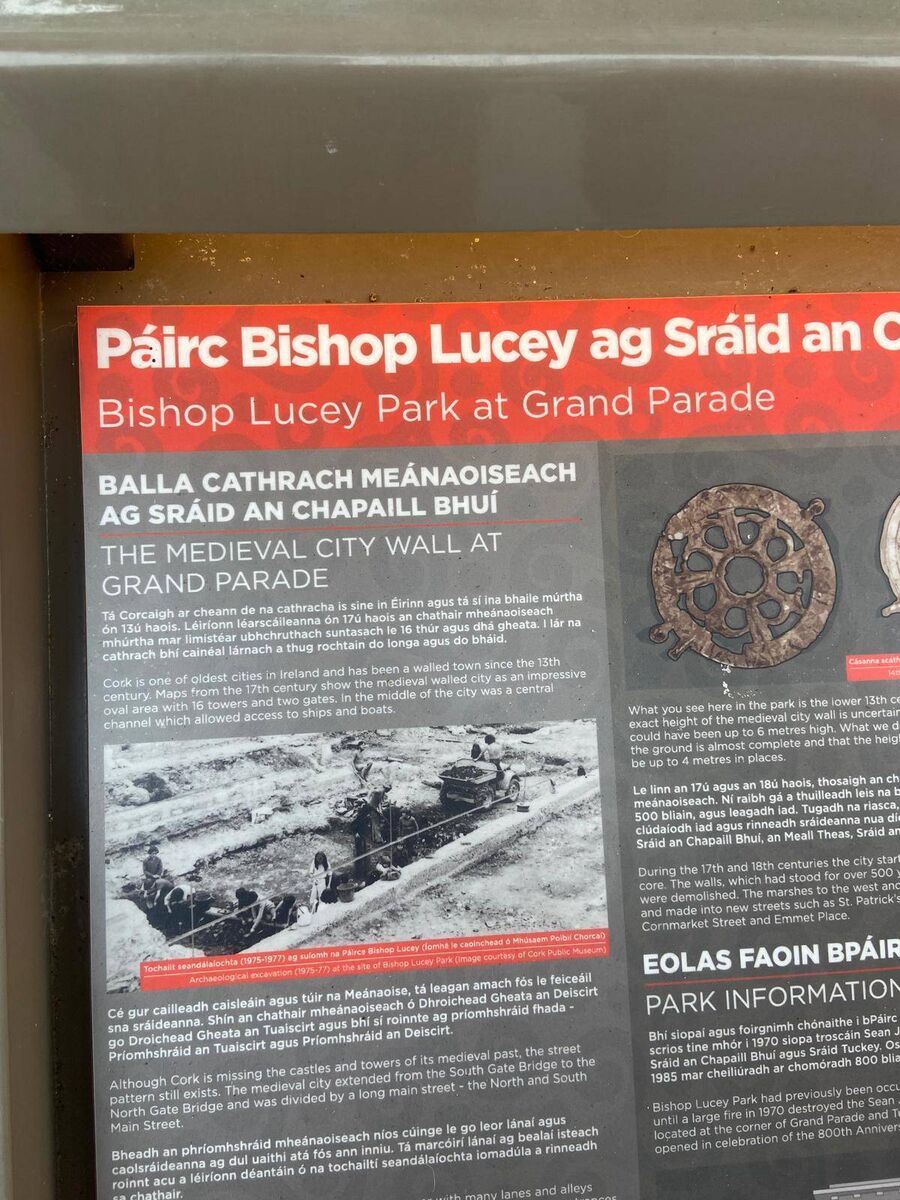
If you go just inside the park itself, you’ll find another information panel which describes the location as Páirc Bishop Lucey ag Sráid an Chapaill Bhuí.
Within a few yards, then, we have a direct contradiction in the Irish-language descriptions — one which goes far beyond the error which made the headlines up in Galway.
But we’re not even nearly finished yet!
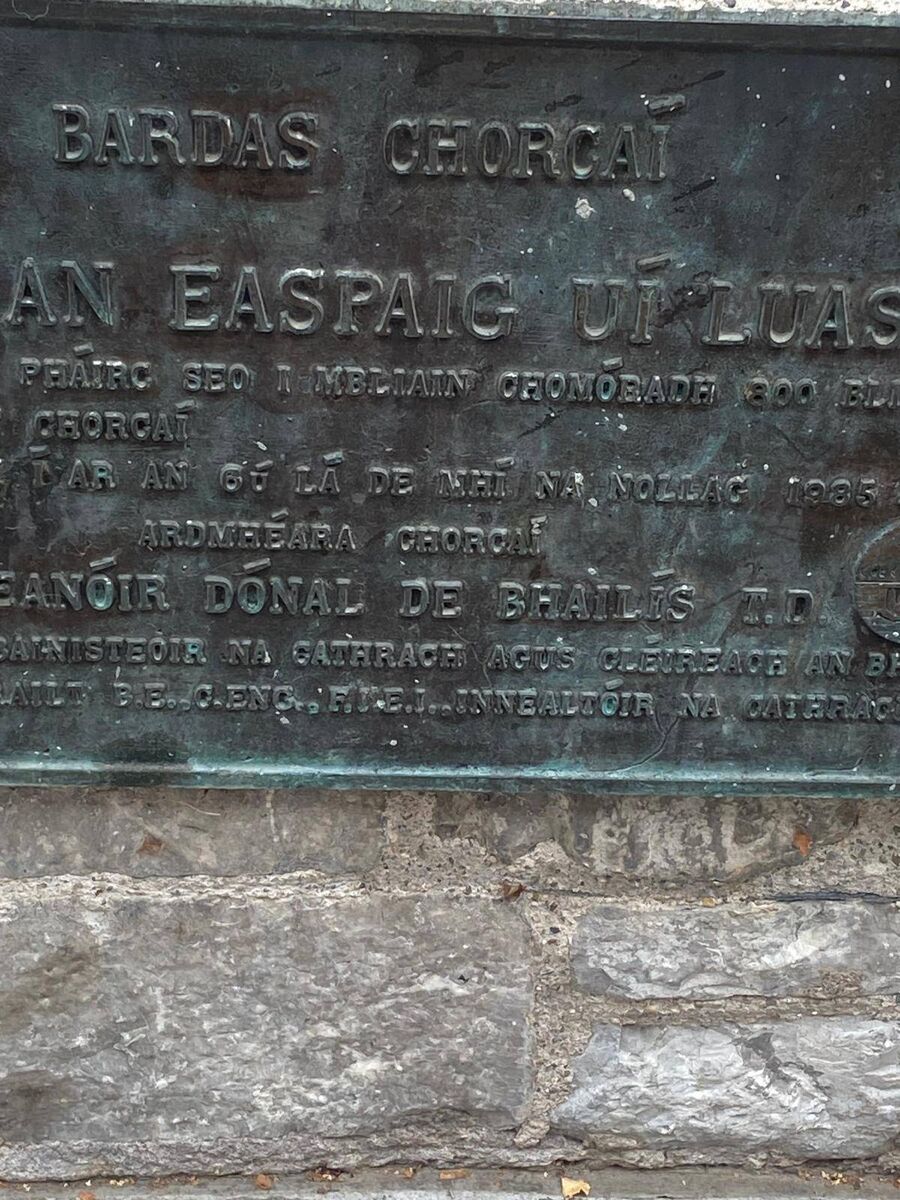
Leave the park itself and go down Tuckey Street nearby — just past the Soma coffee shop — and there’s yet another plaque, this one obviously commemorating the opening back in 1985. In the Irish-language section of the plaque we have yet another variation: Páirc an Easpaig Uí Luasa.
If you are keeping count, that makes three different versions of the Irish name of the park.
Could we make it four?
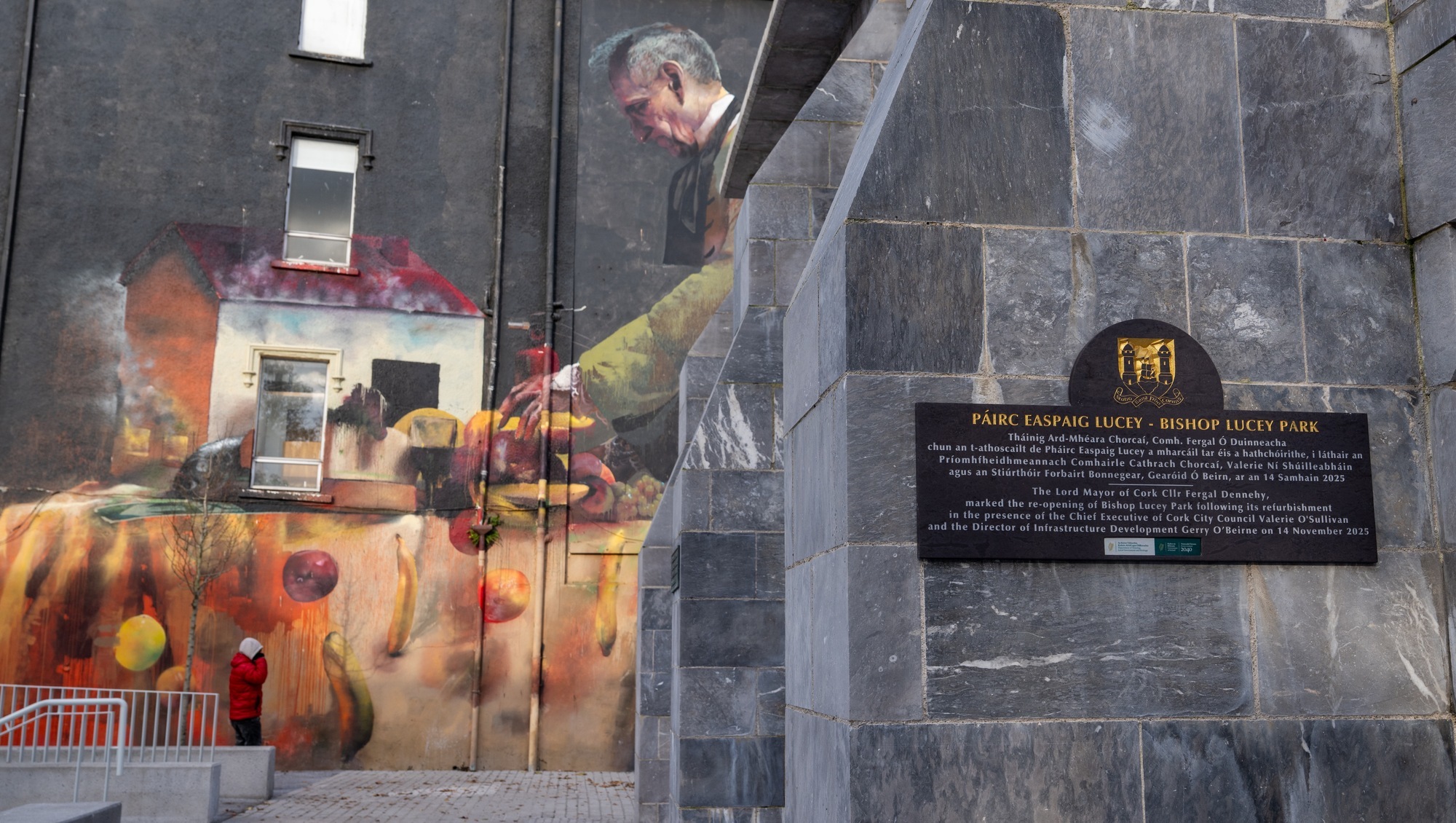
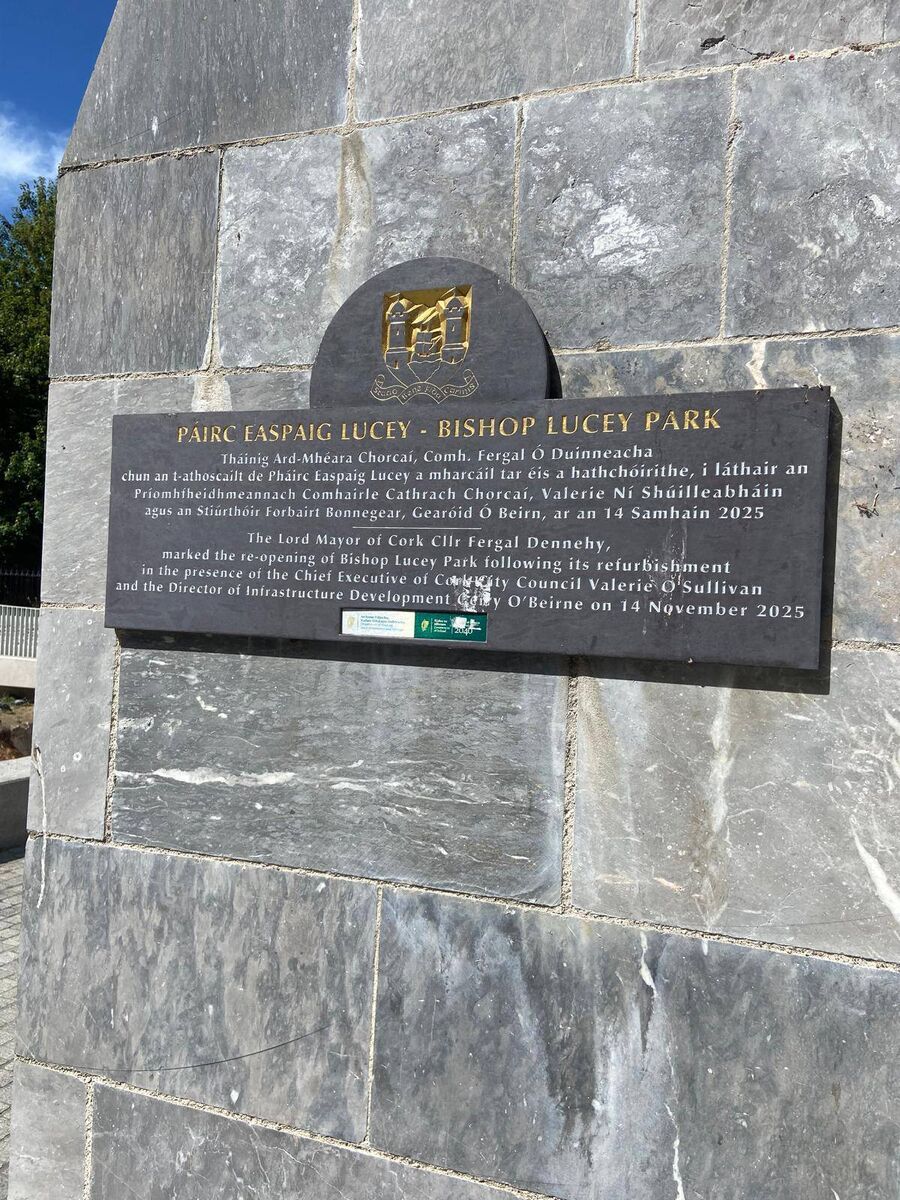
If you come back from Tuckey Street and stroll back over to the two arches that face onto the Grand Parade you can see the plaque which was unveiled when the park was reopened last November after a lengthy, expensive renovation. The names of various officials involved are on the plaque, as is the name of the park: Pháirc Easpaig Lucey.
Even allowing for the use of the séimhiú in the last instance, that makes four different versions of the name in Irish.
Cork has a Gaeltacht west of the city, a lively population of native speakers, and a large Irish language faculty in UCC a few minutes’ walk out the road from the same park. One of them couldn’t have been pulled in for a bit of advice on the grammar?
The public body at fault for the mistaken sign in Galway issued an apology and, as noted above, promised to correct the error: one ‘h’ missing from one word.
Small potatoes on one level. Does this kind of gaffe affect anyone’s enjoyment of the facility? Probably not.
But it is also one of the proverbial small things that tells you all about the big things. About consistency and attention to detail. About making sure that jobs are completed to the highest possible standard (or the basic minimum standard, maybe). About doing things the right way, and not being sloppy and careless.
I won’t begin to discuss the disrespect shown here for the Irish language because of considerations of space.
As for the remedy... the organisations responsible are in a bit of a bind. Leaving things as they are will only compound the embarrassment. Making the necessary adjustments will only acknowledge the shambles they created.
Decisions, eh?
Go n-éirí libh.
- X: /mikemoynihanex
- Instagram: /mikemoynihanex
- TikTok: /mikemoynihanex


CONNECT WITH US TODAY



Be the first to know the latest news and updates