Paul Hosford: Jack Chambers will have his work cut out to manage expectations ahead of Budget 2027
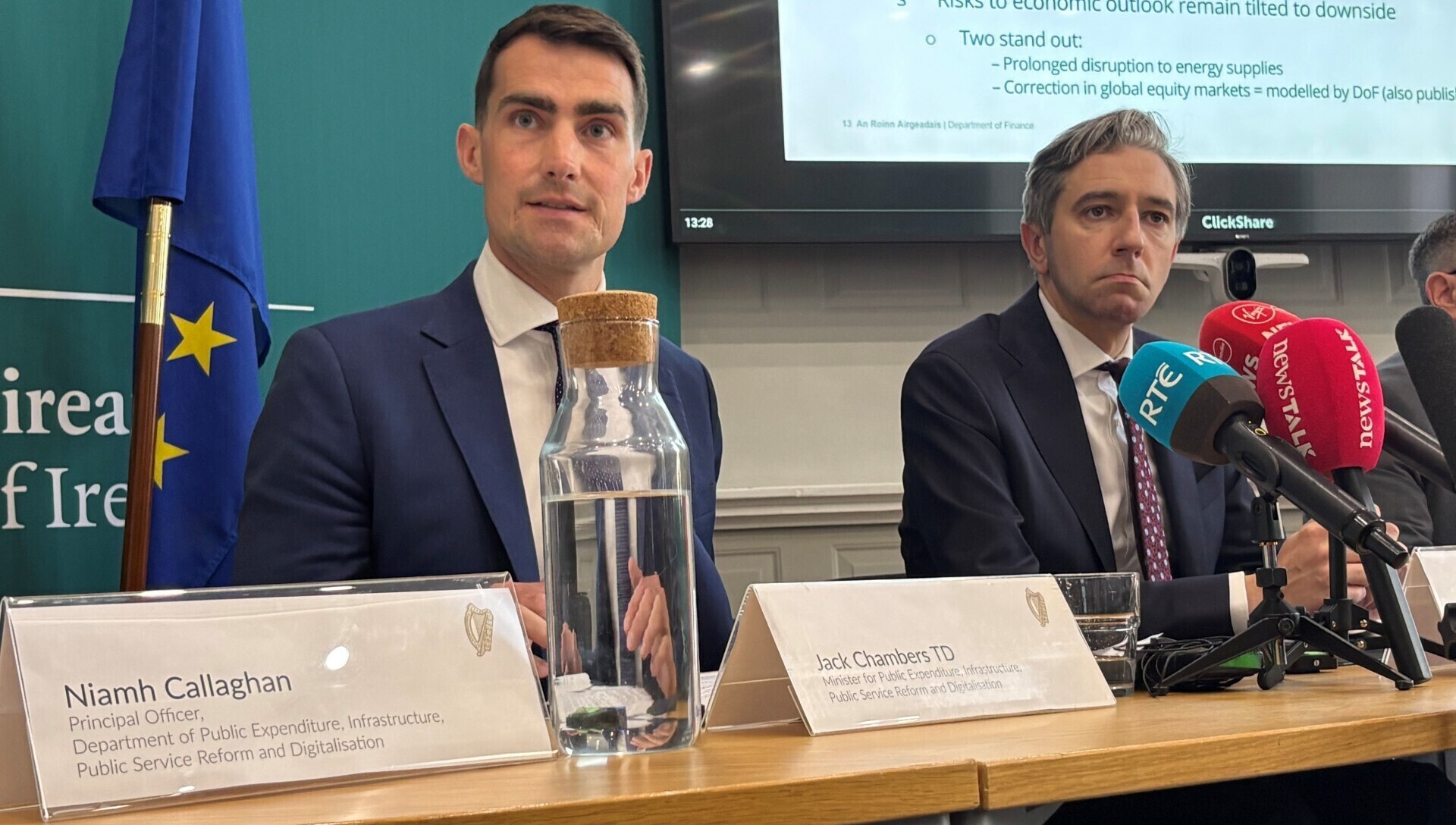
Public expenditure minister Jack Chambers and Tánaiste and Finance Minister Simon Harris at a press conference in the Department of Finance, to announce the Government's Summer Economic Statement on Wednesday. Picture: David Young/PA Wire
While sitting in the Whitaker Room at the Department of Finance on Wednesday, listening to Jack Chambers and Simon Harris launch the Summer Economic Statement, the Green Party's response to the document landed.
The former coalition partners of the two men strongly criticised the Government for its "lack of financial plan", with finance spokesperson Michael Pidgeon saying it was "McCreevy economics all over again — pumping out all available money with nothing set aside for the future".
The criticism is largely based off the statement's own projection that Government spending will increase by 5.9% this year, despite warnings from the Irish Fiscal Advisory Council and the ongoing heavy reliance on the corporate tax intake, without which the economy would be running a deficit.
That criticism was echoed by the fiscal council — Ireland's financial watchdog — itself, which said while €7bn of spending increases were planned, much of this will be absorbed by the rising cost of providing public services.
"A growing and ageing population means more demand for services like healthcare and pensions. No official estimates of these costs were given," Ifac said.
Ifac has recently warned that with a new public sector pay deal and money absorbed by inflation, there would be little if nothing for new measures. The warnings, across the board, are consistent but were in many ways echoed by Mr Chambers.
Read More
In his part of Wednesday's press conference, the public expenditure minister was clear that while €7bn would be added to Government spending in October's budget, that does not mean a blank cheque for ministers.
“There’s less available across Government next year than there was last year, and that means real trade-offs and prioritisation will be required,” Mr Chambers added.
Budget 2027 will see government spending climb to €125bn overall, and Mr Chambers said there had been “too much focus” on the use of the additional money in recent years. He said budget discussions would focus on “clear priorities”.
“There’ll have to be choices and trade-offs within Government about what the clear priorities are, and it’s in that context in which the estimates discussions will take place.
“But I think there’s too often a focus on the additionality and the margin of what extra the budget is delivering, and not enough about the total level of spend in the economy by Government in terms of public expenditure.”
It is a strange paradox. Despite being set to spend €125bn next year, Budget 2027 will be one of the most politically and economically challenging budgets an Irish Government has had to prepare in recent years.
While Ireland continues to enjoy strong economic growth, record employment and healthy public finances, ministers face the difficult task of balancing rising public expectations with the need for fiscal restraint.
At the centre of this challenge is Mr Chambers, whose responsibility is to ensure spending remains sustainable while delivering on the Government's priorities. His message on Wednesday to ministers was that there were no blank cheques and savings needed to be found while pursuing programme for government commitments.
Unlike the expansionary budgets of recent years, Budget 2027 will mark a shift towards greater discipline, he said, but stressed this was in the context of, and bears repeating, €125bn.
The biggest challenge Mr Chambers will face is controlling the growth in day-to-day spending while managing demands from both the electorate and his Cabinet colleagues.
Public expenditure has risen rapidly since the pandemic, driven by population growth, public sector pay agreements, increased demand for healthcare and education, housing investment, and the expansion of social protection.
While much of this spending has become permanent, the pace of revenue growth simply cannot continue indefinitely. Mr Chambers, therefore, faces the politically difficult task of asking departments to fund new initiatives through efficiencies and savings rather than simply seeking additional allocations.
This represents a significant change in approach after several years when strong tax receipts allowed governments to expand spending across almost every department.
This at a time when cost overruns in departments happen to the point where revised estimates have become an expected part of the political landscape, but with Mr Chambers now telling departments overspending in one area will be taken from another.
Health budgets, for example, go over each year, making it difficult for the Department of Public Expenditure to maintain overall spending ceilings. Similar pressures exist in education, where demographic growth, expanding special educational needs provision and school infrastructure require substantial investment.
Another important consideration is the sustainability of Ireland's tax base. Corporation tax receipts have transformed the public finances but remain highly concentrated among a relatively small number of multinational companies.
Economists and the Irish Fiscal Advisory Council have repeatedly warned against using these potentially volatile revenues to finance permanent increases in current expenditure. As a result, the Government has increasingly sought to channel windfall revenues into long-term savings funds while limiting permanent spending commitments.

Coalition and internal Fianna Fáil politics will add another layer of complexity for the Dublin West man. Every minister will seek additional funding for their own department, while Government backbenchers and Independent TDs will advocate for local projects and sectoral priorities, and balancing these competing demands while maintaining collective discipline will be one of Mr Chambers' most difficult political tests.
His insistence that departments identify efficiencies before requesting new funding may prove controversial, particularly where ministers argue services are already operating under significant pressure.
Having seen himself touted as the heir apparent in Fianna Fáil, Mr Chambers has been relegated in talks on the next leader somewhat, bruised by his role as director of elections for the party's disastrous presidential campaign.
But he has looked in 2026 more assured and if he can successfully stake his claim as the party's voice of progressive moderation, and at the same time show he can face down Cabinet colleagues and win, he can quite easily see himself elevated in the eyes of the public.
Ultimately, this budget, just 10 weeks away, represents a transition from an era of exceptional fiscal expansion to one of greater selectivity. The Government still possesses substantial financial resources, but expectations have grown even faster.
Mr Chambers' challenge is not simply to spend more money but to spend it better, ensuring scarce resources are directed towards the Government's highest priorities while protecting the long-term sustainability of the public finances.
Success will depend on his ability to resist competing spending demands, deliver genuine public sector reform and convince both colleagues and the public that prudent budgeting today is essential to preserving Ireland's economic resilience in the years ahead.
This writer is far too young to have covered the McCreevy era in Irish politics — I timed my entry into print media to coincide with a global financial crash — but Wednesday's pronouncements did not feel like there were any champagne corks popping as the economic headwinds were acknowledged.
Whether Mr Chambers and Mr Harris's plans for the Irish economy are successful in the medium term will require time, but for now the message from the public expenditure minister is one of pragmatism rather than profligacy.