Gareth O'Callaghan: There’s nothing modern about Latin Mass — that's why I love it
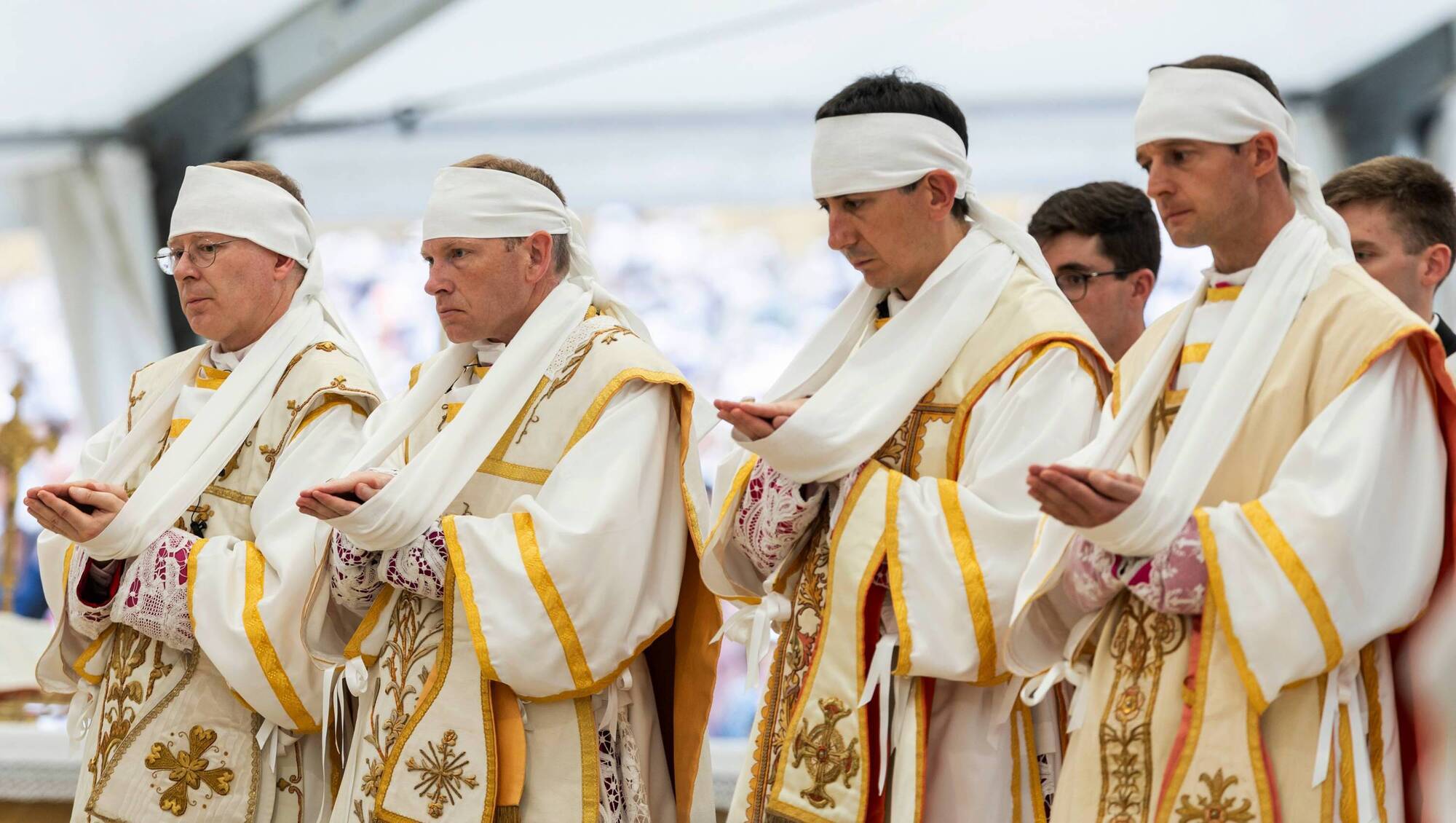
From left, Pascal Schreiber, Michael Goldade, Michel Poinsinet de Sivry and Marc Hanappier receive episcopal consecration during a Mass in a tent set up outside the Society of St Pius X seminary, in Econe, Switzerland, on July 1. Picture: Cyril Zingaro/Keystone via AP

I have a confession to make. I love the Latin Mass, traditionally known as the Vetus Ordo, or Old Order. You could say I was brought up on it from the age of eight. It still fills me with a sense of joy.
As a young altar boy, each weekday morning I knelt on the marble altar step beside our tall elderly parish priest in a small side chapel off the nave of our local church as he celebrated Mass with his back to the congregation. My job was to respond aloud in Latin to his prayers on behalf of the faithful, of whom there were rarely more than three in attendance.
It was an experience that has stayed with me — 30 minutes every morning speaking in words and phrases that had an air of mystery and sophistication about them.
In my young innocence, I couldn’t explain how its joy had such an effect on me, but now I know it felt like a conduit for a sense of the other-worldly, and it felt safe and reassuring: Sed libera nos a malo/”But deliver us from evil”.
It was back in the early days after the revision of Vatican II was introduced, after Pope John XXIII convened the church’s most senior bishops with the intention of updating Catholic teachings and practices in an effort to make them more meaningful in a rapidly changing post-war world.
The pope was adamant that, among his reforms, the church needed to modernise its liturgical practices to make it more inclusive. His priests and bishops would adopt a more pastoral approach — the “medicine of mercy”, he called it — while also preserving doctrinal integrity.
It was around this time the Tridentine Mass, or the “Gregorian Rite”, as it’s known in its 1962 form, would end up becoming a bone of contention for most of his successors. The traditional Latin Mass has become a thorny and, unfortunately, divisive issue for the Church.
Read More
Five years ago, Pope Francis restricted access to the ancient version of the liturgy, stating priests would need special permission from their bishops to celebrate it. For many traditional mass goers, it has become one of the fiercest controversies in modern Catholicism.
From the perspective of this mortal pilgrim, there is nothing controversial that I can sense about a Mass celebrated in Latin, as laid out as far back as 1570 by Pope Pius V.
As I get older, I’m finding that I’m discovering more about my faith that I love. That still includes the Latin Mass.
Gregorian chant and Latin hymns have a transcendent quality, and then there’s that soothing sense when harmony and notes work well together. Harmony is my comfort zone. Where else can I find such a contemplative and serene setting to offer up a few humble prayers and thoughts?
There’s nothing modern whatsoever about the Latin Mass. Why should there be?
Why does everything have to take on “a modern approach” these days? Worship, just like prayer, is a subjective experience so far removed from all the other intimacies in life. It doesn’t upgrade like a smartphone. It can’t be unified or prototyped. It’s why the traditional Latin Mass offers a place to witness the beauty of the ancient unchanged.
Even the great composers captured some of their finest moments by creating sacred music around the Latin liturgy: by Bach (who was a Lutheran) entirely set in Latin text; Beethoven, famous for his ; Vivaldi’s and Mozart’s .
There’s a contagious reverence in the gentle voices of the choir — a reverence that gives way to a humility in the presence of something that in those unexpected moments can literally take your breath away.
Reverence and a sense of awe are at its heart.
But there’s even more to the Latin Mass when it’s sung from start to finish. It’s clear from the number of young people in the church every Sunday that this form of celebration offers more than just an ancient dialect. Traditions are a lifeline to peace of mind, and the Latin Mass is probably one of faith’s greatest traditions.
So why stifle it?
Why not encourage it as an alternative form of worship? Surely choice matters if the church hopes to survive. Surely Mass in the vernacular (the language of the people) can continue to coexist alongside the Latin Mass.
It’s fair to say one of the reasons the music of the 1960s is still a constant for so many today is because those songs remind us of old traditions we grew up with, and for many the Latin Mass is no different.
Pope Francis’s campaign to modernise the faith wasn’t helped last year by comments in his autobiography , when he criticised the “ostentation” of the traditional Latin Mass with its vestments, and “costly tailoring, lace, fancy trimmings” which, he suggested, “sometimes conceal mental imbalance”.
His attitude towards “rigidity” was not well received by the growing Latin Mass congregations around the world, including here, who believe unity can only be achieved through reconciliation, not suppression. His edict has further widened the divisions between Catholics.
In recent weeks, the Society of Saint Pius X — a traditionalist movement founded in 1970 by French Archbishop Marcel Lefebvre — rejected the authority of Pope Leo XIV as one of their senior bishops, Alfonso de Galarreta, consecrated four new bishops without his consent.
The five-hour ceremony held in Econe in Switzerland was attended by an estimated 16,500 loyal followers. Despite a last-minute appeal from the Pope, who said such an act of unpermitted consecration would harm the faithful, the ordinations went ahead.
As a result, de Galarreta and his four newly ordained bishops were automatically excommunicated. The Pope’s message was clear: you can’t have two autonomous Catholic Churches. There’s only one man holding court and he decides who gets the purple hat. Fair enough.
However, the Society of Saint Pius X dismissed the penalty, stating the ordinations were necessary in order to defend the traditional Catholic faith against modernising reforms.
In a legal challenge launched on Tuesday, the society appealed the declaration. How the Vatican responds remains to be seen.
All these years later, the legacy of Vatican II remains deeply divided between followers who believe the church didn’t go far enough with its promises of far-reaching reforms, and those who believe the council went too far, and by doing so turned its back on the beauty of the old liturgy.
There will always be differences within a faith that draws in 1.4 billion Catholics, in the same way that we are all drawn to different aspects of that faith and how we respond to it.
Latin was always regarded as the language of the church. As far back as the 16th century, no religious ritual or act of church worship has ever left a greater impact than the mystery of the Latin Mass.
Last September, Pope Leo warned divisions over the traditional Latin Mass risk turning into ideology, and that the liturgy must never be used as a “political tool”.
If the Latin Mass makes the liturgy more meaningful for a growing number of Catholics of all ages who feel abandoned by modern reform, then why can’t it be accepted as positive rather than political?

CONNECT WITH US TODAY



Be the first to know the latest news and updates