Not quite a stick-in-the mud on the back roads
I remember this happening often during the legendary summers of my childhood, and I can’t have weighed a quarter of what I weigh now. Also, we got tar between our toes running around Clonakilty in bare feet, and my mother had to use butter to remove it.
However, molten tar wasn’t the only memory. When the sun is so warm, the back roads seem to me suddenly old fashioned. The illusion is, of course, entirely in the eyes of the beholder, but the road surface seems dusty, as if it was unmade, and the farms seem half-hidden in an archaic density of trees.
The distant views are soft-focus, floating in a heat mist — and memory is, we acknowledge, often misted. So, despite the replacement of old meadows with silage grass prairies and lakes of plastic, and the change from countless small fields to fewer vast fields, in the heat of the day, in the mist of memory, it might be half a century ago.
There is a sleepiness associated with old-fashioned Ireland; there was then, at least through childhood eyes, no hurry about anything. One could expect to see an ass-and-cart, bearing a single churn of milk, jogging along to the creamery on soft and almost soundless rubber tyres. It’s all sentiment, of course. However, it is enjoyable to indulge warm memories on a warm Sunday afternoon when, even these days, there is no hurry on anything, except, perhaps, on sportsmen out to win an important match.
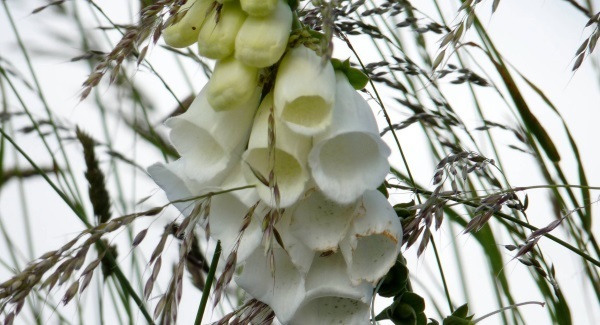
The wildflowers this year have bloomed extravagantly. In country lanes, the coconut smell of the blossoming whitethorn fills the air. Now it’s the march of the foxgloves. They are really striking towers of purple flutes opening, one tier above the other until in the final week all the flower spike is a-bloom at once — roadside sentries, in places solitary, in places exotic dwarf trees.
The ‘foxglove’ name does not, I believe, come from any fanciful idea that the tubular flowers may provide gloves for foxes but from the (equally fanciful) idea that the flowers are ‘fairy bells’. I heard them called that when I lived in Somerset years ago; they’re called the even prettier name of ‘fairy thimbles’ here in West Cork. They’re poisonous but yield the drug digitalis (digits, indeed!) which, used in small doses, was one of the earliest known cardiac medicines.
Spanish visitors I met were amazed at how many cattle they could see in the landscape and how long the grass was. They were also amazed at the weather in early June; from what they told me, they had brought everything but chest-high waders in expectation of Irish rain — waterproof jackets and caps, and wetsuits. Mind you, they made use of the latter, no doubt making the wetsuit-less Irish kids in the sea around them look all the more white.
They couldn’t believe the length of the Irish evenings; barbecuing and playing guitars until midnight under star-filled skies with fellow caravanners of all nationalities, and Irish campers too, they never wanted them to stop. So many were the tents and motorhomes at Sexton’s caravan park near Timoleague in West Cork, that the site spread into nearby fields to extend the outstanding hospitality to latecomers. As I’ve said before, and as we all agree, there’s nowhere on earth as heavenly as Ireland when the summer sun is shining and the evenings are full of song.
An amusing observation to end this column. At Derryconnell House, on a quiet road near Schull, rooks regularly line up beneath the peanut feeders to scavenge the bits that fall when the smaller birds feed. When an interloper recently arrived to compete, they quickly solved the problem. We know that all the crow family have high IQs for birds.
A regally-attired cock pheasant in full breeding array arrived one morning. To command the feeding territory, he rushed at the rooks and used his long tail like a scimitar to literally take the feet from under any that stood their ground. The rooks withdrew for a conference, and returned with a strategy.
When the pheasant attempted to rush at them, one rook would stand on his tail while the others dashed in and scooped up the bounty. At last, frustrated, the pheasant flew away.