Ireland’s carbon tax explained: What it costs motorists and households — and where €1.2bn goes
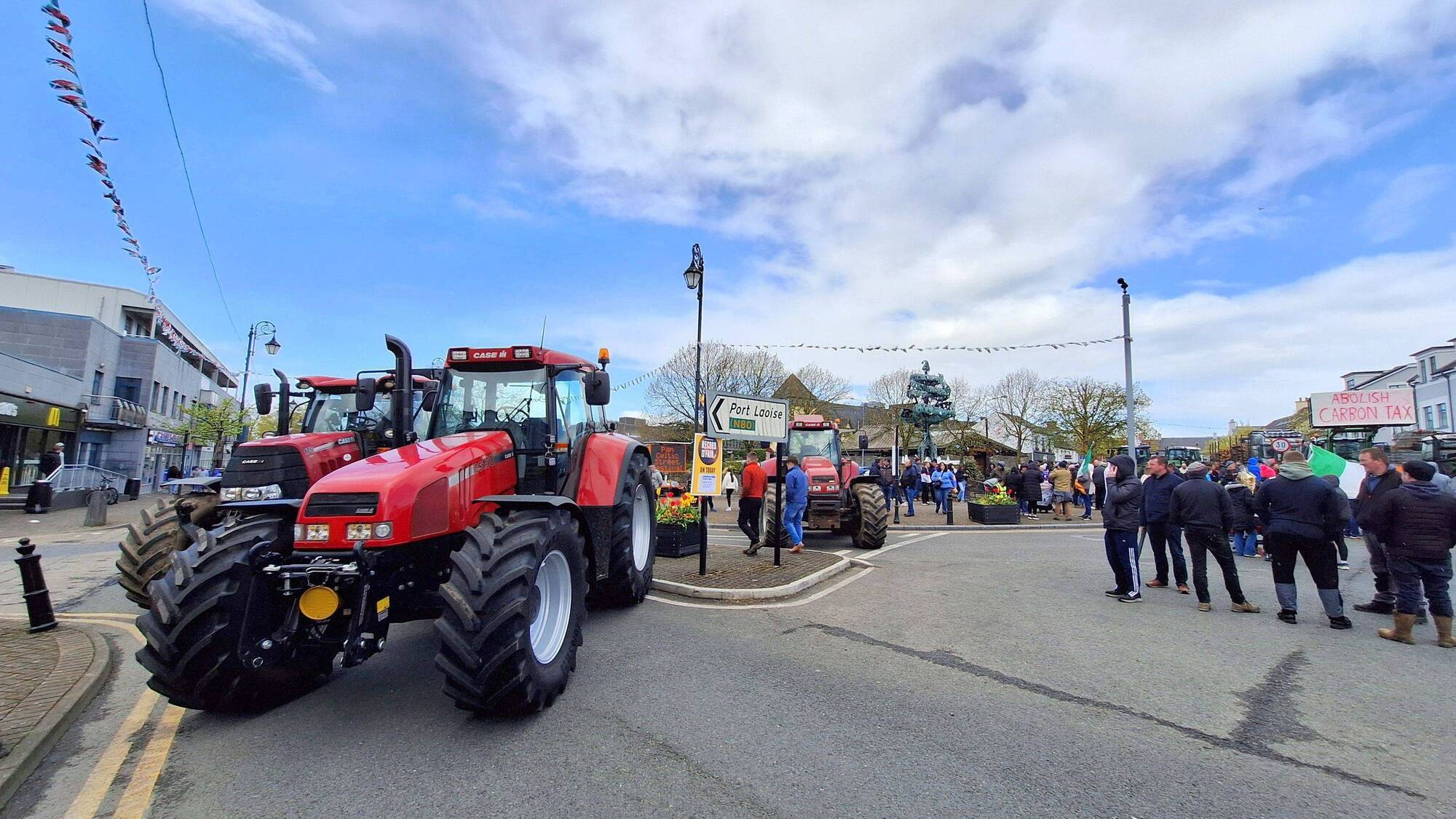
Tractors blocking roads as part of fuel and carbon tax protests earlier this year. Picture: Paul Curran
Hundreds of people gathered in Moate, Co Westmeath, at the weekend to protest rising fuel costs, with opposition to carbon tax emerging as the key issue.
"A show of hands — do yous want the carbon tax abolished across the board?" one speaker asked the crowd.
After cheers went up in the room, the crowd was told “well we’ll do that” and they would “send that in a document”, presumably to Government representatives.
The carbon tax is applied to petrol, diesel, home heating fuels, and natural gas, and is intended to reflect the environmental cost of carbon emissions generated by the use of fossil fuels.
It aims to encourage a switch from relying on fossil fuels to renewable or sustainable alternatives.
First introduced in 2009, there is now a legal commitment to annual carbon tax increases of about €7.50 until it reaches €100 per tonne of carbon by May 2030.
Last October, carbon tax on petrol and diesel rose from €63.50 to €71, as scheduled.
The same increase due in May for home heating oil (kerosene), natural gas, and solid fuels was deferred to October 14 at a cost of €22m, with the Government citing rising fuel prices caused by the conflict in the Middle East.
Read More
In Budget 2027, due to be delivered on Tuesday, the Government is expected to reduce the rate of carbon tax on home heating oil amid calls from fuel protesters, farmers, Sinn Féin and others for the charge to be delayed, reduced, or scrapped.
If the scheduled increase went ahead on October 14, it would add about 2c per litre to the price of kerosene, equivalent to €19.41 on a typical 900-litre fill. The total carbon tax on 900 litres of kerosene would rise to €183.68.
According to oilprices.ie, the average price of 500 litres of kerosene increased from about €500 in February to €815 in September.
Lisa Ryan, a professor in energy economics at UCD, said carbon tax appeared to be the “easiest lever” at the Government’s disposal to reduce fuel prices.
"But if you look at carbon tax on fossil fuels, like petrol and diesel, it's only a few cents per litre compared with the overall taxes that are taken in and the increase that we've seen.
“I do think it's a bit of a red herring to focus on the carbon tax.”
The carbon tax brought in about €1.2bn last year, which the programme for government states will be used “to fund social welfare measures, agri-environmental schemes, and retrofitting”.
Revenues from the carbon tax were used in Budget 2026 to allocate €350m to “targeted” social protection measures, a €44m increase compared to 2025; and €170m for the Agri-Climate Rural Environment Scheme (ACRES), a €30m increase.
A further €558m from the carbon tax was allocated to SEAI grant schemes and initiatives, including the warmer homes scheme for retrofits, the national home energy upgrade scheme which provides heat pumps, and the solar PV scheme.
In December, the Comptroller and Auditor General Seamus McCarthy said between 2020 and 2023, €1.36bn in increased carbon tax revenue was allocated to specified expenditure programmes across five departments.
Mr McCarthy said only 61% of the sum could be verified as being spent on additional carbon tax measures, as expenditure was “less than the amounts provided” and had to be surrendered, or because funding was mixed in with other core funding.
For example, over four years, €110m had been allocated to green schemes within the Department of Agriculture, with about €60m returned.
He said: “The more general point that is coming out of this is that with the ring-fencing, or semi ring-fencing, of the money that was collected for carbon transition purposes and so on, effectively that system is failing to ensure that the money is spent for the purposes intended.
"It is a regularity problem. In terms of the purpose for which it was collected, to a significant degree it is failing to be delivered.
Alex White, chair of the Climate Change Advisory Council, urged the Government to improve transparency around how carbon tax revenues are spent to help people.
“Already, we know that well over half of the revenues are used to support welfare supports, environmental measures in agriculture, and retrofitting.
“It is important that the Government work on improving the allocation and use of these revenues so that it is in line with the original commitment for the use of all carbon tax revenues arising from increases beyond the €20 per tonne amount.”
Mr White said if Ireland’s carbon tax structures were materially changed, there was a “significant risk” of Ireland losing its derogation from the European Emissions Trading System Directive, which would “undermine the predictability” of the carbon tax revenues.
Ireland currently benefits from a derogation under the directive because, without it, some sectors would effectively face double taxation through both the Emissions Trading System and the carbon tax.
Ms Ryan said economists “would nearly prefer it all to go into general expenditure”.
“Carbon tax is an environmental tax reform where you tax the bad fossil fuels and you put it back into reducing taxes on other areas, and so that could be income taxes, for example.
“So in general economic theory, that would be a good idea, because in fact if you just put it all into retrofits, or some kind of environmental pot, you could end up with sort of a very wasteful situation where you're not using it efficiently.
“In a way, it would be better not to earmark it, and then decide each year where you're going to put it, but that is generally not very popular.
She said the funds from the carbon tax could be used to proactively retrofit detached houses in rural Ireland that use home heating oil.
“They really would be great targets for heat pumps and insulation and EVs, because they have driveways they could plug into and they have no public transport.”
Is there evidence it is encouraging people to switch?
A 2020 ESRI study on carbon tax and poverty in Ireland noted a "large literature" showing carbon taxes would reduce emissions with limited wider economic costs. It cited a number of studies published between 1992 and 2019.
It said while carbon taxes had proved highly effective at reducing emissions, particularly from transport, it could be regressive rather than progressive if lower-income households were not compensated by the State.
Poverty can be reduced and the lowest-income fifth of households left better-off if a third of revenues from a carbon tax rise were targeted increases in welfare payments, it concluded.
Ms Ryan said it was “difficult to measure” the behavioural impact the carbon tax has had.
She said while people may change their behaviour and habits in response to rising fuel costs, it was difficult to isolate the effect of the carbon tax because it is not separately identified on energy bills.
“If you look at fuel prices, how they go up and down, they're a lot more volatile than just the carbon tax, which might be five cents or seven cents, depending on the year," she said.
“So it will be very difficult to measure just what the carbon tax does.
Prof Ryan said fuel price shocks, such as the crisis in the Gulf, exposes households in Ireland who are highly dependant on home heating oil and cars or machinery that run on petrol or diesel, where the carbon tax can redistribute funds to those that need fuel support.
“Depending on what you do with the revenue, it can actually be extremely progressive, and it's nearly better than any other measure that you might put in place.
“Whereas if you see a fuel price rise, like we're seeing right now, that money is going to whatever oil company, so we don't get back the revenue, and unfortunately, it's still the low-income groups that are most affected. We don't have any way of compensating them.”
Asked about the possibility of another carbon tax deferral, Ms Ryan said the main concern would be the potential impact on funding used to support households vulnerable to energy price shocks, including measures such as the fuel allowance.
However, she said a further postponement would not derail Ireland's broader transition away from fossil fuels.
"You have to think about what we're trying to achieve with it, and if fossil fuel prices are already very high, this just might do the job of a carbon tax and make fossil fuel cars very unattractive,” she said.
"In fact, if you insist on putting on the carbon tax when prices are already much higher than usual, you might just turn people away from the green agenda overall, whereas I think actually people are coming to the conclusion that EVs make a lot of good sense right now because the prices are just so high."


CONNECT WITH US TODAY



Be the first to know the latest news and updates