Mick Clifford: Siege of Holy Cross primary school a depressing low after the Good Friday Agreement
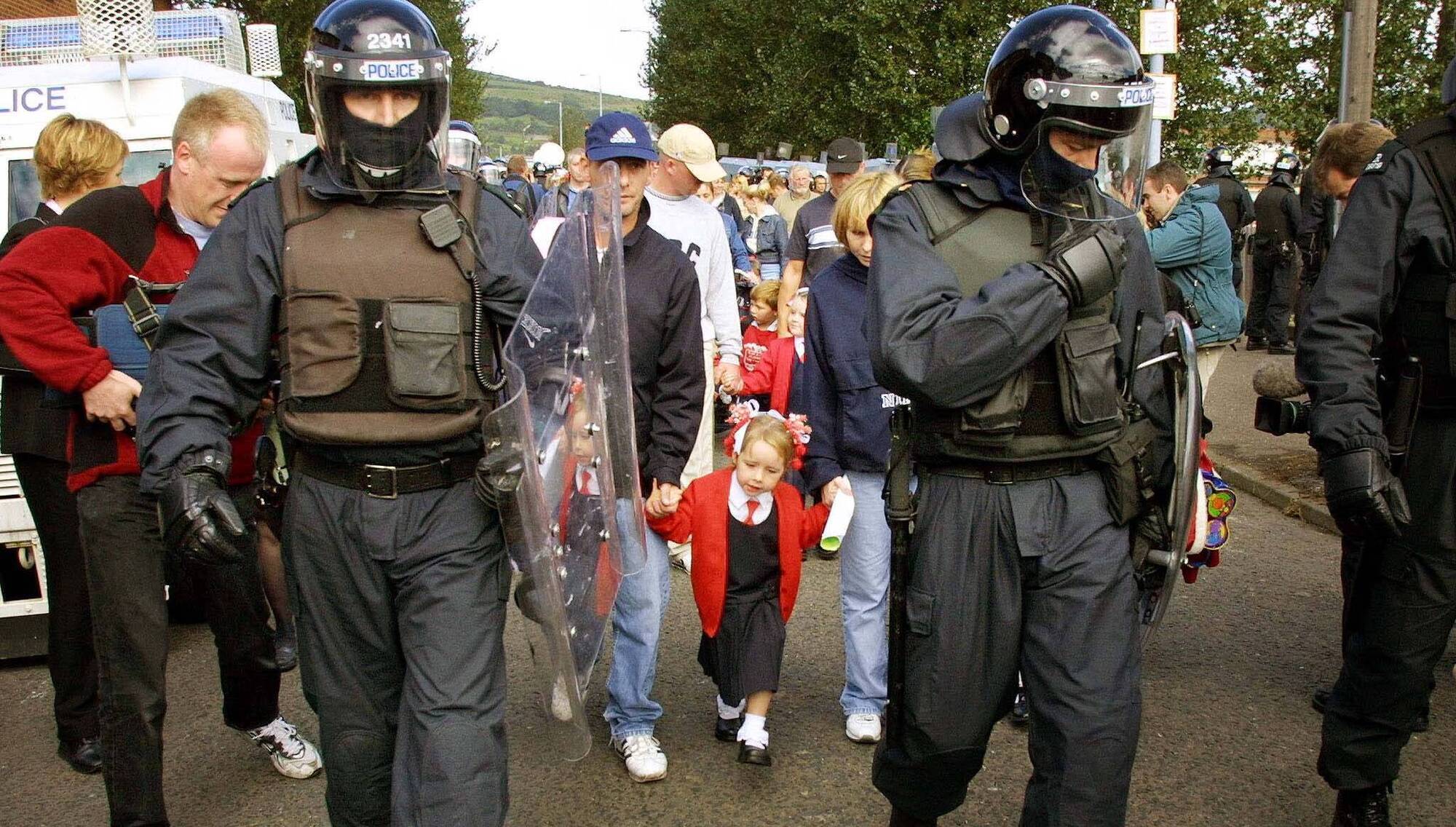
RUC officers escort children from the Holy Cross Primary Girls' School on the Ardoyne Rd, Belfast, Picture: Adrian Dennis/AFP via Getty Images
In the first week back at school, the British army supplied a fleet of armoured cars. Officers from the RUC were togged out in full body armour to lead the schoolgirls.
This was the scene at the Glenbryan end of the Ardoyne Rd in north Belfast this week 25 years ago.
Inter-community tensions had arrived at a point where loyalist and Protestant residents and their supporters were intent on harassing and even attacking Catholic schoolchildren going about their business.
The siege of Holy Cross primary school for girls was a depressing low in the post-Good Friday Agreement society that was trying to be born.
Things kicked off the previous June near the school, to the extent that summer holidays were brought forward.
HISTORY HUB
If you are interested in this article then no doubt you will enjoy exploring the various history collections and content in our history hub. Check it out HERE and happy reading
If anybody thought that the turning of the leaves in autumn would have quelled the unrest, they were in for a stark awakening when the school opened again.
After the first day back, when it became obvious that serious injury or worse might occur, the security forces kicked into action.
The army vehicles were parked up to provide a protective corridor down the street to the entrance of the school.
Soldiers, their guns visible, stood ready to take action if required.
Walking ahead of the girls aged eight and nine were RUC officers in full body armour, wielding night sticks to hunt away anybody who wanted to do harm to the schoolchildren.
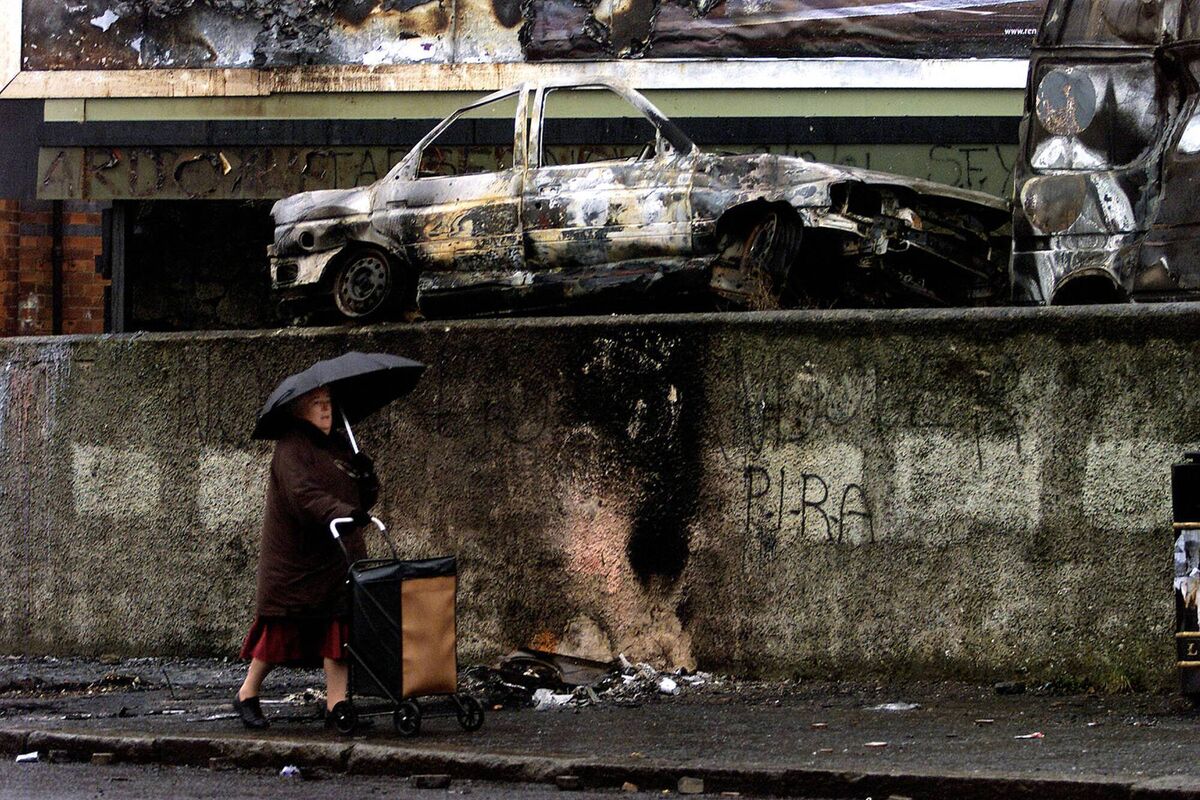
Behind the lines of vehicles, angry residents hurled abuse, various missiles and, here and there, the odd bottle of urine.
At night, Ardoyne turned into a seething mass of riots.
North Belfast was struggling to come to terms with a new normality in the wake of the Good Friday Agreement.
What separated the area from the rest of the six counties was the fact that both sides had to live cheek by jowl.
You couldn’t throw a stone within one enclave without hitting somebody from the other side of the divide.
The most obvious example of this was in the Holy Cross school itself. The school was at the bottom of the Ardoyne Rd, which was a Protestant area.
Around 200m up the road was the dividing line, beyond which lay the Catholic area. A further 200m on was the Holy Cross boys’ school.
So a family with boys and girls would be dropping the boys to the gate of their local school in the heart of the community, engaging in school-gate chatter, and banter with other parents.
Meanwhile, the girls would have to be brought cautiously into the other community and left within the school, with the parent returning quickly to the safety of their own community.
That was bad enough at the best of times. The first week in September 2001 quickly descended into the worst of times.
Tensions were always bubbling beneath the surface following the paramilitary ceasefires.
Just around the corner from the Holy Cross school, in Hesketh Rd, Protestant taxi driver Trevor Kell had been shot dead in December 2000.
He was a father of three with no known paramilitary connections. Republican gunmen were suspected of the murder.
On the other side of the divide, two of the local bars were known colloquially as The Suicide and The Sitting Duck.
These names had attached through the long years of the violence because patrons in both had been attacked and killed by various loyalist paramilitaries.
In a community where suspicion of your neighbour was ever present in the wake of any attack, the tension never eased.
So it was that everything exploded into the lives of young girls going to school in the first week of September 2001.
Chris Donnelly, who taught in the Holy Cross boys’ school for 15 years, believes that at the time the Protestant and loyalist communities were feeling under siege in the new dispensation.
“Loyalism was destabilised because of the Good Friday Agreement,” he says.
“There was a feud in the Shankill at the time involving Johnny Adair and others and all that kind of thing fed into what was happening in north Belfast.
“Once it started at the Holy Cross, people within unionism, people with influence were not there to quell what they knew was a disaster. Nobody of sufficient political or civic authority in the area was doing anything.
“On the other side, people were saying ‘we want to retaliate, we have to’. But Gerry Kelly [Sinn Féin MLA and former IRA man] and others were saying, ‘no, that’s not what we’re going to do here’. They brought some stability.”
The lowest point was on the morning of day three when a homemade bomb was thrown at the school-bound procession.
About 100 girls and their parents literally ran for their lives. Four police officers were seriously injured.
The attack was too much to stomach even for some loyalist figures who were considered community leaders at the time.
Billy Hutchison told reporters on the road that nothing justified what had occurred.
“I want to walk away from it, and even leave this country,’’ he said.
“It isn’t worth fighting for any longer. This is not about children going to school any longer; this is about people hellbent on causing trouble.
"I’m sick to my stomach, and I’m ashamed to be a loyalist.”
Yet it continued for weeks after.
At the centre of the whole affair was Fr Aidan Troy, chair of the school’s board of management.
By common consensus, the Wicklow cleric was a sane and compassionate presence, attempting to defuse tensions at a time when it appeared as if the neighbourhood was beyond any rational input.
Not that the loyalist agitators saw it like that.
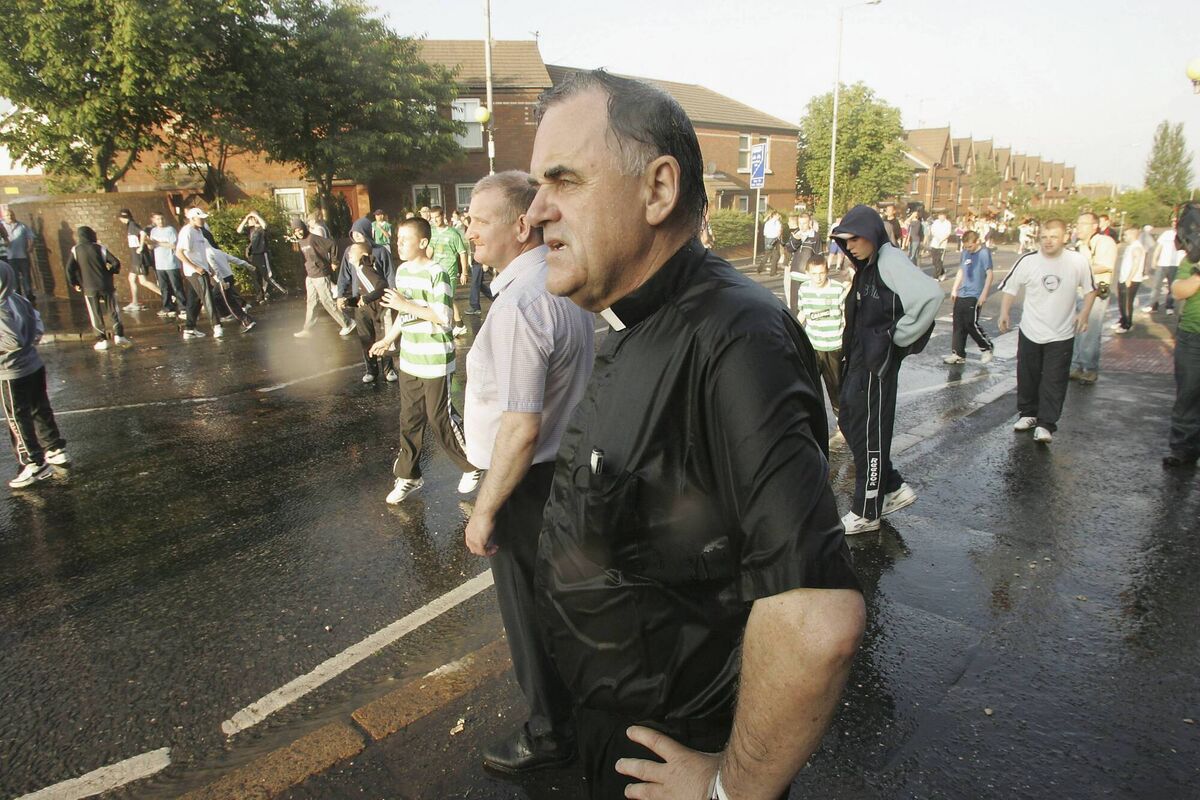
“What was happening was the most tangible sense of conflict, of really not being wanted on that road,” he later told the BBC.
“As far as they were concerned I was the absolute nemesis of all that was wrong with Northern Ireland, all that was wrong with Catholic church and all that was wrong with the green community.
“And the posters [that were erected by the residents], ‘Father Troy is a paedophile’, that sort of thing and it going out on the television. My father was dying at the time and he saw that.”
Eventually, as Christmas was on the horizon, things got back to normal.
Little girls were allowed to resume their lives as little girls.
A quarter of a century on, the whole ugly episode has all the appearance of being from another world.
Yet there are some echoes down through the years.
It remains a moot point whether working-class Protestant areas have been able to come to terms with the new Northern Ireland over the last 25 years.
In June, the anti-immigrant riots were largely confined to Protestant areas despite the spark for the riots originating geographically in the other community.
Mr Donnelly believes that civic an social structures within the Protestant working class areas are still not nailed down or invested with any authority.
“The associations politically within nationalism are much stronger in the working class communities,” he says.
“The influences of the church, the GAA, even Republicanism, all of these really matter. They are collective organisations that have a degree of authority, particularly at key times.
"The most recent example of that was the race riots this year. The reason we did not see that in poorer Republican areas is because of the political and civic pressures pushing down.
“Within unionism I think those relationships and structures still don’t exist.”

CONNECT WITH US TODAY



Be the first to know the latest news and updates