Schoolbooks are free, so why are Irish parents paying hundreds for digital devices?

For more than a decade, digitalisation has carried an air of inevitability. Children inhabit a technological world; schools must prepare them for it. Stock picture
In Ireland, the schoolbooks are free, but the iPad might cost €800.
There, in one peculiar contradiction, sits the reality of our supposedly free secondary education in 2026.
The State now provides schoolbooks to students under the free education scheme.
However, some parents preparing children for the new school year have been presented with bills running to several hundred euro for laptops or tablets, sometimes specified by the school and purchased through a particular supplier.
Barnardos' latest Back to School survey found 57% of secondary-school parents surveyed had been required to buy a digital device, at an average cost of €447.
Some reported costs reaching €850.
And the hardware may only be the beginning; insurance, software, ebooks, and technical-support packages can follow.
For one family, €800 is an irritation. For another, it is money borrowed, savings raided, or something else sacrificed.
After years of seemingly inexorable digitalisation, something appears to be changing.
For almost two weeks this summer, RTÉ Radio 1's became a sounding board for parents questioning not merely the cost of compulsory devices but why their children needed them in the first place.
Ann Marcus-Quinn of the University of Limerick has researched technology in education for years.
She believes Ireland may be approaching a tipping point, driven less by some great governmental reassessment of digital education than by parents simply refusing to absorb another cost.
“I never heard this out of parents before,” she says of conversations this summer. “They are literally stating ‘I'm not going to pay for it.’”
The revolt, if that is what it becomes, may therefore begin not with pedagogy, concentration, or screen time, but with something more prosaic.
Read More
If the discourse is to be believed, parents have had enough. Which might finally force us to ask the question we perhaps should have asked at the beginning: Why does every child need a device?
For more than a decade, digitalisation has carried an air of inevitability.
Children inhabit a technological world; schools must prepare them for it. Digital literacy matters.
Textbooks, video, interactive exercises, and an almost infinite library can exist inside a machine weighing less than a school atlas.
There are obvious advantages.
But somewhere along the journey two different propositions became conflated: That technology has an important place in education and that good education therefore requires an individually owned, permanently available screen in front of every child.
Ms Marcus-Quinn suggests four tests: Cost, purpose, equity, and accessibility.
Purpose may be the most revealing.
“A lot of the time a decision is made that we just want to use technology for technology's sake,” she says, “and we haven't thought about alternative ways of carrying out that task or what the task should be.”
One secondary-school teacher, speaking anonymously, described what the consequences can look like from the other end of the classroom.
“You can be teaching at the top of the classroom and they could be online at anything.”
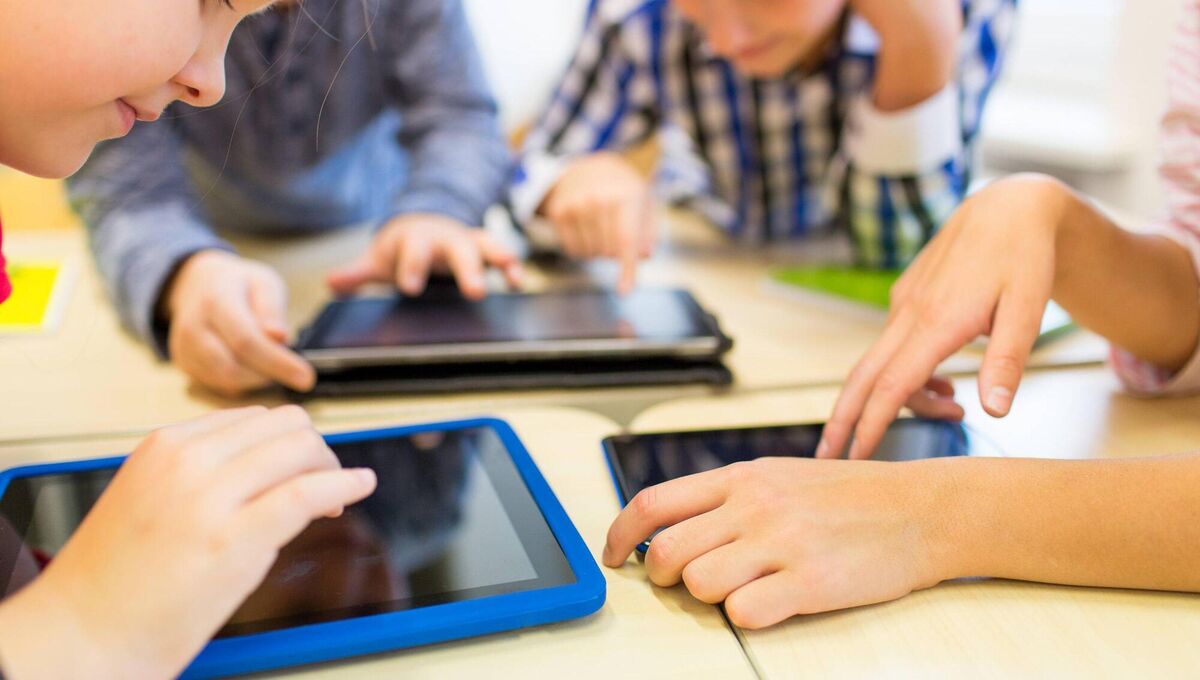
Thirty pupils with 30 internet-connected screens create 30 alternative places for their attention to go.
Students find ways around firewalls. Games, messaging, websites, and other distractions remain tantalisingly close.
“The biggest issue is concentration, and the misuse of a device in class is so hard to police,” the teacher said.
There is evidence beyond the anecdotal.
The OECD’s Programme for International Student Assessment found about 30% of 15-year-olds across OECD countries reported being distracted by their own digital devices in most or every mathematics lesson.
Those reporting frequent distraction also performed worse academically, even after socioeconomic differences were considered.
Yet the research does not support the equally simplistic conclusion that screens are inherently bad.
Moderate educational use of devices can be associated with better outcomes than no use at all.
Technology can provide immediate access to resources, allow innovative teaching, and, critically, transform education for students requiring additional supports.
Ms Marcus-Quinn raises precisely this complication.
Universal access to technology can remove the stigma from a child who genuinely needs it.
Text-to-speech, adjustable presentation, and other assistive technologies can radically alter that child's experience of school.
The argument should therefore not be digital versus analogue. It should be about purpose.
Nor should device ownership be mistaken for digital literacy.
“We talk about them being digital natives,” Ms Marcus-Quinn says.
Yet schools can assume that teaching children to log in, use Teams, and access ebooks constitutes digital education.
She encounters students reaching senior cycle and university without understanding something as fundamental as file management.
A child can navigate TikTok effortlessly while possessing little understanding of how to evaluate a source, recognise manipulation, organise information, or distinguish evidence from opinion.
Teachers live that problem daily.
A pupil can find a website asserting 'X, Y, and Z' without necessarily possessing the critical maturity to establish whether it is authoritative, partisan, manipulated, or simply wrong.
Instant access to information is an extraordinary educational resource.
It isn't the same thing as understanding information.
There is also an uncomfortable commercial dimension.
Ms Marcus-Quinn and fellow researchers have described private technology providers as occupying a “quasi-advisory role” with schools.
“They might be presenting themselves as an education adviser,” she says.
“They can call themselves whatever they want. But at the end of the day, they are a salesperson, and there's huge money involved.”
That does not imply wrongdoing.
Companies can provide excellent educational technology while also having an obvious commercial interest in schools buying more of it.
But the distinction matters when a decision by a school can effectively create hundreds of customers among parents who have little practical choice about purchasing the selected product.
And there is an extraordinary historical wrinkle to how we arrived here.
Ms Marcus-Quinn was involved in an independent review of iPad use at Ratoath College, published at the beginning of 2020.
It raised significant questions about distraction and how devices were actually being used.
Then the world shut down.
Within weeks, the question facing Irish education wasn't whether children should learn through screens, it was how quickly we could get screens into their hands so they could learn at all.
Covid made technology indispensable, but then the emergency passed.
The assumptions it accelerated remained.
Now, elsewhere, the pendulum is beginning to move.
At the heart of Silicon Valley, parents are campaigning to reduce classroom screen use.
California schools have introduced restrictions.
Closer to home, Oatlands College in Stillorgan moved away from individual iPads after older students increasingly preferred books and reported concentrating better.
Oatlands did not abandon technology.
It retained laptops and computer facilities and uses them when appropriate.
Perhaps that distinction contains the answer. Technology is not the problem. Unquestioned technology might be. And ultimately the argument returns to money.
“Digital strategies are wonderful,” Ms Marcus-Quinn says.
“They recognise what we need to do in terms of digital literacy and having our students coming out ready for the labour market.”
Then comes the qualification.
“But they need to put money and nuance behind that.”
The education minister has already reminded schools that individual digital devices are not required to complete either junior or senior cycle.
Yet schools retain considerable autonomy over how they deliver the curriculum.
So what happens when a school tells a parent an €800 device is necessary and the parent replies that the department says it isn't?
Perhaps that is the tipping point Ms Marcus-Quinn senses.
Parents are beginning to say no. And that leaves two questions which should have been answered years ago.
If an individually owned digital device is genuinely necessary to receive a modern Irish education, why isn't the State paying for it?
And if it isn't necessary, why are parents being told they have to?
CONNECT WITH US TODAY



Be the first to know the latest news and updates