From Karl Marx to TikTok: What Speakers' Corner says about free speech today
A visit to London's historic Speakers' Corner explores whether face-to-face debate still has a place in the digital age
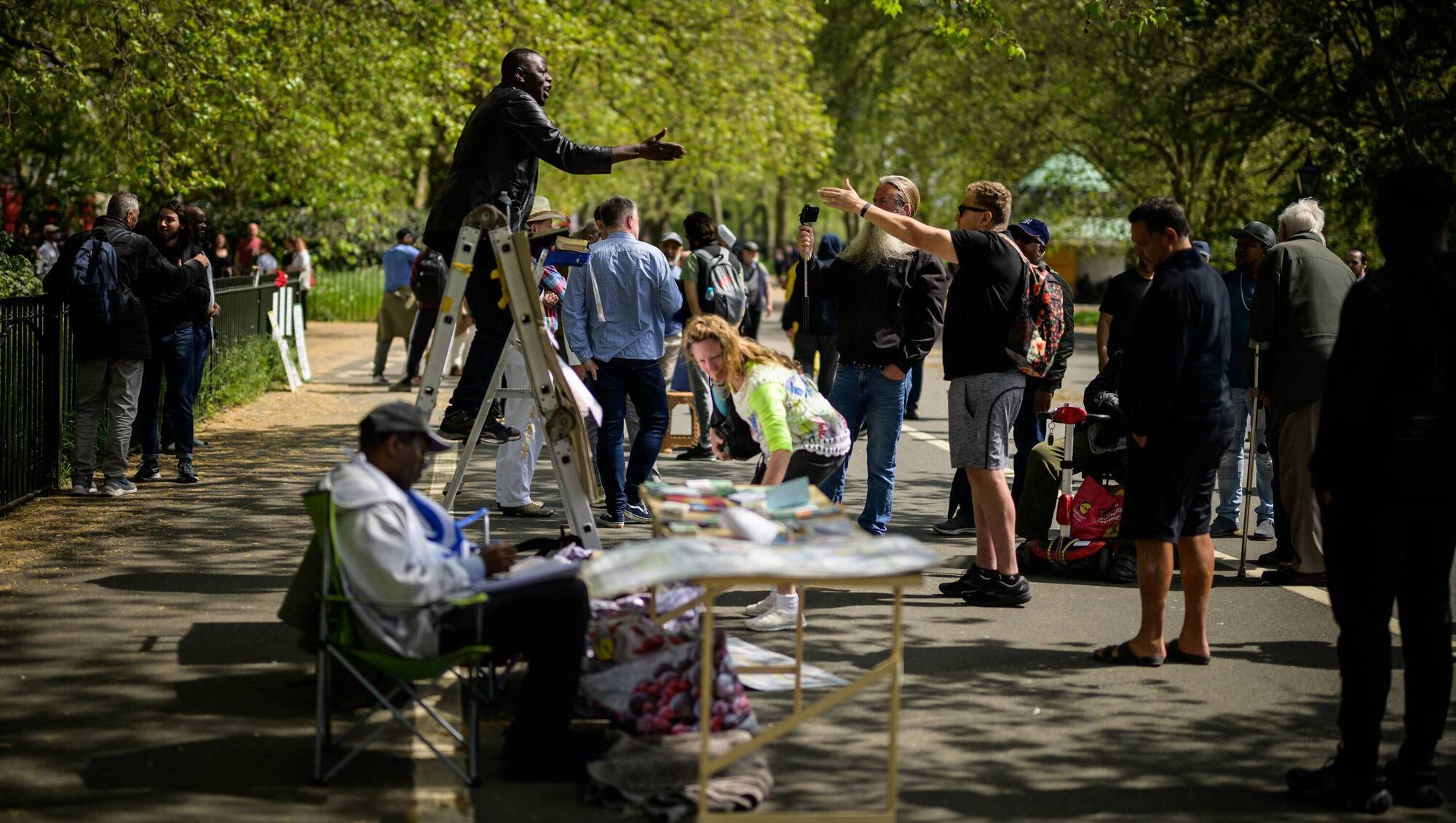
A man holds a heated debate with a member of his audience at Speakers' Corner in Hyde Park, London. File Picture: Leon Neal/Getty 

A man holds a heated debate with a member of his audience at Speakers' Corner in Hyde Park, London. File Picture: Leon Neal/Getty 

Karl Marx didn’t have social media to disseminate his ideas, but he had Speakers' Corner. George Orwell, in the days when he couldn’t get published, used to go to Speakers' Corner to read his work. Vladimir Lenin, in the years before the Russian revolution, was known to show up at Speakers' Corner of a Sunday to inform the world that change was on the way.

The little patch of Hyde Park, London, dedicated to free speech has a storied history. In the time long ago, when social media was confined to science fiction, it was to here that men and women of ideas and strong opinions came to disseminate.

Technology has transformed the public square, yet Speakers' Corner persists to this day. But does it remain a place where small acorns can begin to grow into movements that might change the world?

On a baking Sunday, in town to take the temperature of Britain a decade on from Brexit, I got my corners mixed up. Instead of Speakers' Corner, I landed in Hyde Park Corner.

The park attendant gave me a double take when asked to show me the way to Speakers' Corner.

“Oh, yeah,” he said. “It’s Sunday. Are you really looking for a headache?”

He pointed up through the main drag.

The location is as it ever was and not on the corner of anything. It’s just a length of the side of the road corralled for the speakers. There is even a cafe and shop down a little way from it, trading under the title of, you guessed it, Speakers' Corner.

Mr Marx, whatever about Mr Lenin, would be turning in his grave up in North London if he knew how commerce had hijacked the former marketplace of ideas.

Today, a cycle lane runs right through the allotted space. One cyclist, quite obviously unaware that he was entered sacred ground, came along at a rate of knots and skidded to a halt short of colliding with the assembly that has started to gather.

John Danoe is speaking here and has been for more than 20 years. He is togged out in quasi-military gear, and advertising what he calls “identity codes used for visual ethnicity”.

On inquiry, he gave a detailed description of the codes. They amount to something to do with different ethnicities in different parts of the city of London. He is circumspect on whether this is a good or a bad thing.

John Danoe has been coming to Speaker's Corner for the past 20 years.

“It’s good for the schoolchildren to know,” he says. He has a hearty laugh, adding that he enjoys coming here nearly every week to listen to some of his fellow speakers.

“There were attempts to gentrify this place, but we resisted it. You can learn a lot, have your opinions challenged and maybe changed.”

One man challenging opinions is just along from Danoe’s perch. Oliver is standing on a step ladder, exhorting in a hoarse voice about religion. He is engaged in heated debate with one of those who have come to ostensibly listen to the wisdom. This man is in a motorised wheelchair, and he has only one leg. He is shouting at Oliver, who shouts back with a pointed finger.

Tourists stop and listen. They know this is hallowed ground.

As best can be discerned, the two men are arguing the merits of Christianity versus Islam. Their arguments are invested with plenty of volume, anger, and the odd bit of humour.

In a different context, there might be fear of violence, but everybody here is wedded tightly to the concept of free speech.

Just as on social media, there has never been any gatekeepers at Speakers' Corner.

If you have opinions too radical for mainstream media, if you sense revolution in the air, if you need to get something off your chest,  this has always been a platform and a refuge.

Unlike social media, nobody is making money out of it, confining you to a number of characters, using your opinion to elicit anger, resentment, or hatred in order enhance engagement.

If Orwell exemplifies the virtues of Speakers' Corner, Donald Trump typifies the vices of social media.

Once Oliver comes down from the step ladder, I sidle up to him for a chat. He doesn’t want to give his second name as he’s afraid that it might expose him.

He has been coming here for 33 years. He lowers his voice: “I am Afghan, I grew up here but my parents came to London. My children are now in Lithuania, where I do some work because I don’t want them going to school here where they have homosexual teachings.”

So, were you up there advocating for Islam? He looks at me as if I have two heads.

“No! Christianity, I am Christian, couldn’t you tell from listening?”

Realising that I couldn’t, he begins laughing. Realising how ridiculous all this is, I too saw the funny side and pretty soon both of us are falling about in stitches.

There was nothing funny about how Speakers' Corner got its name.

Round about 1196, a gallows was placed on this location where multiple people could be hanged at one time.

The condemned men were allowed to make a final speech before execution and, while some used the occasion to protest their innocence, others criticised the government, beginning the tradition of speaking truth to power. From there, it took off as a venue to let rip verbally against the established order — often disseminating new ideas and politics.

The Cowboy Preacher makes an appearance at Speaker's Corner.

Soon after Oliver has stepped back, a group of women gather in an alcove just behind the step ladder. They unfurl a sheet on which is written: “Against All Wars.” Two of them step forward and speak eloquently about the futility of war.

Their friends gather round and, when the speaking is done, they all clap and hug each other. The sheet is taken down and they skip off.

Even though this is communication by old-fashioned standards, the online world won’t leave the place alone. All speaking and interactions are being recorded by a young man with mirror shades and fuzzy hair spilling from under his baseball cap.

He goes by the name JFR, and he obviously gets a kick of the fare on view.

“I’m into free speech. I stream every weekend and, if there’s no big protest or gathering on in the city, I come here. Everybody should have an opinion, and this is the place to let it loose,” he says.

Next up the step ladder is the Cowboy Preacher. He wears a Stetson, a shirt studded with rhinestones, and white trousers that look like they were stepped out of an ad for washing powder. He has a face and an accent that would work wonders in a Robert Duvall lookalike contest.

Pretty soon he’s into an argument with the one-legged man over how old was the youngest of Mohammad’s nine wives. There is still an audience for this monument to free speech, perhaps in some ways even more so in a world where verbal interaction has been displaced by online disembodied engagement.

You may not find a Marx disseminating ideas about organising the proletariat today, but you can still locate some entertainment and maybe a shard or two of enlightenment. Stay too long, though, and you might end up losing the will to live as it must have been with those men so long ago in the shadow of the gallows.

More in this section

Lunchtime News

Newsletter

Get a lunch briefing straight to your inbox at noon daily. Also be the first to know with our occasional Breaking News emails.

Cookie Policy Privacy Policy Brand Safety FAQ Help Contact Us Terms and Conditions

© Examiner Echo Group Limited