Brexit 'driven by the far right and costing this country a fortune', say Rejoin EU campaigners
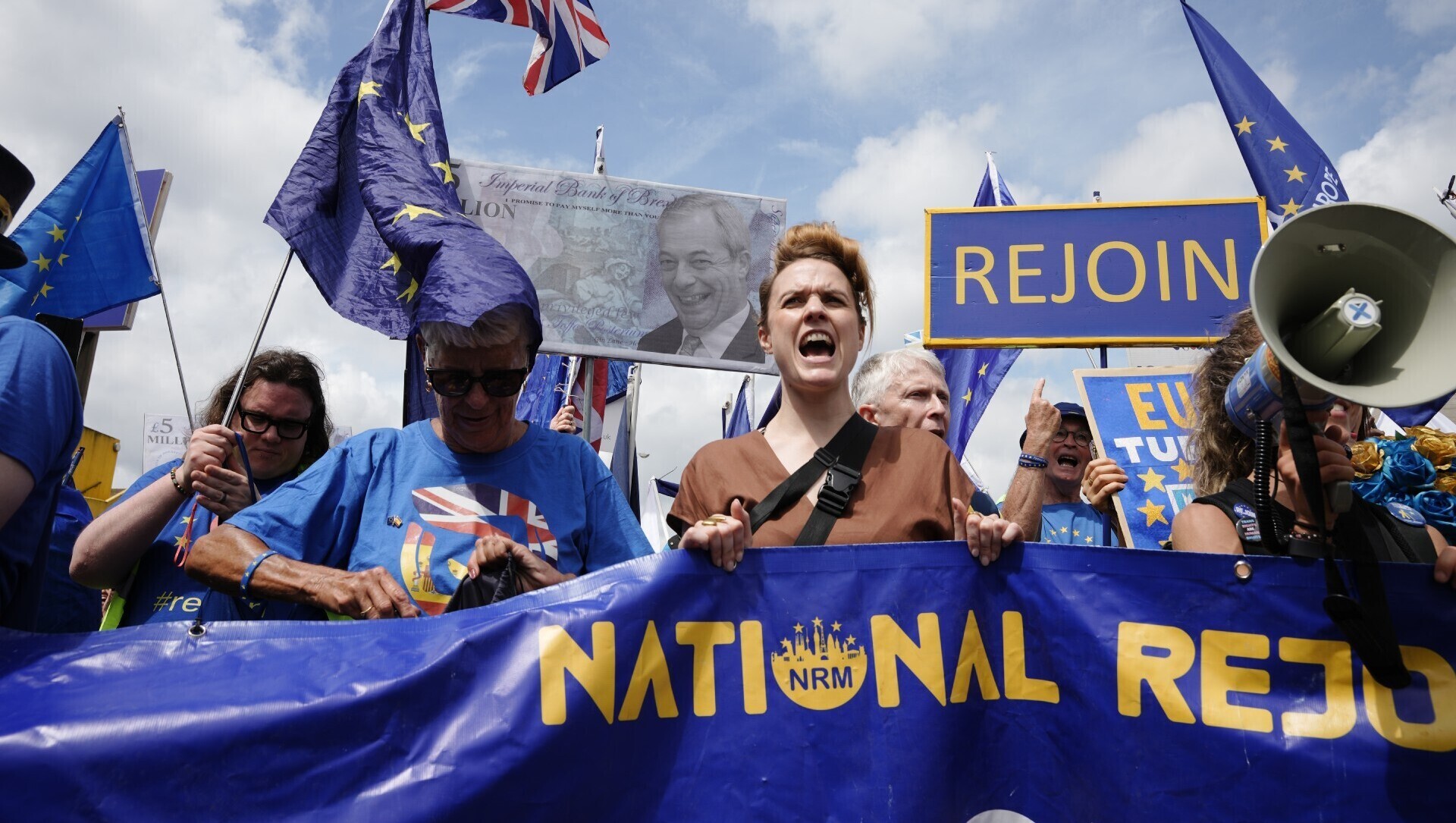
Around 5,000 Britons donned EU hats, grabbed a flag, and joined the Rejoin March on the banks of the Thames for the 10th anniversary of the Brexit vote, writes Mick Clifford
People take part in the Rejoin March in London, marking 10 years since the Brexit referendum. Picture: Jeff Moore/PA

People take part in the Rejoin March in London, marking 10 years since the Brexit referendum. Picture: Jeff Moore/PA

For three years, Neil Remington frequently showed up at No 10 Downing St on a Wednesday afternoon.

He is not an activist, nor does he have a very strong party political affiliation. In his day job, he runs a business out of Surrey. He was just so devastated that Britain had left the EU that he felt he had to do something.

On Saturday, he donned his EU hat, grabbed a flag, and headed off to the Rejoin March on the banks of the Thames.

“I’ve been doing this, marching, protesting for most of the 10 years,” he told the Irish Examiner.

“It started with the vigil outside No 10. I was never pro-Europe or anything. I love my country. My father and grandfather both fought for it. But this is just crazy.

“It’s been driven by the far right, and it is costing this country a fortune.”

The 10th anniversary Rejoin March on Saturday might have been expected to be a show of force.

Exactly a decade ago on Tuesday, Britain voted by 51.9% to 48.1% to leave the EU.

There is general consensus today that Britain is in rag order, economically at least, and that much, if not most, of the malaise is down to Brexit.

The Atlantic Magazine this month ran a feature which described British output per person as just above that of the state of Mississippi, the USA’s poorest state. Without London and its financial centre, it would be much worse.

Terry Enga: ‘Brexit made us poorer.’

“Outside the capital, in places where tourists do not visit, living standards fall well below Mississippi’s,” the piece reports.

“British wages have lagged well behind those in the US and also those in Germany, France, the Netherlands, and Denmark.

“Within the next decade, the typical Pole will have a standard of living equal to the typical Brit if current trends continue.”

So, presumably, the Rejoin March was a chance to express frustration at what has occurred and demand that there be some efforts to repent and rejoin. Well, not exactly.

The crowds began assembling outside Temple Tube Station in the heart of the city around noon. There was plenty of colour, a surfeit of EU flags, and not a few Union Jacks to emphasise that the two can be as one. There were plenty of people wearing blue berets as if they were refugees from a 1970s French movie.

Terry Enga was togged out with his beret and brandishing a flag.

“Brexit made us poorer. No question about it. Small companies have really been hit,” he said.

His friend, David Relamb, concurs and offers an example of the other way that British lives have been adversely affected.

“My son has a job in Germany, and his contract is up,” he said.

“Now, he will have to leave that country for a while and come back here to reapply and get a new visa. It’s making things very difficult for young people who want to work in Europe.”

Jackie Smyth is worried about interference to a referendum.

Both men don’t see a new referendum as a way back.

“No way,” Terry says. “That would be a disaster. We saw what happened the last time. This has to be settled by politicians. We just don’t do referendums in this country.”

The obvious reposte is that any attempt to rejoin without a referendum would spark divide and bitterness that would make the last campaign look like an episode of Love Island. Terry has a convoluted answer to that, which amounts to referendums not being capable of working in the British system.

Jackie Smyth is no fan of another referendum either.

“No, there would be interference and Russian money used like it was before. Not to quote Michael Gove, but we should leave it to the experts. This is too important for a referendum,” she said.

Those marching were, for the greater part, of an older age profile. It was next to impossible to spot anybody who might have been too young to vote a decade ago. The demographic, sometimes obvious in class-conscious Britain, would have been overwhelmingly middle class and southern English. There were no special buses from Wigan pier to bring workers down to the capital to protest the cause of their stagnating wages.

European media looks on

The media in attendance told its own story. There were TV stations from Switzerland and Germany, and reporters from France. There was a chap from the popular Unherd website in Britain, but there was no sign of a major presence from the BBC or ITV.

It was as if those in Europe are far more exercised — either positively or negatively — at the prospect of a rejoin campaign than the natives whose lives would be most impacted.

Just after 1pm, the caravan moved off under the supervision of liaising police who were friendly and relaxed as befitting an assignment where they were far more likely to encounter frail marchers collapsing from the heat than instigating violence or blockades.

One officer reckoned the gathering was around 1,000 strong. Another went as far as 5,000, which sounded more in the ballpark. This paucity of interest over an issue that has literally affected household incomes and restricted hugely a former freedom to travel around Europe is highly curious.

The latest YouGov poll on Brexit has 58% saying they would vote to rejoin in a referendum, while just 33% would vote to stay out.

Neil Remington, right, wears his blue beret in support of rejoining.

Among the young, the wish to rejoin is particularly strong, with 68% of those aged 18-34 opting for it and 58% of voters aged 35-54. Yet, among those over 55, only 37% want to leave.

These results may as well have been lying at the bottom of the Thames as the late middle-aged and elderly marchers crossed Waterloo Bridge en route to Parliament Square. The mood permeating the march in the brilliant afternoon sunshine was light if determined.

Every now and again, a singsong was started: “You can stick your Brexit up your arse, you can stick your Brexit up your arse….”

In other hands, this kind of thing might have sounded vulgar or threatening. Here, it was just an expression of good-natured banter.

The tourists milling about observed the passing march in fascination as if it were a modern incarnation of English eccentricity.

At Parliament Square, the crowd was addressed by the former Labour leader, Neil Kinnock. While Mr Kinnock was an admired politician in his day, he has been out of politics for over 20 years. Still, even if he doesn’t represent the political zeitgeist, he retains a bit of fire.

Brexit was, he told the crowd, “an unmitigated, unprecedented, continuing disaster”. He went on to talk about how it had done so much damage, before concluding with a warning.

“We are stuck in Brexit. We are trapped, as outsiders, from the rest of our continent. If anything else was ever doing this much political and economic harm to our beloved country, the demand to end it would be unstoppable,” he said.

He’s on the money there.

Yet, despite all that is at stake, it’s as if nobody wants to contemplate the major upheaval that would ensue should definitive moves be made to attempt to rejoin.

Or, to put it bluntly, better the disaster they know than the one that might be unleashed. In the meantime, the state of denial persists.

More in this section

Lunchtime News

Newsletter

Get a lunch briefing straight to your inbox at noon daily. Also be the first to know with our occasional Breaking News emails.

Cookie Policy Privacy Policy Brand Safety FAQ Help Contact Us Terms and Conditions

© Examiner Echo Group Limited