Ireland's EU presidency: Events outside Europe will dominate security agenda
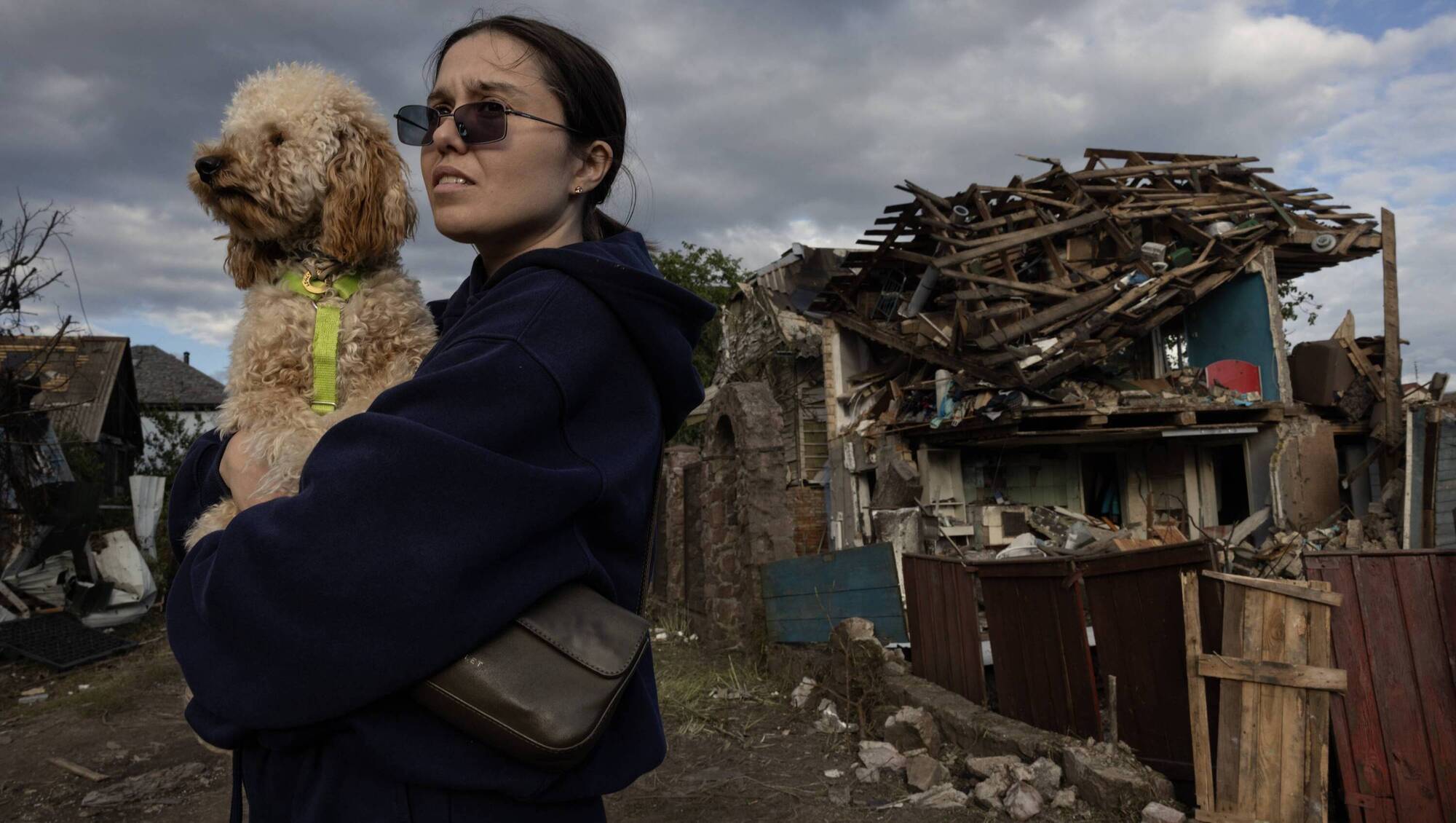
Alisa and her dog Barney walking by a destroyed house hit by missiles overnight on June 15, 2026, in Kyiv: Ireland pledges 'unwavering support' for Ukraine during its presidency. Picture: Paula Bronstein/Getty Images
What’s happening outside the EU continues to dominate the security agenda for the union.
That reality is reflected throughout Ireland’s programme for the EU presidency.
Russia’s war in Ukraine remains the driving force behind upheavals in defence and foreign policies.
Those priorities, set out by Ireland in the programme, will bring Ireland closer than it has been before in conflict with Putin’s war state.
“Responding to Russia’s aggression towards Ukraine will remain the major foreign policy priority for the EU,” the programme says regarding the work of the EU Foreign Affairs Council.
“We will continue to pressure Russia to end its illegal and unjustified war of aggression, including via robust sanctions.”
All three actions — support for Ukraine, progress towards EU membership and sanctions — are sure to make Ireland an increased focus of Russian hybrid activities.
As the captain of the EU tanker for six months, Ireland assumes the job of steering actions to beef up the union’s defence — not just because of Russia but also because of US hostility to, and withdrawal from, liberal Europe.

The document says: “In support of a more resilient and secure Europe, the Irish presidency will ensure a coherent, inclusive and coordinated approach to the union’s defence and security agenda, supporting the EU’s focus on the development of critical defence capabilities.
Read More
“Advancing work on the proposed new European Security Strategy will be a priority during the Irish presidency. We will promote the development and evolution of the EU’s Common Security and Defence Policy to ensure it remains responsive to ongoing crises, and advance work on military mobility and on defence procurement.
In addition to Russia’s war in Ukraine, now it is fifth year, the programme cites the “key priority” of resolving the “ Israel-Palestine conflict", and keeping to the aim of a two-state solution.

The document does not mention the estimated 70,000 death toll in Gaza at the hands of Israeli military.
It does say the “ conflict in the Gulf” is also a priority, but does not mention the US or Israel for starting the war in Iran or the resulting worldwide energy crisis in oil and natural gas.
The programme says Ireland’s focus to support a “more resilient and secure Europe” will be done with “full respect” for the national security and defence policies of member states.
Though the word “neutrality” is not mentioned, this refers to Ireland’s policy of military non-alignment. While there is no talk of military alliances, there is much reference to deepening military partnerships.
The document says: “The EU needs strong partnerships on security and defence across the globe to address these challenges, including with like-minded non-EU states, the UN, OSCE and Nato.” It says Ireland will ensure the “swift disbursement” of the Ukraine Support Loan to ensure the country has what it needs to defend itself against Russian aggression.
It adds: “We will champion the full integration of Ukraine into EU defence initiatives with the same access as EU member states.” The programme says Ireland will support the EU’s focus on the development of critical defence capabilities through “a stronger and more flexible European defence industry, and the promotion of inclusive and mutually beneficial EU-Nato cooperation”.
The programme says: “Following on from the EU’s white paper on defence and defence readiness roadmap, the Irish presidency will aim to steer progress to allow us to achieve greater collaboration to close our collective critical capability gaps and build our resilience to hybrid threats, including through the Annual Defence Readiness Report to be presented at the October meeting of the European Council.”
The Irish presidency will also support dual-use industry (devices and equipment that can be used for civilian or military use).
It will progress the commission’s proposed regulation on military mobility, to allow for the smooth movement of military personnel and equipment across the EU.
Ireland will push the issue of maritime security challenges, including measures to counter Russia’s shadow fleet, and enhance maritime domain awareness.
It says it supports the mid-term review of the EU’s maritime security strategy, due in the second half of 2026.
Ireland says it will work to “strength responses to hybrid and cyber threats”, including with a new EU hybrid toolbox and a cyber diplomacy toolbox.
The programme says it will focus on the EU response to foreign information manipulation and interference (FIMI) and the threats posed to critical infrastructure by hybrid activity.

The work does not end there for Irish officials and politicians.
The document says the Irish presidency will also advance a new preparedness union strategy, to deal with any and all crises and hazards, and develop an EU-wide comprehensive risk and threat assessment.
In addition, Ireland will oversee the EU-Nato integrated resolve parallel and coordinated exercise (PACE), which relates to a coordinated civilian and military response to a hybrid crisis. This exercise will take place this November.
Elsewhere, the document says Ireland will ensure full transposition and implementation of the Critical Entities Resilience Directive. It will develop the EU action plan on drone and counter drone security, the EU action plan on cable security, the digital omnibus, and the blueprint for critical infrastructure.
Ireland says it will also focus on existing and emerging threats from “international terrorism and violent extremism”.
Under the justice and home affairs council, migration, securing borders, fighting serious and organised crime, addressing domestic, sexual and gender-based violence as well as protecting minorities and children are among the top issues in the programme.
It says the commission will publish proposals on the mandates of both the external border agency Frontex and the internal police agency Europol.
Ireland will push for agreement on the internal security regulation, dealing with organised and serious crime, operational cooperation and protecting critical entities from hostile attacks.
The Irish presidency will advance negotiations on the union civil protection mechanism, the health emergency preparedness and response regulation and the EU preparedness strategy.
There will be a revised directive on the European investigation order and a new organised crime directive, as well as mutual evaluations on combating cross-border drug trafficking.
The Irish presidency will also host a ministerial meeting of the European Ports Alliance regarding drug trafficking and will also prioritise a migrant smuggling directive.
On protecting children, the document says: “Over recent years, we have seen a proliferation of child sexual abuse material flooding the digital sphere, and the Irish presidency stands ready to progress work on the Child Sexual Abuse Directive and Regulation.”
Elsewhere, the programme says strengthening the safety of children online is a key priority, and decisions will be sought on a digital age of majority and age verification.
The Irish presidency says it will actively push for implementation of the new EU Anti-Racism Strategy.
In the telecommunications section of the programme, Ireland says a revision of the Cybersecurity Act (CSA) will be essential for revising the mandate of the European Union Agency for Cybersecurity (ENISA).
It says: “The aim of the Irish presidency will be to align the revised CSA with the supply chain priorities of the European Internal Security Strategy (ProtectEU), reflected in the provisions of the NIS2 Directive, the Directive on the resilience of critical entities (CER), and the Cyber Resilience Act (CRA).”
The programme says Ireland will also advance discussions on “coordinated risk assessments” in the telecommunications and electricity sectors, 5G networks, as well as the recently-adopted risk assessment on connected and automated vehicles.
It’s sure to be a demanding six months.