ONE IN 10 people in Ireland say extreme heat is the most worrying future impact of climate change, but severe storms such as Éowyn top the list particularly among rural and older people, an Irish Examiner poll has found.
Taken before the heatwave that hit the country in late May, the poll of 1,056 adults for the Irish Examiner, conducted by Ipsos B&A, found that food insecurity and risks to public health topped the list of people’s worries when it came to climate change impacts, with most people thinking Ireland isn’t ready for what lies ahead.
While these impacts are a concern for adults in Ireland, they rank much lower among the issues that shape day-to-day life and voting decisions.
Amy Brogan, a senior clinical psychologist and member of the Psychological Society of Ireland’s special interest group for addressing climate and environmental emergency, said that climate change is often seen as something that can be set aside in favour of more immediate pressures.
Read More
CLIMATE & SUSTAINABILITY HUB
“[This may] reflect a limited understanding of the long-term burden, particularly on younger generations, and perhaps the need for more meaningful public engagement with how climate change will impact the young people in their lives who will disproportionately carry the burden of our inaction,” said Ms Brogan.
“If climate action is framed as something being imposed on individuals through restrictions or sacrifices, it can provoke resistance. In contrast, framing it as a collective challenge, requiring shared responsibility and solidarity, is more likely to foster meaningful engagement.”
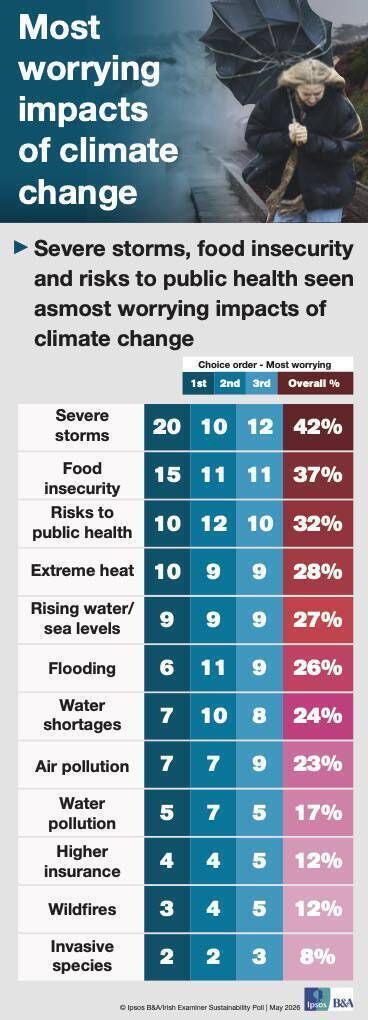
In the poll, people were asked what the top three impacts of climate change most concerned them.
More than two in five (42%) said severe storms, with 20% ranking it as the highest concern. This may come as little surprise given Ireland’s exposure to such weather events in recent years.
Storm Éowyn was the most expensive storm-related insurance event in Irish history, with claims in excess of €301m, as well as costing ESB Networks almost €100m as it scrambled to restore power to hundreds of thousands of customers.
The Climate Change Advisory Council has cited the impact of this and other storms as showing the great need for Ireland to invest in climate adaptation measures to ensure we can mitigate the worst effects of storms .
“How quickly do we forget Storm Éowyn, the heatwave and drought of 2018, or the ‘Beast from the East’ in 2018? We have to be resilient to all kinds of things,” said the chairman of its adapation committee, Peter Thorne, a professor at Maynooth University.
“We have to be ready for what the weather throws at us. The trouble is that we are loading the dice, we are giving steroids to the weather, so the weather is landing stronger and stronger punches.”
Next on the list of most concerning climate change impacts to the Irish public was food insecurity, which was cited by 37% of people. Some 15% made it the top concern.
The risk to public health was mentioned by 32% of respondents, rising sea and water levels by 27%, followed by flooding (26%), water shortages (24%), air pollution (23%), and water pollution (17%).
Lesser mentioned concerns included higher insurance premiums (12%), wildfires (12%), and invasive species (8%).
All of which shows that the public has a wide variety of concerns when it comes to climate change, with specific fears perhaps relative to past experiences, geographic location, and other factors.
Last week, Ireland saw its hottest May temperatures ever recorded as it and the rest of North-West Europe sat under what Met Éireann described as an “intense high-pressure system” that was stacked through the atmosphere.
France and Britain also saw records tumble for the hottest May days.

The new normal
“When we get a weather situation with very strong high pressure stacked through the atmosphere and sinking air over several days, the maximum temperatures reached can be higher than similar situations in the past due to the increased background warming caused by climate change,” said Met Éireann’s Paul Moore.
On an increasing basis, Met Éireann’s commentary around significant weather events has highlighted the impact that climate change is having on such events.
It is clear that climate change has increased the frequency and intensity of extreme weather events, with heat extremes like last week likely to become warmer and happen more often in future.
Ireland isn’t warming as fast as other European countries due to the Atlantic Ocean’s influence, but extreme weather is nevertheless making its presence felt.
“Ireland’s average temperature is expected to further increase into the future due to climate change,” Met Éireann added.
“This further increases the risks of more frequent and extreme heat events.”
Experts such as Prof Thorne and Mary Bourke, a professor in geography at Trinity College Dublin, also clearly linked last week’s heatwave with our warming climate.
“In this way, this heat event is a signal of the new normal,” said Prof Bourke.
“It adds an extra ‘drying pulse’ into a year already characterised by high flows, and it foreshadows a future in which repeated short heatwaves can progressively erode water availability and increase both flood and drought risks.”
Prof Thorne added: “We have more than 100 years of observational records. To break the all-time May record by more than 2C, a week out from the end of the month when we’d expect records to be set, is hard to comprehend.
“While people may think this is great, the impact upon heat-related mortality and morbidity will be considerable [early season events have much greater impacts as society is not acclimatised] and the impacts upon agriculture and industry considerable.”
It came as the UN’s World Meteorological Organization (WMO) warned that a record-breaking hot year is now almost certain by 2030 as the impact from climate change intensifies.
With an El Niño warming event due this year, the WMO said the global temperature record could fall as soon as next year.
Carbon dioxide emissions from fossil fuels are continuing to rise, trapping more heat and driving more extreme weather.
Simon Stiell, the UN climate chief, said: “The latest heatwave in Europe is a brutal reminder of the spiralling impacts of the climate crisis — both human and economic. Many other parts of the world are also getting hit hard such as India and other parts of Asia.
“Protecting human lives, businesses, and economies from extreme heat and the many other soaring costs of climate change is core business for every nation, and it starts with kicking the fossil fuel addiction much faster,” he said, noting that clean power is now cheaper than fossil fuels and faster to produce.
In April, the European State of the Climate report for 2025 suggested Europe was heating up faster than any other continent in the world, while research from Britain suggested that the world experienced some of the most destructive and deadly wildfires in recent history last year.
That research on the wildfires from the University of East Anglia suggested that, while the overall size of the areas covered by fire were low compared to other years, their devastating impact far outweighed those recent times.
“Studies clearly show that the hot, dry, windy weather conditions which drove devastating wildfires across southern Europe have been made much more likely due to human-caused climate change,” said Theodore Keeping from World Weather Attribution at Imperial College London.
“Whilst identifying trends in wildfires on the continent are complicated by shifts in land use, it’s clear that fast spreading, intense wildfire events are becoming more likely as weather extremes increase.”
Marica Cassarino, an environmental psychologist at UCC, said that all of the evidence before us should provoke action, adding that combining incentives with disincentives tends to produce the most effective and lasting change.
She said the low priority people place on climate change when compared to other issues points to gaps in how we understood challenges facing us that are actually interconnected.
“Issues such as cost of living, migration, and resource pressures are closely tied to global environmental and geopolitical dynamics, yet this complexity can be difficult for individuals to fully engage with,” she said.
“This highlights the need for clear, trusted communication that helps people make sense of these interconnections, fostering more systemic thinking and, ultimately, supporting more sustained climate-positive behaviours.”
This article was funded by the News Reporting Scheme
Read More
CLIMATE & SUSTAINABILITY HUB
CONNECT WITH US TODAY
Be the first to know the latest news and updates