'Friedreich’s Ataxia doesn’t wait': Cork father urges approval of drug as son’s condition deteriorates
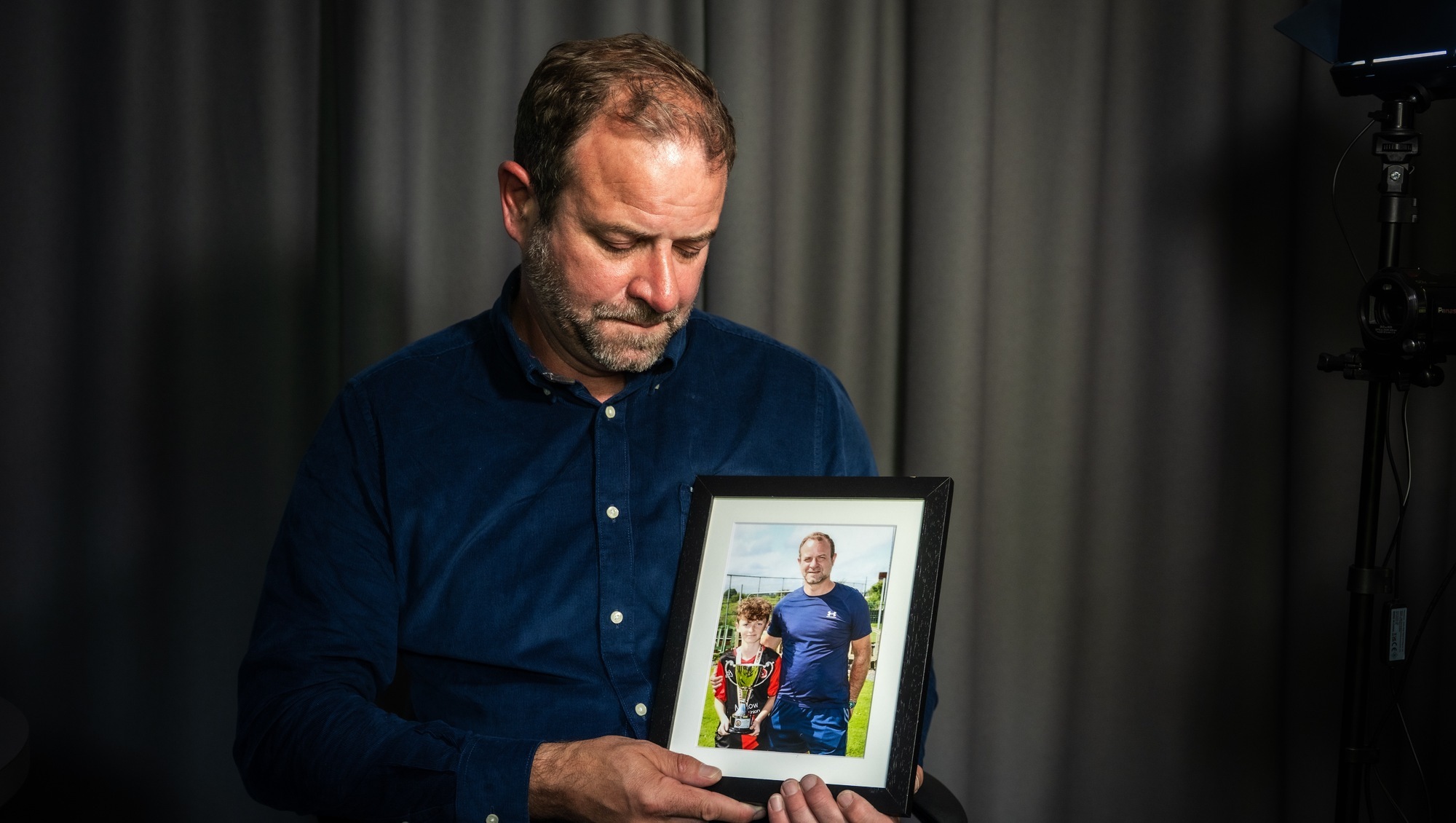
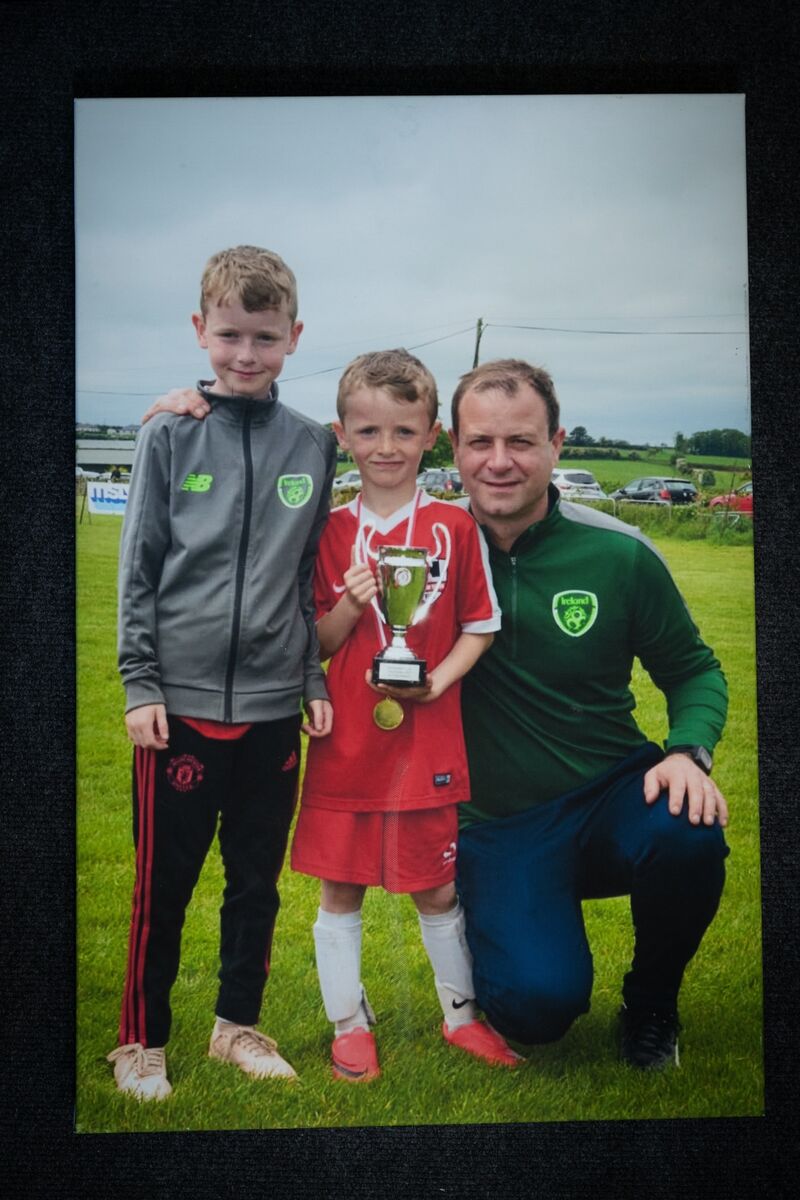
Craig Coady holds a photograph of himself and Rory celebrating a sporting success. He said Rory’s memory gives him the strength to continue fighting for access to treatment for Paudie. Picture: Chani Anderson
Friedreich's Ataxia doesn’t wait, Craig Coady says, as he details the harrowing reality his family faces as they desperately wait for life-changing drug, Skyclarys, to be approved for use in Ireland.
Mr Coady, whose 16-year-old son Paudie suffers from the genetic condition, told The Deirdre O’Shaughnessy Podcast that following a recent meeting with Taoiseach Micheál Martin, he is hopeful the medicine will soon be greenlit.
A discussion surrounding the availability of the drug was due to take place in September. However, Mr Martin has “promised” Mr Coady that the HSE’s Drugs Committee will deliberate on the matter at the next meeting in July.
Time is of the essence for Paudie.
“The Taoiseach has promised me that it will be on the list in July – and he is hoping that he can push that meeting forward to the end of June,” said Mr Coady.
“He was a really nice guy — a family man. He was very sympathetic. He was emotional when I went through my story — he’s been there himself.
“He understands that Friedreich's Ataxia doesn’t wait.”
Read More
The Buttevant native, who already lost his 13-year-old son Rory to the disease in September, said the medicine would not only improve the life of his surviving son, Paudie, but would potentially enable him to regain his mobility.
“Skyclarys can slow the disease down by 50%, and it helps with the heart as well,” said Mr Coady. “There are patients with Friedreich's Ataxia that weren't able to walk or write, and [after taking Skyclarys], they can actually do something again."
Mr Coady said it is vital that the drug is approved. "If there's a price tag on every child in this country, it's a sorry country”.
Friedreich’s Ataxia is a rare genetic disorder which causes progressive damage to the nervous system and can lead to heart complications.
Having coped with his condition for some time, Paudie is now showing signs of advanced deterioration, leading to Mr Coady’s plea to approve the use of the drug.
Detailing the first time he noticed an issue with Paudie, Mr Coady said it happened during a friendly football match, where he noticed his son standing off-balance.
“When he was standing waiting for the ball to come, he was [leaning] forward to try and hold his balance," he said.
Two days later, Mr Coady said he observed Paudie walking off-balance again, prompting them to visit their local GP.
“We went to the GP, he looked at him and said there’s something amiss here,” said Mr Coady.
“We brought him to CUH, and the neurologist at the time checked him. She did a line test, and he couldn’t walk straight, so she was 90% sure after an hour that he had Friedreich's Ataxia."
His bloods went to the UK, and five weeks later, they came back and said he had it, Mr Coady said.
“He didn’t understand what Friedreich's Ataxia was — when he was told he could no longer play soccer, he wasn’t right for a long, long time,” he added.
“He can no longer write. He could write this time last year, so that will tell you how aggressive it is.”
Mr Coady further described how his younger son was diagnosed after Paudie, a diagnosis that came as a shock to him, as “he wasn’t showing any signs”.
“Paudie had an appointment at CUH, and they asked me to bring in Rory as well,” said Mr Coady.
“He was checked, and I knew there was something wrong.
“[The doctor] pulled me aside and told me that Rory had Friedreich’s Ataxia as well, and that the lower left muscle in his heart had thickened.
“I said it was impossible, that he’s walking fine — I actually thought with everything going on in life, we'll get away with Rory, that he’ll escape this.”
However, not long after his diagnosis, Rory died as a result of the condition.
"He went upstairs to play with his friends on the PlayStation, and I think his last text was sent at 1.10am to a friend,” said Mr Coady.
“The next morning, I said I'd go into town while the boys are asleep and get a few bits.
“When I came back, Paudie was up, and I asked where Rory was — he said he was still in bed.
“I went down to his room, and I could hear music, so I thought he was just chilling,” he added.
“I went in, I went over to him, and I was a bit confused because his eyes were still up and down, but the colour was completely off.
“His lips were blue. When I touched him, he was frozen.
“I knew Rory was gone – he was stone cold – but we had to go through the process.”
Mr Coady further explained that his wife, Della, who has Huntington’s Disease, receives around-the-clock care at Bloomfield Hospital in Dublin.
“We had to bring Rory up to Della when he passed,” said Mr Coady.
“I didn’t go up, her family were there, but what I hear from the undertaker was that they had a lovely setup up there for Rory and his mum.
“[With Huntington’s] normally, it’s your body that goes first, but with Della, it was dementia that set in first.”
Explaining how Della comprehends the grief of losing her son, Mr Coady said that Huntington’s dementia works in mysterious ways, and to his understanding, she is aware of his death.
“We had a dog, Trix, she used to walk him every day with a carer, and I told her two years ago that he passed. To this day, she still asks if I’ve walked him, [but] she never really speaks about Rory,” he said.
CONNECT WITH US TODAY



Be the first to know the latest news and updates