Helen McEntee rejects triple lock 'rhetoric' following Michael D Higgins' comments
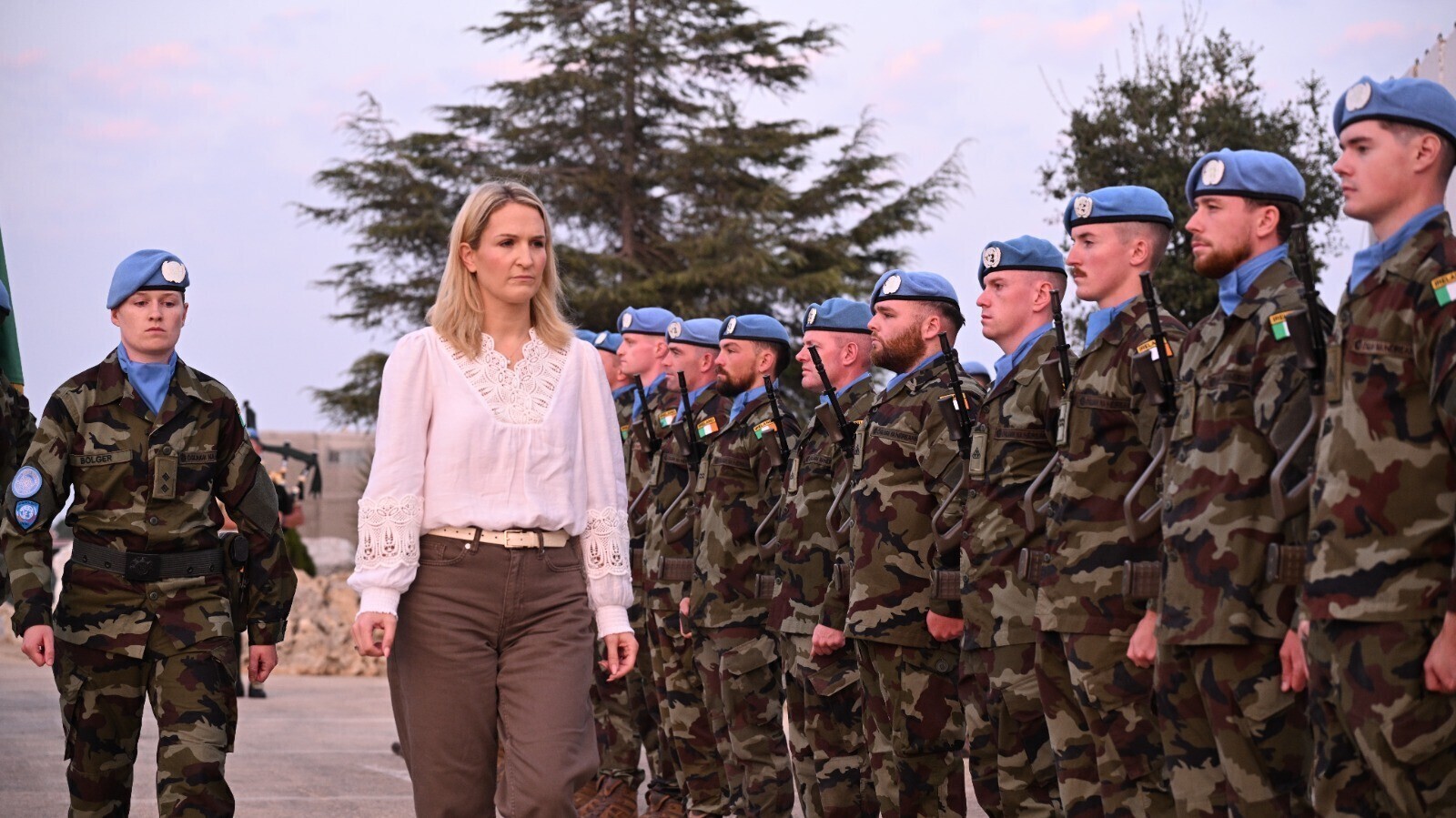
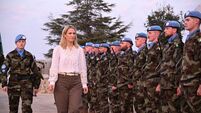
Defence minister Helen McEntee meeting Irish peacekeepers at UNP 2-45, also known as Camp Shamrock, in southern Lebanon. Picture: Defence Forces /PA
Defence minister Helen McEntee has rejected “rhetoric” that the removal of the triple lock for overseas deployments is part of a strategy to end neutrality and join Nato.
She was responding to comments at the weekend from former president Michael D Higgins, who said the country was “sliding” into military alliances and criticised the Government’s move to end UN authorisation for foreign missions.
In an interview with the Irish Examiner , Mr Higgins suggested that with the removal of the triple lock, the EU could “tell” Ireland where to go for peace-keeping missions.
Speaking during a visit of Irish troops serving in the Unifil peace-keeping mission in southern Lebanon, Ms McEntee said the proposed ending of a UN requirement for more than 12 military personnel in overseas deployments had nothing to do with neutrality or Nato.
Read More
Questioned about Mr Higgins’ remarks, the minister said: “This is about making sure Ireland can choose where to contribute to international peace and security and the ability of the government to make that decision.
“There’s a lot of rhetoric and suggestions about forcing troops to go places. It will always remain an Irish decision.”
She said that as a neutral country, the primacy “first and foremost” for Ireland is peace, stability, and security — and that ending the triple lock was “not going to change that”.
Ms McEntee, who is also the foreign affairs minister, said any deployments “must align” with the country’s values, the UN Charter, and international law.
In his interview, Mr Higgins claimed that Ireland was "absolutely" sliding into military alliances.
He said: "I think that it's less than honest not to give the full story when you're talking about going into preparatory alliances.”
On peacekeeping, he said: “You've lost the United Nations [element of the triple lock], let's deal with that one. Where are you going to go? How are you going to assist? Are you going to wait for the African Union? Are we going to Africa? For instance, in relation to South or Latin America, are we going?
"Are we going to wait for the European Union to tell us where to go to become active for peace? The evidence is that the European Union is not in favour of that kind of peace."
Ms McEntee said that, as it stood, any or all of the five permanent members of the UN Security Council can “dictate” where Irish peacekeeping troops “can go to or be removed from”.
She said ending the triple lock "does not in any way alter military neutrality" and is instead about ensuring Ireland can make its own decisions on overseas military deployments.
All opposition parties in the Dáil oppose the bill removing the triple lock, arguing it is an erosion of military neutrality.
Ms McEntee was also asked about claims that any Irish involvement in an EU mission in Lebanon, to replace Unifil, would see a shift to peace enforcement, rather than peacekeeping.
Under Chapter VII of the UN Charter, peace enforcement can involve the use of military action not just for defensive reasons but to forcibly restore international peace and security.
Ms McEntee said Irish troops have previously taken part in peace enforcement in UN missions in Congo, Chad, and Libya and that it was nothing new.
The UN states that peacekeeping operations “may use force to defend themselves, their mandate, and civilians”.
Ms McEntee said towns and villages in southern Lebanon have been “completely devastated” by mass Israeli bombardment and look like they have been "hit by an earthquake".
Speaking during a visit to Irish troops serving with the departing Unifil mission, Ms McEntee said there is “no sign of life” in these once-vibrant towns and villages.
Accompanied by Chief of Staff Lieutenant General Rossa Mulcahy, Ms McEntee said Unifil, including its 300-strong Irish contingent, was the only independent presence capable of recording the actions of the Israeli Defence Forces.
- Cormac O’Keeffe, Security Correspondent
CONNECT WITH US TODAY



Be the first to know the latest news and updates