Colin Sheridan: Premier League partly brought the Man City problem on itself
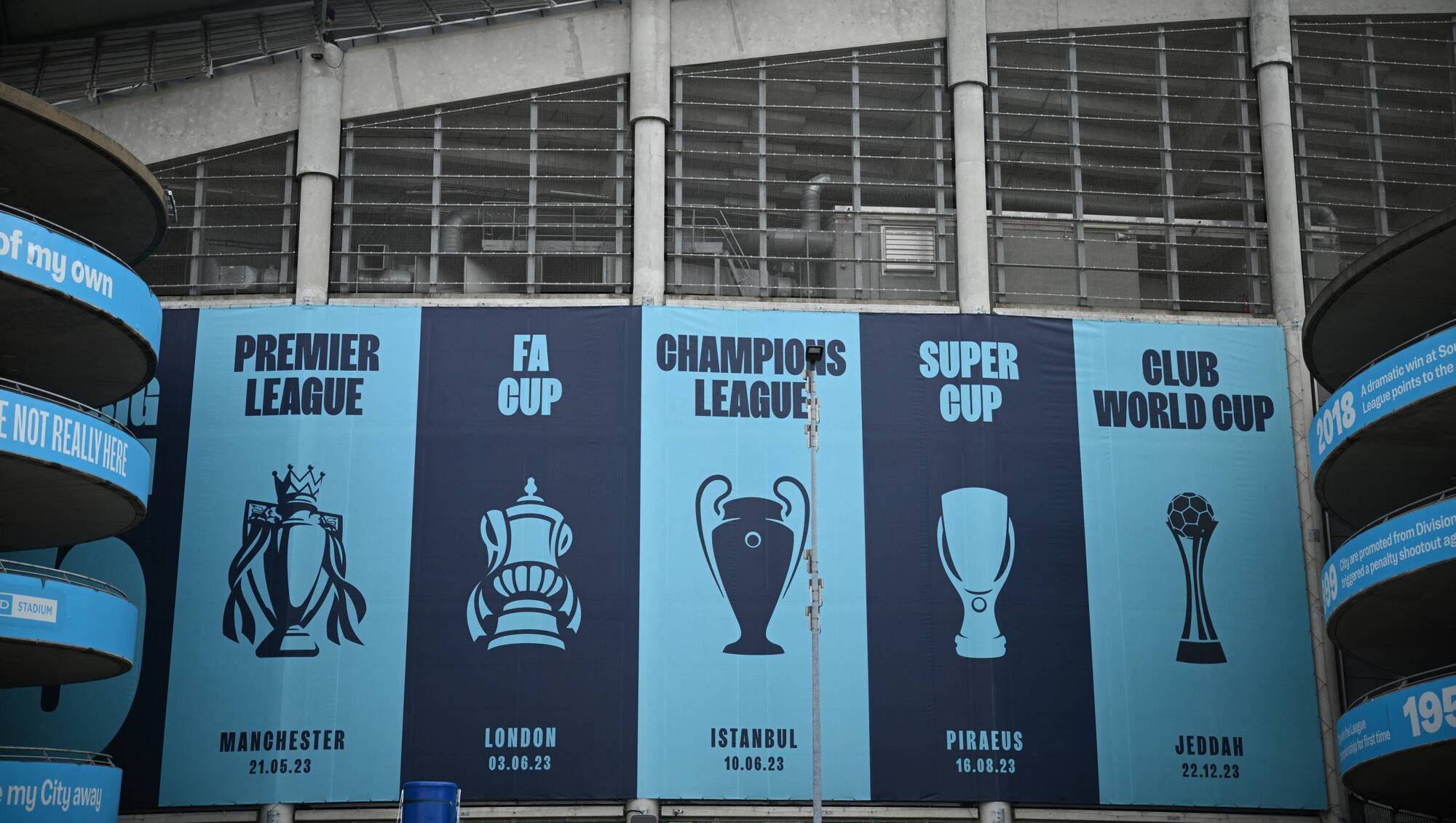
An independent commission has found Manchester City guilty of serious breaches of the Premier League’s financial rules over nine seasons. Pic: Oli SCARFF / AFP via Getty Images
It has been billed as one of the biggest stories in football history. But after all the noise, outrage, and forensic examination of Manchester City’s accounts, one fairly straightforward question remains — what is actually going to happen? Will the bite match the bark? Will there be a consequence proportionate to the findings? Or will this become another story in which the scale of the wrongdoing makes meaningful punishment harder to contemplate?
Ireland, societally speaking, has some experience with that last scenario. The Celtic Tiger and its subsequent catastrophic decline, taught us plenty about the distinction between responsibility and accountability. Responsibility could be prosecuted indefinitely. Accountability was considerably more elusive, particularly when enforcing it threatened to inconvenience people whose importance had previously been measured by the amount of money they controlled. The larger the interests involved, the more complicated everything became.
Football’s predicament now has a familiar ring to it. An independent commission has found Manchester City guilty of serious breaches of the Premier League’s financial rules over nine seasons. City maintains its innocence and has lodged an appeal. Punishment, expected to be announced before season's end, remains a separate question. That distinction matters. But it also creates the space in which football’s capacity to police itself will be tested. A finding is one thing. A consequence capable of discouraging somebody else from doing the same is another.
Read More
The white-collar comparison does not require us to confuse a football disciplinary ruling with a criminal conviction. It concerns the way institutions respond when wrongdoing involves powerful organisations, expensive advisers and sums of money beyond ordinary comprehension. At that altitude, the language changes. We hear about complexity, exposure, unintended consequences. We are encouraged to appreciate how many innocent people might suffer. There are employees to consider (Betty, the tea-lady. Always the tea-lady), investments to protect, and diplomatic relationships between the UK and UAE to preserve.
Loathsome as it sounds, these are legitimate considerations. They are also considerations that tend to become especially urgent when the subject can afford an exceptionally good lawyer.
Football supporters understand punishment perfectly well when it arrives in a form they can see. A suspension. A points deduction. A club falling through a division. They are entitled to wonder whether financial power buys a different relationship with the rules.
Yet concentrating exclusively on City would allow the Premier League to occupy a rather comfortable moral position: the wronged institution, patiently restoring order to a competition whose essential innocence remains intact.
What that misses is the critical fact that the Premier League invited this problem into its home, spending decades selling expansion as an unquestionable good. Bigger broadcasting contracts. Bigger international audiences. Bigger commercial partnerships. Owners capable of financing ever more ambitious versions of the product. Sovereign wealth, billionaires, international conglomerates, private equity: different sources of money, welcomed into a competition increasingly organised around attracting more of it.
Their presence does not establish wrongdoing, but it does establish the need for regulation strong enough to withstand their influence. You cannot continually advertise the benefits of extraordinary wealth without preparing for the difficulties of regulating extraordinary power.
Money buys players. It also buys expertise, access, endurance and the ability to contest a decision long after a less wealthy organisation would have exhausted its options. The Premier League wanted a global business. It acquired global business problems.
There is an old saying about lying down with dogs and waking up with fleas. No need to apply it personally to anybody involved. The institutional point is sufficient: you cannot embrace an economic model and then express bewilderment when its complications arrive.
Nor does the commission’s decision establish that other clubs have behaved similarly. It does, however, make scrutiny of the wider system essential. A competition cannot reassure itself merely by identifying one offender.
What safeguards worked? Which failed? What did the league know, and when did its structures become capable of establishing what had happened?
Those questions are not answered by pointing to the successful prosecution of a case. Pursuing it was necessary. So is examining the environment in which the breaches occurred.
There is a particular danger in treating this as an argument between rival supporters. City fans defending their club. Liverpool and Arsenal fans revisiting old tables. Everybody suddenly calculating which trophy might belong somewhere else. That reduces a question about the credibility of an entire competition to another weekend of tribal grievance.
Supporters did not design the financial arrangements. Players did not audit them. Neither group should be required to explain away findings made against the organisation they represent or love.
The obligation belongs elsewhere. It belongs to those who ran the club, and to those responsible for governing the competition. Subject to the appeal, both must now confront what the findings mean.
The Premier League cannot promise sporting uncertainty while permitting financial power to determine the limits of accountability.
Perhaps meaningful punishment will follow. Perhaps the appeal will alter the findings. The process must take its course. But the league’s credibility will ultimately rest on what it does with the outcome. If an institution becomes too valuable to punish, its value has become a form of immunity.
Football was warned, and chose to ignore the danger. Whether it has the moral courage to punish the perpetrators while owning its own guilt remains to be seen.
Kerry people are generous with their football wisdom, provided nobody mistakes it for permission to use it against them. One of their own managing another county is an altogether delicate business. They wish him well, naturally. Just not that well. Certainly not in July. Éamonn Fitzmaurice taking charge of Galway therefore constitutes something between a career move and the unauthorised export of a national treasure.
Somewhere in Kerry, a man is wondering whether the county board should have confiscated his notebooks. Fitzmaurice himself admitted wrestling with the prospect of facing his native county. Galway supporters will be pleased he won that particular argument. They have recruited a manager who delivered Kerry’s 2014 All-Ireland, six consecutive Munster titles and a National League.
His involvement in the Football Review Committee also gives him an intimate understanding of the game’s changed possibilities. More importantly, he has inherited players capable of exploiting them. Shane Walsh, Rob Finnerty, Cillian McDaid, Seán Kelly and John Maher give him considerable material. Keeping Galway’s best players available will matter as much as anything drawn on a tactics board.
Pádraic Joyce brought Galway to two All-Ireland finals. That deserves respect. It also explains why another season of being good was unlikely to satisfy anybody. Don’t let perfect be the enemy of good, they say. Sound advice when choosing curtains. Less persuasive when Sam Maguire keeps going elsewhere.
Mayo’s breakthrough under Andy Moran demonstrated what a change of leadership can unlock. I doubt it happens without him. Galway’s appointment carries that same ambition. Changing managers offers no guarantee, but accepting a familiar ceiling guarantees nothing either. Fitzmaurice has already won an All-Ireland with Kerry. Galway are asking him to win one with them. Kerry will understand that ambition completely. Whether they forgive it is another matter entirely, best discussed after the championship.
In Canada, hockey occupies the space the GAA does here: family inheritance, local identity, something you grow up with rather than choose. Since 1952, CBC’s Hockey Night in Canada has brought that world into sitting rooms. Now its NHL coverage has ended after its agreement with rights-holder Rogers expired. Imagine generations gathering for championship Sundays, then being told the national broadcaster would no longer carry them? Of course we can because it’s becoming reality here, too. The matches continue, of course. But a sport’s value cannot be measured solely by what somebody will pay to broadcast it. There is also what everybody loses.
Charlie O’Shea’s two tries and three conversions against the Bulls gave Munster a thrilling glimpse of what might be. The 20-year-old’s first start deserved its standing ovation. It does not require a coronation. One swallow does not make a summer, and Irish rugby should have learned something from the haste with which Sam Prendergast was anointed at Leinster. It served nobody, least of all the player, whose development became a referendum on everybody else’s predictions. Munster must nurture O’Shea, protect his room to make mistakes and resist loading their hopes onto his shoulders. Let him become himself before becoming everybody’s answer.