HSE to decide on €280,000-a-year Skyclarys drug for Friedreich’s ataxia
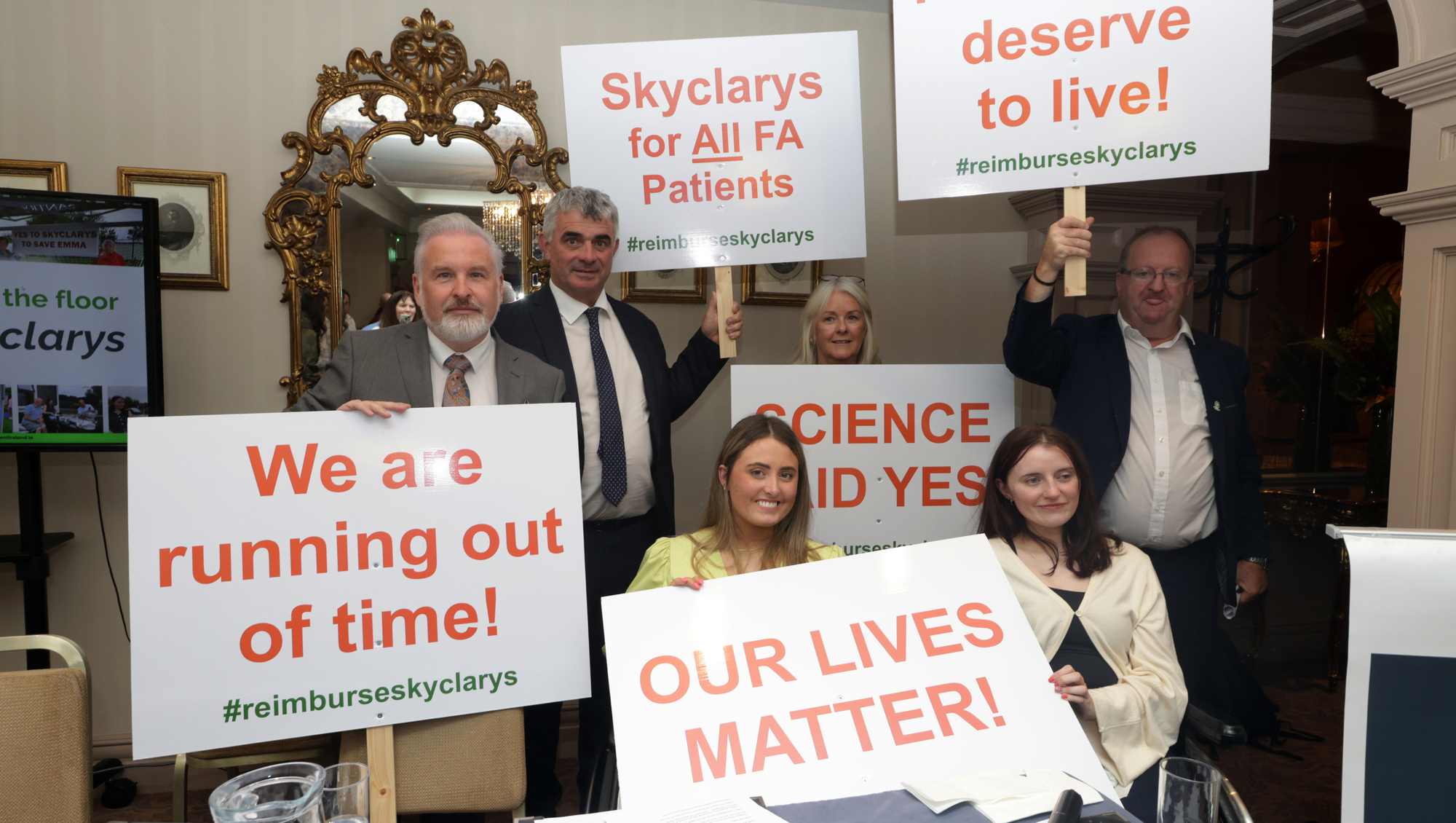
Independent Ireland councillor Ken O'Flynn with and TDs Richard O'Donoghue and Michael Collins with Kilkenny woman Emily Felix, who has Friedrich's ataxia, at an event in Dublin this week ahead of the HSE decision on Skyclarys. Picture: Leah Farrell/RollingNews.ie
Ireland’s role as a "problematic child" for rare drugs has cast a reimbursement decision over Friedrich’s ataxia drug Skyclarys in doubt, according to politicians, campaign groups and healthcare experts.
Skyclarys is an oral medication produced by biotech firm Biogen. It is the first known drug that can slow the neurological deterioration associated with the rare genetic disorder Friedrich’s ataxia.
Around 200 people in Ireland suffer from the disease.
HSE senior management will decide on Tuesday, August 25, whether to publicly reimburse the drug.
Earlier this month, the HSE drugs group recommended against publicly reimbursing Skyclarys, citing a lack of clinical data and a high “opportunity cost”.
The HSE has cited a figure of €280,000 per patient per year for the drug. That would cost the State around €134m over a five-year window. Biogen has disputed that figure while the HSE refused to comment on negotiations with Biogen.
As the highly anticipated decision looms, advocates in the sector have called for an overall reform in Ireland’s management of rare drugs.
Rare Diseases Ireland chief executive Vicky McGrath said Ireland’s framework for approving rare drugs is antiquated and rife with red tape compared to European counterparts.
“Germany accepts stuff pretty much immediately and sets a price a year or two later after they get some real-world evidence as to the effectiveness of the drug,” she said.
“We have such a difficult reimbursement system; companies are delaying making applications in Ireland.
“We'd wait five years before we start providing it in this country until we get all of that data. But in the interim, people are deteriorating… people are dying.”
Read More
Skyclarys was first authorised by the European Medicines Agency in February 2024. The HSE has since dealt with Biogen in formal pricing and reimbursement negotiations, while the National Centre for Pharmacoeconomics reviewed the clinical data and cost-effectiveness of the drug.
The drug is available in 11 other European countries, according to Biogen.
An analysis by the European Federation of Pharmaceutical Industries shows Ireland has approved 53 rare drugs from 2021-2024, in comparison to Germany’s 156.
According to the Irish Pharmaceutical Healthcare Association, a robust analysis for the reimbursement of a new medicine can comprise 20-30 steps in Ireland.
The IPHA said the HSE drugs group meets on average once a month for two hours, while equivalent bodies in England and Wales delegate their work across four committees and meet for eight hours once a month.
Fianna Fáil TD Padraig O’Sullivan said that Ireland was viewed as “a problematic child” by pharmaceutical companies when it comes to rare drugs.
“If you look at bigger countries like Germany, France, who have far more progressive reimbursement in the rare disease space, those countries I would assume get preferential rates because they reimburse more drugs,” he told the .
Mr O’Sullivan called for more State funding to be directed towards rare drugs.
“The existing budget annually for rare diseases and new cancer medicines is €30m. €30m of (the healthcare budget)… it represents less than 1%.
“And until such time as there’s a more even distribution of that budget, you're always going to have rare diseases and new innovative drugs at the back of the queue.”
Current government policy on rare drugs approval stems from 2013 legislation.
In June, health minister Jennifer Carroll MacNeill said she had signed off on a plan for a fresh review of Ireland's rare drugs reimbursement framework.
Ms McGrath is among those who have warned that a review commissioned by Ms Carroll MacNeill's predecessor, Stephen Donnelly, failed to bring about meaningful change.
As the decision looms, patients, and advocates raised alarm at the consequences of an unfavourable decision.
“I think with something as serious as this, I hope they can look beyond some of the trial data and kind of realise the human side of it,” said Helen Carney, company director of Friedrich's Ataxia Research Ireland.
Ms Carney was diagnosed with the condition in 2002.
“There's no services and there's no symptom management going forward if this disease-modifying treatment doesn't become available,” said Maureen Sweeney, head of operations at Ataxia Foundation Ireland.
“There's no neurorehabilitation centres around the country. Ataxia is not on the long-term illness list. There's no age-appropriate care facility for progressive neurological conditions.”
CONNECT WITH US TODAY



Be the first to know the latest news and updates