June — and 2023 — on course for heat records

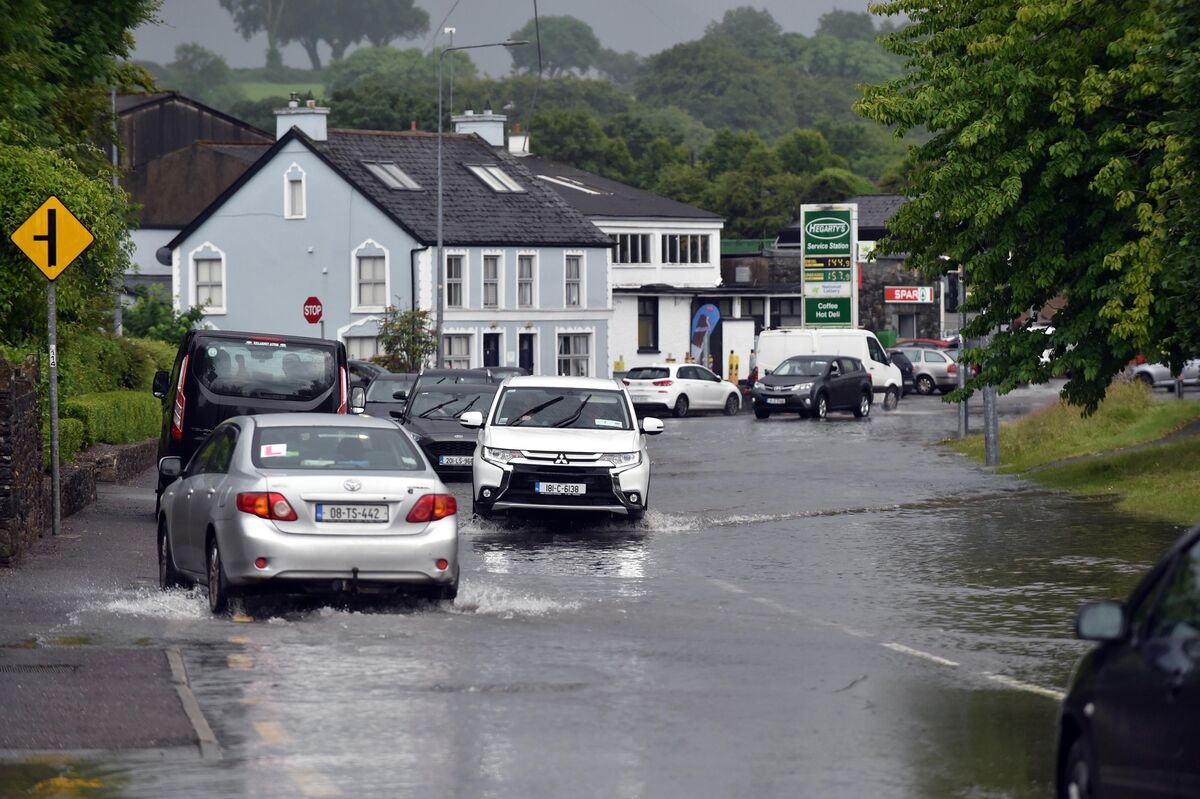
A major deluge of rain in Tralee caused significant flooding in the town last weekend. Picture: Domnick Walsh
Despite a week of thunderstorms, torrential rains and rarely-seen funnel clouds, this month is on track to be the hottest June on record.
Along with a scorching June, this year may squash all previous records, according to a Met Éireann climatologist, with the weather seen this week potentially becoming more frequent and more extreme in the years ahead.
This week alone saw significant flooding in Kerry and Dublin, with funnel clouds becoming more visible in the historically bland Irish climate.
Met Éireann climatologist Paul Moore described June as a “remarkable month of weather”, with absolute drought across the country leading up to the prolonged thunderstorms.
Mr Moore said 24 out of the 25 synoptic stations across the country were in absolute drought, with the station in Malin Head experiencing a dry spell while three stations recorded 35 days of partial drought in the Phoenix Park in Dublin, Oak Park in Carlow and Johnstown Castle in Wexford.
CLIMATE & SUSTAINABILITY HUB
“Since 2018, I haven’t seen anything like that,” he said.

Data provided by Met Éireann’s Dr Sandra Spillane shows this month so far is the warmest June on record, and although still only halfway through the year, the first half has been the warmest recorded.
Mr Moore said it was likely 2023 would break previous high temperature records as the months go on.
“It’s still very early days, we’re on track but we could have a cool autumn, but so far that’s what it’s looking like,” he said.
The prolonged dry spell broke this week resulting in eight straight days of intense thunderstorms across the country, another remarkable feat, he said.
“To have eight consecutive days with severe thunderstorms is quite remarkable as well,” he said.
The break in drought landing on rock-like soil is a recipe for disaster alone, but with Killarney on Tuesday experiencing 66mm of rain in one day, an amount Mr Moore said could be usually expected for the month of June, several towns fell victim to extreme floods, namely Killarney, Listowel and parts of Dublin.
The record for the maximum millimetres of rain in June was 111mm in 1986 in Leitrim.
“Rainfall rates have been extremely high in these thunderstorms where you’re getting lots of rain in a short period of time, which is causing flash flooding,” Mr Moore said.
One contributor to recent weather events is the very high sea surface temperature surrounding Ireland’s coast, with the US National Oceanic and Atmospheric Administration declaring an extreme marine heatwave off the coast of Ireland, he said.
Mr Moore said record global sea surface temperatures were recorded last month, with buoys surrounding the coast of Ireland recording record temperatures for June.
The sea surface temperatures surrounding Ireland are getting higher earlier in the year, with current temperatures usually seen in August or September, after months of heating up.
“The dataset only goes back to 2007 but since then three of the buoys look like they’ve hit record-high temperatures for June,” he said.
Mr Moore described Tuesday’s funnel clouds in Dublin and Mayo as a “freak day”, although stressed they were not necessarily becoming more frequent.
“A tornado is a funnel cloud that reaches the ground and causes extreme wind, it’s not known if these reached the ground or not,” he said, but added Ireland will not turn into a “tornado alley”.
It comes as Met Éireann’s first Translate climate projections confirm a decrease in the frequency of cold winter nights along with an increase in the frequency of summer nights.
The project which brings all of Ireland’s climate datasets into one place confirms a warming climate for Ireland in which there will be an increase in heatwaves, the level of which will intensify.
The projections confirm a 10-fold increase in the frequency of summer nights which are categorised as a night with a minimum temperature of 15C.
The projections also show an increase in heatwaves in Ireland, which Met Éireann define as a period of five consecutive days where the daily maximum temperature is greater than 25C.
In addition to drought conditions, Translate shows overall annual precipitation is increasing with more variability, meaning drier summers and wetter winters.
Check out the Irish Examiner's WEATHER CENTRE for regularly updated short and long range forecasts wherever you are.
CONNECT WITH US TODAY



Be the first to know the latest news and updates