Cork boat builder in bid to set transatlantic record
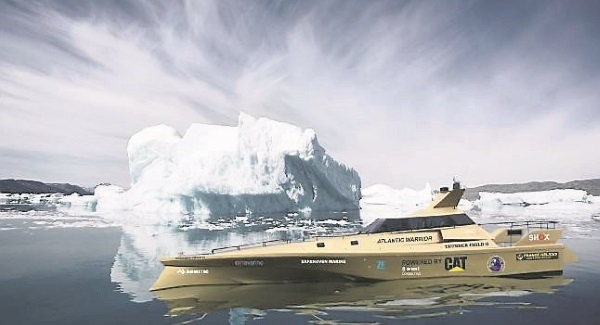
A pioneering Irish boat builder has upgraded his James Bond-style wave-piercing powerboat in a bid to set a new transatlantic world record.
Cork-based Safehaven Marine’s managing director Frank Kowalski has developed a radical hull for the new Thunder Child vessel that will take on the challenging 4,500km voyage across the north Atlantic next year.
Kowalski, who led a crew on the record-breaking circumnavigation of Ireland last year in his sleek €1m Thunder Child 1 interceptor vessel, said they believe Thunder Child 2 can make the transatlantic journey in under four days.
We think we can do it in 3.5-days if we can maintain speed and don’t get caught by storms,” he said last night.
Thunder Child 1 powered her way the ‘long-way round’ Ireland, a voyage of just over 2,000km, which included Rockall Island, in July 2017 in just over 34-hours. Key to its success was its 60ft wave-piercing monohull design.
But the design of Thunder Child 2 has fused the proven wave-piercing monohull with a catamaran hull — it blends from a monohull at the bow to a catamaran hull midship. The company has applied for a patent on the hull design.
Scale models have been tested already and construction work on the superstructure is under way.
Kowalski said: “If the hull performs as well as our model testing predicts, and looks as good as the initial design impressions show, it should be a pretty amazing craft and what a way to prove the design by making this record attempt.
The crew plans to make the record attempt on the so-called northern route, from Newfoundland east to Ireland, with refuelling stops at Greenland and Iceland.
The 2,400 nautical miles, or some 4,500km voyage, will finish at Killybegs.
As well as the normal challenges faced by crews sailing in the open ocean, this route will take the crew close to the Arctic Circle, where sea ice and icebergs are prevalent.
The route tracks through two of the world’s most active and potentially violent weather system regions off the east coast of Canada, and in the North Atlantic.
The crew hopes that forecasting technology will help them time the attempt during a settled period, or that the speed of their boat will allow them to avoid or outrun any weather fronts.
They are targeting a six-week window from mid-July 2019 for the record attempt, before hurricane season closes in in early September.
They will deliver the boat to Newfoundland up to two months before the record attempt.
The new vessel is a 75ft-long high-speed interceptor powered by four 650hp Caterpillar engines and four France Helices SDS surface drives which should give her a cruise speed of just over 40kts, a maximum speed of well over 50kts, and a range of 800 nautical miles.
The crew will sit in military-spec shock mitigation seats and the boat will have state-of-the-art satellite navigation and tracking technology.


CONNECT WITH US TODAY



Be the first to know the latest news and updates