Bullet lodged in cricket bat in rebellion crossfire
J.W. Elvery & Co, one Ireland’s oldest sports stores, specialised in sporting goods and waterproofed wear, with branches in Dublin, Cork’s St Patrick’s St, and London’s Conduit St,t. Each shop had the distinctive statue of an elephant above the front door, giving them the name Elvery’s Elephant House.
In 1916, the Dublin city centre branch was located at 46 & 47 Lower Sackville St, and was famous enough to be mentioned in James Joyce’s Ulysses.
The shop’s location, about one block from the GPO, meant it was in the middle of the crossfire and general destruction of the main street.
The Rising began at 12pm on Monday, when the Irish Volunteers, led by Patrick Pearse and James Connolly, took control of the General Post Office and declared the Irish Republic on the street outside to the passers-by.
Within a short time the regiments of the British Army garrisoned around Dublin were making their way into the city centre to suppress the rebellion. By Tuesday evening, between 5,000 and 6,000 soldiers had mobilised on Dublin from around the country.
Their focus was to dislodge the Volunteers’ from their headquarters, the GPO, and they concentrated their fire on O’Connell St from the army’s base at Trinity College Dublin.
For regular updates on news and features (as well as twitter action action as it may have happened 100 years ago) to mark the revolutionary period follow @theirishrev HERE
As the rifle fire intensified over the next few days, so did the number of civilian casualties, as those trying to escape the battle were caught in the crossfire.

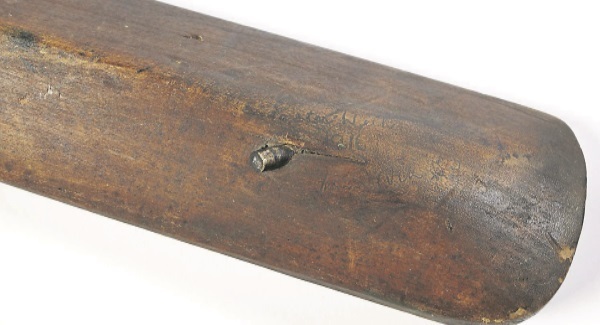
Lodged in the wood of the cricket bat is a .303 bullet; the calibre used for the British Army’s standard issue rifle — the Lee Enfield — or the Lewis machine gun.
The majority of the rifles used by the Irish Volunteers were the 900 German Mausers landed at Howth in 1914, which used .45 calibre ammunition. There were other firearms, such as shotguns, in Irish hands that week, along with the occasional Lee Enfield which had been illicitly received from a British Army soldier.

The bat was saved as a souvenir by the Elvery family, who donated it to the National Museum of Ireland in 1981.
Brenda Malone is a curatorial researcher for the National Museum of Ireland’s ‘Proclaiming a Republic: The 1916 Rising’ exhibition, which opens at the Collins Barracks museum in Dublin on March 3, 2016. Read more about items in the museum collection in Ms Malone’s blog, ‘The Cricket Bat that Died for Ireland’.
Enjoyed this? Then check out our dedicated micro-site, developed in collaboration with UCC, to mark the revolutionary period HERE