Cork gets first of 15 new buses
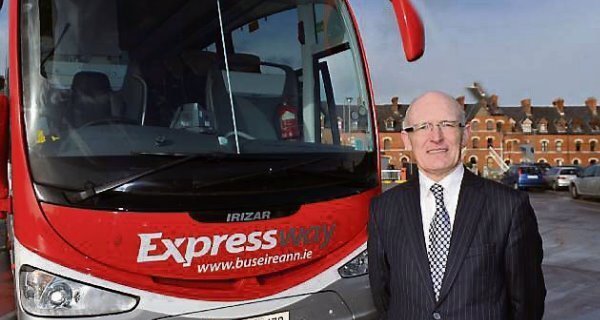
Despite taking fire yesterday for cutting some of its commercial Expressway services, company chairman Aidan Murphy said the improving economic conditions and the introduction in Cork of the Leap Card, warranted investment in 15 new buses.
He was speaking after he and board members visited the Capwell bus depot to see the arrival of the first of the low-floor, fully accessible double-decker buses.

The rest, which will be delivered over the coming weeks, will be allocated to some of the city’s busiest commuter routes, including Route 205, which services Cork Institute of Technology , the city centre, and Kent Station; Route 206, which links the city to Grange and Frankfield; Route 215, which links Mahon Point to the city and Blarney; and Route 220 which links Crosshaven, Carrigaline, Douglas, the city, UCC, CIT, Ballincollig, and EMC.
Five new Public Service Obligation coaches are also due to be delivered to Cork in the next month to service routes to West Cork, Newmarket, and Ballycotton.
Three new coaches will be added to the Cork fleet operating on Route X8, between Cork, Dublin City, and Dublin Airport.
Mr Murphy said the company is also working with the National Transport Authority, Cork City Council and other stakeholders on the Cork City South East Strategic Transport Corridors scheme designed to improve bus routes and services in the South-East quarter of the city. The study area has a population of just over 28,000, and is home to two of Cork’s major employment hubs — Mahon and the Docklands — several schools, and the Mahon Point Shopping Centre.
Data from the 2011 census indicates a large proportion of short are made predominantly by private car.
“As such, there is good potential for modal shift to sustainable transport modes,” a company spokesman said.
The study aims to identify strategic transport corridors in the area, and the size and timescale of investment, that will encourage people to switch to sustainable forms of transport.
‘You need access to health services to survive’
Jane lives on her own in a rural area 15km outside Tipperary town. She does not want her full name or location published, as she does not want to highlight the fact that she is a pensioner who lives alone in a remote location miles from her nearest Garda station.
Her children have emigrated to the southern hemisphere, and she has no family nearby. Years ago, she suffered a mild stroke and she regularly attends clinics in Clonmel hospital.
To do this, she used to avail of a HSE-provided transport service, but it was cut in 2008.
She said yesterday that while the route she now uses to get to hospital — the Expressway 55 — was not mentioned in news reports on Bus Éireann’s planned review, she is fearful that it, too, may come under scrutiny as the company seeks to cut costs.
Bus Éireann’s activities can be divided into three categories — school services, commercial, and Public Service Obligations (PSO).
The PSO contracts are awarded to Bus Éireann by the National Transport Agency and, through this, funding is allocated to Bus Éireann to provide public transport services for routes deemed “socially necessary but financially unviable public transport services”.
The routes now under review, however, are not services that are provided under the PSO contracts. They are commercial Expressway services and, as such, Bus Éireann is under no contractual obligation to service the routes.
A taxi to and from Clonmel hospital would cost Jane €60, a price she cannot afford on her pension. She pays for a taxi to get into Tipperary, and gets the bus from there.
“It’s a problem when you can’t get in to pay your bills or get your groceries, but you need access to your health services to survive,” she says.
“You have to be very rich or very fit to get to the hospital. The HSE tells you to get your family to drop you in but how can they when they’re overseas?”
She says nurses in Clonmel have told her of an increase in the number of people who don’t make it to their appointments.
“Then we’ll hear no one is using the hospital, and that will be justification for cutting that as well,” she says.
While the decision to review these services has earned Bus Éireann the ire of rural groups such as the Irish Creamery Milk Suppliers Association and the Irish Cattle and Sheep Farmers’ Association, in reality the pressure will shift to the National Transport Agency and the Government.
Both will be expected to step into fill whatever void is left following Bus Éireann’s review and, after the withdrawals of post offices and the closure of Garda stations, the pressure to deliver for rural Ireland is growing.