Meg O'Connell: 'Granddad left a legacy of standing against racial inequalities and supporting the arts'
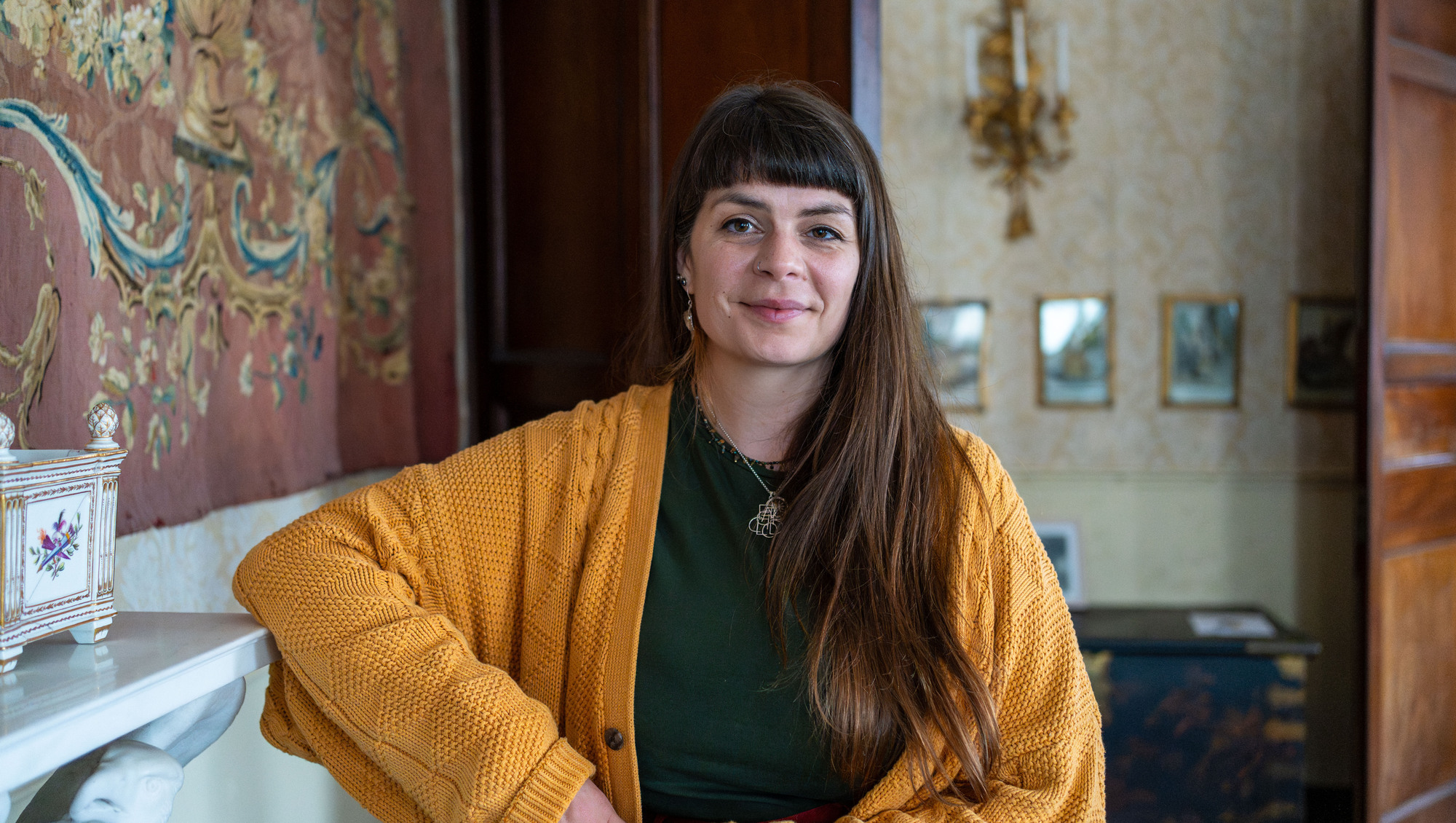
Meg O’Connell, programme coordinator of West Cork Music at Bantry House. Pictures: Noel Sweeney.
A particularly impactful day was two years after my grandfather Jack O’Connell’s death — May 2019. The artist Frank Bowling’s first major retrospective had opened at the Tate Britain.
The opening night itself was busy and chaotic. There was a great buzz and I was really looking forward to meeting my step-granny, Barbara, the next day and having a slower wander through the gallery.
I noticed a painting called Fishes, Wishes, and Uncle Jack and I thought: ‘Oh, I think that’s granddad!’ He’d been a kind of father figure to Frank and I knew Frank had dedicated paintings to my grandfather before, but I wasn’t expecting this that day.
I read the caption and I saw it was dedicated to him. Seeing it, I missed granddad a lot, and I wished he could be there to see it. And the nicest part: Watching Barbara, his wife, take it in. I have a great photo I took of her standing, looking at it.
The exhibition didn’t have a huge amount of paintings, so I knew this was a conscious choice by Frank to have that painting there. It showed what an important part of his story my granddad was.

Granddad grew up in Kilkenny. He was a publican in London during the “No blacks, no Irish” era. He ran The Finches on Fulham Road. He met Frank, a young black artist who had moved from British Guiana, in Chelsea in the late ’50s.
With significant prejudice against Irish people and people of colour in the UK at the time, Granddad went by Connell and not O’Connell — so as to have on paper a bit of administrative distance from being an Irish immigrant in London then. When he moved to Ireland — to West Cork — in the ’80s, he changed it back!
Read More
Granddad’s pub was extremely multicultural, a melting pot, and there were stories about him kicking racists out of the pub, and also how he didn’t care how much money someone had. Stories about people paying off bar tabs with pieces of art and books. He was a big reader, loved poetry and history. He wasn’t an artist, but he was always surrounded by artists.
There were only six or seven years between Granddad and Frank, but still, Granddad was an older figure in Frank’s life. From when they made friends, he was always incredibly supportive of Frank. My aunt said Frank was just another member of the family and he called granddad Uncle Jack.
My dad and Frank’s son were born in the same hospital during the same week in January 1962.
When I visited Frank’s studio in London in 2014, he showed me a painting of a snowy bridge he’d done that week in 1962.
For me, it showed how all-consuming his art was, that he painted it while his wife was in hospital having a baby. And he was able to pull it out and say: “This is the one”.

I had a really close relationship with Granddad. We moved over from London when I was six and lived next to him and Barbara near Ballydehob. He’d take me for walks up the boreen, we’d pick fuchsia off bushes and suck the honey. He had a collection of walking sticks and I’d get to choose which one I’d take with me. He’d make up stories about the Collywobblers and their cousins, the Garibaldis — small people you couldn’t see who lived in the bogs.
He was an incredibly stable person in my life. Unfortunately, my parents broke up when I was 11, and when I’d come home from school or was home alone, I’d go down to Granddad and Barbara. I’d sit and read. They loved moving their paintings around, so very often a different painting would be next to the dining table, and I’d get to hear about that artist.
I’d stick labels on envelopes when they were sending out books in the post. Granddad had opened the first bookshop in Schull.
There’d be jokes at dinner about which of us — Granddad or me — would be last to finish because we’d spend so much time talking.
Granddad is why I did a degree in history of art and a masters in human rights and intercultural heritage. I also took from him: To value things at their inception, rather than waiting for something to become popular and successful before you realise its value.
But that moment in the Tate, standing in front of Frank’s painting, was kind of a full circle moment and gave serious weight to all of the stories I’d heard growing up and the art I’d been surrounded by. I felt incredibly appreciative of the world I’d grown up in.
But also knowing Granddad had been one of Frank’s biggest supporters in his early days and throughout his career, showed the immense importance of supporting artists and the arts.
- Meg O’Connell is programme coordinator at West Cork Music. The West Cork Chamber Music Festival runs June 26 to July 5, while Masters of Tradition runs from August 19 to 23.
- Visit westcorkmusic.ie.