Caitríona Redmond: E-scooters affect how safe public spaces are — rules need tightening
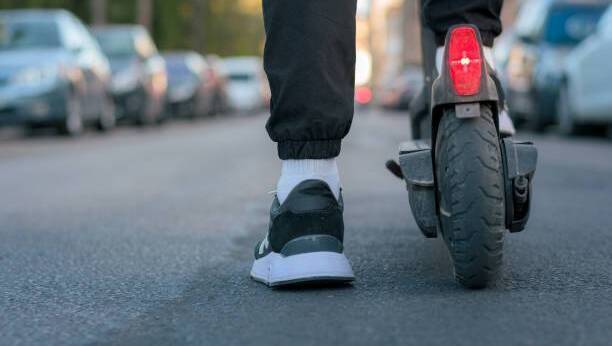
There are fixed charge notices that will apply to people who breach the rules around e-scooters. Each of these costs €50 per fine , and although it's designed to be a deterrent, I don't think €50 is an awful lot. Picture: iStock

Picture this. Walking down the footpath beside the public road, and at the last minute, you suddenly realise somebody is propelling towards you at speed from behind. It’s a relatively new experience — it’s not something that had ever happened to me pre-covid.
Despite strict legislation, e-scooters pose some risks and have been attributed to an increase in traumatic brain injuries in young people.
Under legislation introduced in May 2024, e-scooter users must be over 16 and obey a speed limit of 20km/h. They should also not carry passengers, have a seat, or carry goods.
Funnily enough, I have seen all the above happen within the last couple of days in my own local area, and this behaviour, I’m sure, is repeated in towns up and down the country.
While all of this seems clear, if you’re going to buy an e-scooter tomorrow morning, you may still be able to buy one that could be used in a way that is not compliant with this legislation.
Ahead of writing my column, I conducted research on popular e-scooter firms across Ireland. Some firms issue notices regarding the e-scooter legislation. Others did point out the speed on scooters was limited, but also stated the scooters could achieve speeds in excess of 50km/h.
To be clear, if a speed limiter is removed from those scooters, they will not be legal in any public place.
E-scooters for sale in the EU must comply with the machinery directive 2006/ 42/ EC, and to be used in a public area in Ireland, they must comply with the technical requirements of S.I. (Statutory Instrument) 199 of 2024.
It must also be CE marked, and the declaration of conformity must be provided with the e-scooter to show it complies with the machinery directive and relevant standards, according to the RSA.
There are fixed charge notices that will apply to people who breach the rules around e-scooters. Each of these costs €50 per fine, and although it’s designed to be a deterrent, I don’t think €50 is an awful lot.
As it happens, I was also in a large electrical store just after Christmas, and I noted they had e-scooters on sale with advertised speeds over 50km/h. I went back recently to see if they were still on sale, and they weren’t. It’s impossible for me to say whether they sold out, or whether they were requested to remove the items from sale.
We have very strict speed limits for vehicles in this country, and the maximum speed any car should achieve is 120km/h. That said, almost every car on sale in Ireland today can reach more than 120km/h. I wonder why those cars can be sold.
Well, it’s very simple: every single car on the Irish road should be registered, taxed, and insured as a motor vehicle. As the registered owner is responsible for the vehicle and their name and address are linked to the vehicle’s registration number, the gardaí can trace the driver.
Cars sold from garage forecourts are not allowed to leave the garage forecourt without evidence of insurance.
E-scooters don’t have a registration plate and are extremely difficult to track and trace. Theoretically, customers can walk out of a shop, disable speed limiter settings, and buzz off up the road at an illegal speed. Who’s to stop them?
The issue of e-scooters is not just a consumer issue; it is also a safety issue. The gardaí can’t be everywhere at once, and they are overstretched as it is. Catching illegal e-scooters is quite tricky to do.
To build on the existing legislation, here are some thoughts that could offer a partial solution to the issues consumers face.
An e-scooter amnesty or a trade-in offer may remove many of these illegal vehicles from the road (and, indeed, the footpaths). After all, I don’t think there is a high enough price to pay for people’s lives.
E-scooters need to have some form of highly visible identification or be sold without the ability to remove speed limiters.
Finally, retailers need to be held responsible for selling vehicles (because essentially that’s what they are) that put other road and footpath users at risk.
In my opinion, they have a moral obligation to play a greater role in this discussion.
Maybe that’s an area the CCPC, HSA and RSA can work on into the future.
If you’re going to buy any bike, scooter, or skateboard for your family, factor in the cost of a helmet as well. There’s always been a very clear rule in my house, and that’s "no helmet = no wheels”. Simply put, if any of us are cycling a bike, heading out on a scooter, or a skateboard, if we’re not wearing a helmet, we can’t go.
This was drilled into me at a very early age by my grandad, a former international cyclist. He knew, even back in the days when a helmet wasn’t compulsory for competitive cycling, that a helmet would one day save his life. Now you do too.
CONNECT WITH US TODAY



Be the first to know the latest news and updates