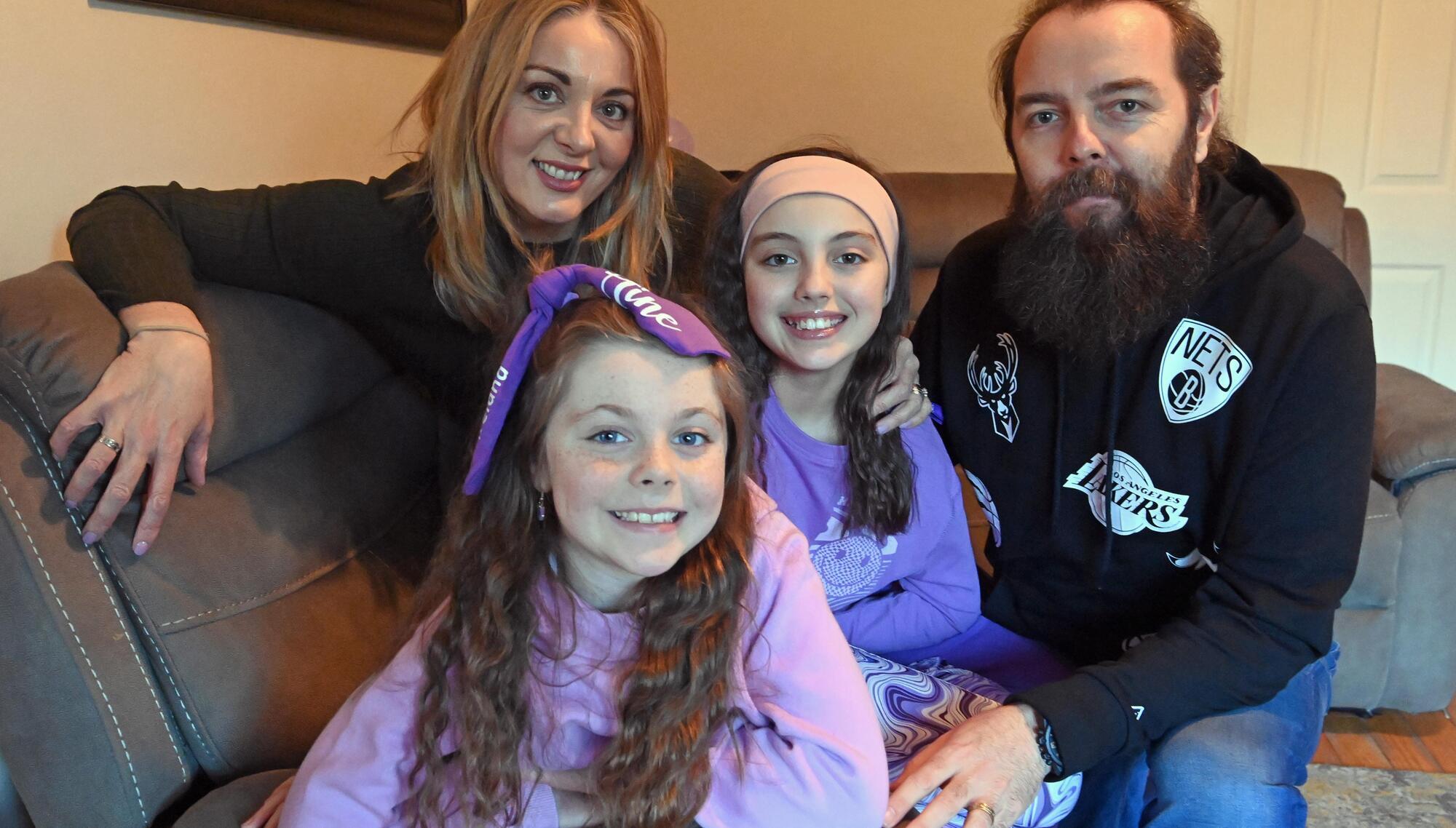
In her 24-year army career, Bernie Hart has been in hostile, difficult environments but she never felt fear until she sat by the hospital bed of her young daughter and grappled with the fact that Áine had epilepsy.
“Epilepsy was a foreign word to me. I was scared. It was something I couldn’t fix. It was the child’s brain. It was something I didn’t know anything about,” says the Douglas-based mum of two.
As a sergeant in the army, Bernie has seen some difficult things. “I’m tough and strong, but this was the first time in my life I was scared.
Everything else had been coping with uncomfortable situations. This was me, sitting on a hospital bed, looking at my child. I was terrified,” says Bernie, recalling that harrowing time two years ago.
Just days earlier, life had been busy and ordinary and wonderful for Bernie, husband Karl, and their two daughters, Áine, now 7, and Caitlin, 11.
Áine was “a very strong child” who had hit every milestone. “She was thriving,” says Bernie, recalling how on that night in January 2022, everything was as usual.
“We did our bedtime routine. It was a Monday evening. So it was up the stairs, clean their teeth, into PJs, into bed and a story. The only difference was Áine asked if she could sleep in the same bed as Caitlin.”
The girls settled quickly, but sometime later, watching TV downstairs, Bernie and Karl heard a sound like a cough or calling out. “We went up and checked and the two were asleep.”
An hour later, checking on the girls before they themselves went to bed, Bernie found Áine unresponsive but shaking violently.
“I saw her shaking, deliberately, aggressively. I called her name, but she didn’t answer. I’d never seen a seizure in my life. I didn’t even have a word for it. I roared for Karl, and he pulled her out of the bed.”
In the stronger light of the landing, Bernie could see how serious things were. “Áine was very rigid, a green/white colour, her lips were blue.”
On the phone with the first responder, waiting for the ambulance, Bernie was urged to administer CPR. Thankful for her army training — and that she had done a first aid course with Douglas GAA just two weeks earlier — she managed to do so.
“But physically Áine was getting worse. She started choking furiously. Karl put her in the recovery position, her head back and her airway seemed to clear. She didn’t come out of the seizure; she was still staring, but her colour was better, she wasn’t as rigid and the choking stopped.”
At CUH emergency department, Bernie recalls medics “doing every test and asking every question”. It took Áine six hours to come fully out of the episode.
“Her muscles were very sore, her eyesight poor. She was disorientated, hugely physically exhausted. But we were very lucky we still had her.”
‘Nobody mentioned epilepsy’
Under paediatric supervision, Áine had further tests. “We worried we’d leave hospital with no answers. Nobody mentioned epilepsy but the paediatrician said ‘it could go down the neuro route’.”
Three days later following an EEG (electroencephalogram), the neurologist confirmed Áine had epilepsy. MRI would determine the type and whether there had been structural damage to her brain.
“I didn’t take anything in after the word ‘epilepsy’,” recalls Bernie, who says the family were assigned a ‘point of contact’ nurse. “That nurse was beautiful. She said ‘don’t take out your phone, don’t Google’.
The diagnosis gave Bernie more “questions than answers”.
“I couldn’t accept or understand that I’d put Áine to bed that night, in my eyes, perfect, and now, three days later, she had an unpredictable disability.”
Epilepsy is one of the most common neurological conditions in Ireland, affecting more than 45,000 people countrywide, compared with approximately 12,000 people living with Parkinson’s and upwards of 9,000 living with MS.
“The highest rates of new diagnosis in children are in the first 10 years of life,” says Dr Daniel Costello, consultant neurologist at CUH, who has an interest in epilepsy.
He emphasises the high incidence after age 60. “It is under-recognised that epilepsy is very common in older adults.”
Dr Costello says epilepsy is not one condition but a group of conditions where people are predisposed to having epileptic seizures.
“A seizure is an event, an electrical problem in the brain, typically lasting two minutes or less and producing signs/symptoms in the person. This could be convulsions — stiffening, shaking — [although] many seizures aren’t associated with convulsions but with transient disorientation and confusion.”
Epilepsy can be focal (starts in part of the brain) or generalised (both sides of brain involved). In half of cases, there is no known cause — the person has no illness, disease, or damage to explain their epilepsy.
Some causes are structural, for example, genetic abnormalities or developmental problems in the brain like malformed veins or areas that haven’t developed normally.
Genetic factors can be unique to the person or hereditary. Many people with epilepsy have no family history though some epilepsies are more common in some families.
“In general, in many children, seizures will settle over time. But there are children whose seizures remain active throughout life,” says Dr Costello, explaining that medication is the mainstay of treatment for most people, though lifestyle modification has an important role too.
Types of seizures
Áine has focal epilepsy with tonic-clonic seizures. “They’re classed as the most severe type of seizure. They’re quite aggressive. And over the past two years she has got other types of seizures as well,” says Bernie.
On the drug Keppra for over 18 months until she moved to a different meds regimen last September, Bernie says.
“The medication kept Áine out of hospital but she still had seizures, though not as dangerous as the one she had in January 2022. But every time we saw the neurologist the medicine had to be adjusted and upped.”
On an oral tablet now — Tegretol — Áine is doing very well, says Bernie, adding that the family have come a long way since the early days. “Bringing her home from hospital, we felt so vulnerable.”
Support organisation Epilepsy Ireland “was the lifeline we needed”, she says. The charity and its local community resource officer have given vital support.
“They took every question, every wonder, out of our mind — they gave us sound, plain information. They trained the teachers who’d be around Áine, including in how to administer the medication, which they also did for us and for anyone who’d be around her.”
But life has changed — for Áine and her family. “Áine’s on a monitor no matter where she is. She has co-slept with Karl and me for the past two years. We take it in turns to sleep with her. If there’s any event coming up, we prepare three weeks beforehand so her sleep patterns are meticulous and her food bang on.
“Playdates in someone else’s house are a no-no. They’re in our house with no massive excitement — [just activities like] colouring.”
Áine loves fashion, Liverpool, and GAA. “She wanted to go back to camogie and football,” says Bernie, who was nervous about this.
“But the neurologist said you can’t bubble-wrap a child with epilepsy, especially Áine who’s so full of life, of wonder, of ability. It gave me confidence. I trusted the medication and the neurologist’s advice — and I listened to my child. I decided to let her play sports, let her run in the field with her friends.
“Áine has taken her disability in her stride. And on a personal level, my anger, fear, and uncertainty have left because Áine has been so strong. We didn’t know how unpredictable and life-changing epilepsy would be, but we also didn’t know how we could still thrive with it. We can achieve the life we had before epilepsy — it just has to be heavily supervised. And that’s OK.
“We’re so grateful to be a family of four because things could have gone very differently for us.”
- International Epilepsy Day is on Monday, February 12. For more on epilepsy, seizure first aid, and to contact your local Epilepsy Ireland Community Resource Officer, see epilepsy.ie
CONNECT WITH US TODAY
Be the first to know the latest news and updates