Sky Matters: Voyager 1 spacecraft nearly one light-day from home
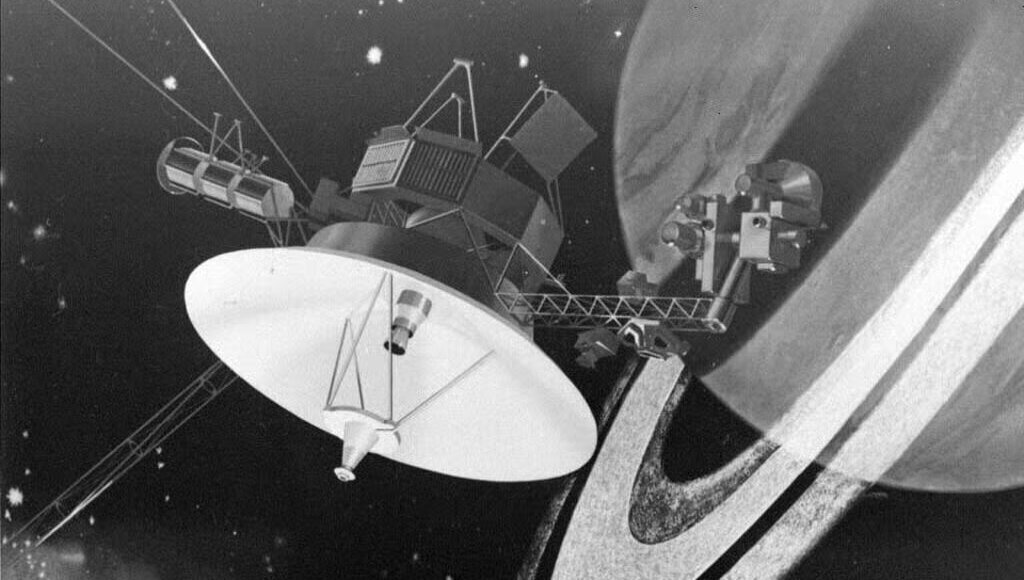
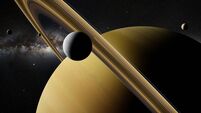
The Voyager I spacecraft is shown approaching Saturn in an artists rendering. Launched in 1977, Voyager 1 visited Jupiter and Saturn, returning images that transformed our understanding of those planets. Picture: AP
One light-day from home What will you be doing at 10.16am on Wednesday, November 18? Nothing unusual perhaps, but at that moment a small spacecraft launched nearly half a century ago will quietly achieve something extraordinary. Voyager 1 will become the first human-made object to reach a distance of one light-day from Earth.
A light-day is not a measure of time but of distance: nearly 26 billion kilometres, the distance light travels in 24 hours. Light takes just over a second to reach us from the Moon and eight minutes from the Sun. A radio message sent to Voyager now takes a full day to arrive. Even an immediate reply would take another day to reach Earth.
Launched in September 1977, Voyager 1 visited Jupiter and Saturn, returning images that transformed our understanding of those planets and their moons. It crossed into interstellar space in 2012 and continues its journey, powered by a dwindling supply of electricity generated from radioactive material. Some scientific instruments still operate, almost 50 years after launch, though engineers must carefully manage the spacecraft's diminishing power supply.
Voyager also carries a golden record containing music, natural sounds and greetings from Earth. It is a message in a bottle cast into the cosmic ocean. The chances of anyone finding it are vanishingly small, but perhaps that was never the point. It captures our desire to explore, understand and, one day, be understood. Among its contents are greetings in 55 languages and music from different cultures, a small portrait of the planet that sent it.
Back on Earth, November offers plenty to enjoy overhead. The longer evenings are welcome to stargazers, provided the Irish clouds cooperate!
Saturn remains prominent in the southern evening sky, its steady yellowish light easy to recognise. Its magnificent rings, almost edge-on last year, are gradually opening up again. A small telescope or even binoculars (and a steady hand) will reveal them.
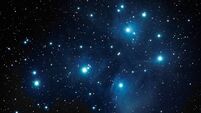
Look east and you will find the Pleiades or Seven Sisters. Higher in the sky, the W-shaped Cassiopeia points the way towards the Andromeda Galaxy. Under dark skies, you may glimpse it with the naked eye. Its light has travelled for 2.5 million years to reach us and it’s the farthest object visible to the human eye.
The morning sky brings another treat. Venus is returning as a brilliant morning star. Before dawn on November 16, look southeast for Mars and Jupiter appearing close together, just over one degree apart. Jupiter will be much brighter, with reddish Mars beside it. No telescope is needed.
November also brings the Taurid and Leonid meteor showers. The Taurids, active in early and mid-November, can produce spectacular fireballs, while the Leonids peak around November 17–18. Choose a dark location, look up after midnight and give your eyes time to adjust.
The Full Moon on November 24 is a so-called supermoon, something we have discussed many times in this column. Worth a look, but so is every “ordinary” Full Moon.
But return, for a moment, to Voyager. Imagine sitting on the spacecraft and looking forwards. The planets and moons that once filled its cameras are far behind, no longer visible as the magnificent worlds it explored. Yet the stars, constellations and distant galaxies visible ahead would appear almost exactly as they do from Earth.
That is the real wonder of a light-day, and a reminder of how deceptive distances can be. It is an immense distance by human standards, but scarcely alters our view of the universe. The nearest star beyond the Sun is more than four light-years away, over 1,500 times farther than Voyager is from us.
After nearly 50 years travelling at tens of thousands of kilometres per hour, Voyager has ventured farther than anything we have ever built. Yet, on the scale of the cosmos, it has scarcely moved at all. Another reminder to us of the fragility, yet privilege, of our existence.

CONNECT WITH US TODAY



Be the first to know the latest news and updates