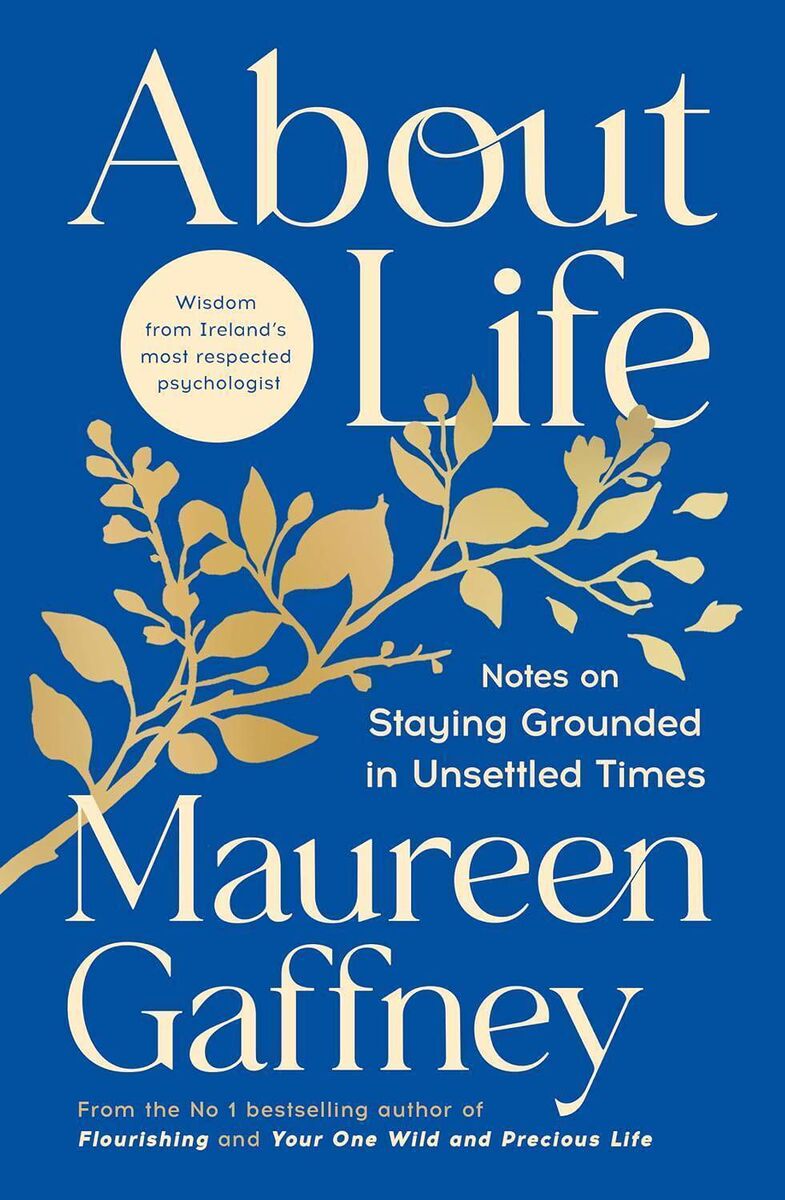
Book review: Exploration of centrality of human connection in 'About Life'
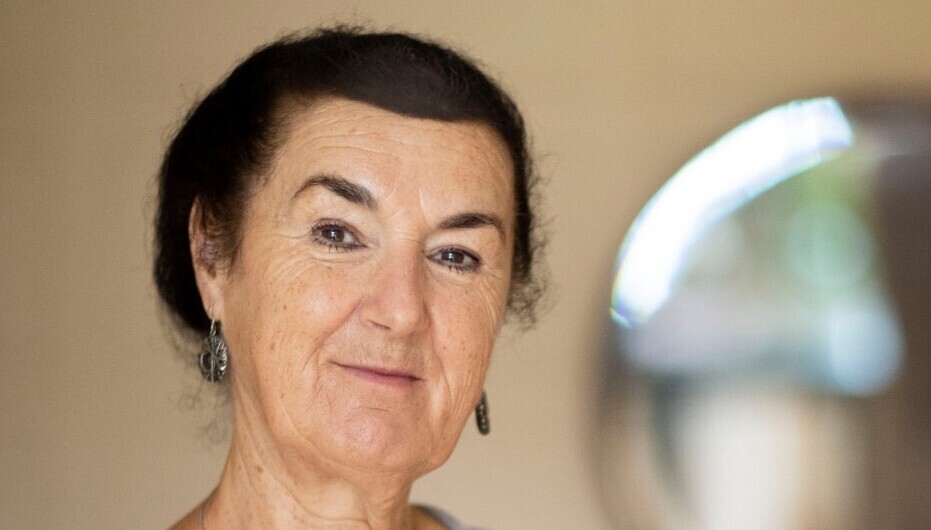
In her latest book we encounter a very human Maureen Gaffney where her lifetime of scholarship and clinical work, combined with her personal struggles, are offered with an endearing humility
Over the years Maureen Gaffney has skilfully combined science and scholarship with her well-tuned ability to convey psychological knowledge with ease and warmth, and free of jargon. Picture: Tom Honan

Over the years Maureen Gaffney has skilfully combined science and scholarship with her well-tuned ability to convey psychological knowledge with ease and warmth, and free of jargon. Picture: Tom Honan

  • About Life 
  • Maureen Gaffney
  • Sandycove, €17.99

Maureen Gaffney has been a steadfast voice of psychology for decades. A trailblazer, she broke boundaries and she broke rules. 

She made a notable contribution to the psychological maturity of a people who once were restricted to the impoverished vocabulary of religion to put language on their inner lives. 

She did all this in a male-dominated society, where clinical, academic, and media worlds were at the very least inhospitable, if not hostile, to women.

Gaffney’s approach over the decades has been marked by two things: rigour and warmth — uncommon bedfellows. 

She skilfully combined science and scholarship with her well-tuned ability to convey psychological knowledge with ease and warmth, and free of jargon. She brings all of this and more to her latest book.

Like any good therapist, Gaffney remained, over the decades, somewhat reserved, some might say even aloof. 

In About Life, that changes; we encounter a very human Gaffney in these pages, her lifetime of scholarship and clinical work combined with her personal struggles. Less scientific sources of inspiration are generously offered with an endearing humility.

There is a term therapists use called “appropriate self-disclosure” — this is when the therapist reveals something of themselves to their client in order to help them. About Life is Gaffney at her most generous in this regard — she is at her most self-disclosing.

This results in a different tonality compared to her other previous publications. It does not lack the precise, evidence-based, empirical focus that we have come to expect from her, but it has a range and register that is different.

There is a striking reveal in About Life, a very considered self-disclosure. Gaffney discloses an influence on her that may surprise some — the medieval Dominican monk and mystic Meister Eckhart. 

She describes attending multiple trainings influenced by the work of Meister Eckhart, where spiritual traditions and self-development were explored in tandem.

Such an orientation is in contrast to much of contemporary psychology that has been impoverished by its desire to be seen only as a science, reliant on evidence, empirical studies, randomised controlled trials, and replication studies.

Gaffney is well versed in empiricism; her previous publications attest to that.

About Life reveals Gaffney’s reverence for mystery. Along with that comes a kind of rewilding of psychology or, at the very least, a return to a psychology that can also embrace all the things that can’t be counted, measured, and empirically verified. 

In this more spacious landscape, a less definitive, more playful, humble and creative psychology, Gaffney seems to dance.

Elegant and accessible structure in six sections

As we have come to expect, however, Gaffney does not lose the run of herself. She provides the reader with an elegant and accessible structure. 

This is presented in six sections, ranging from the early experiences that shape us, explaining the basic psychological mechanisms that shape our behaviour and our lives and how to live with purpose. 

Gaffney does a particularly fine job on attachment theory and stress — demonstrating her capacity to convey complex psychological information in digestible and applicable ways.

At times I found myself wondering had Gaffney overemphasised individual wellbeing and, as a result, privatised psychological wellbeing to the exclusion of the social and political determinants of psychological health. 

There is a notable absence of the evidence-based social, political, and structural inequalities that affect individual wellbeing. 

Such an overemphasis may, in part at least, be a hangover from an era of psychology that resembled and reinforced a pernicious individualism and a neoliberalism dressed up as the self-actualising human.

All of that said, there is nonetheless a through-line in this book: the centrality of human connection. The final section is explicitly given over to this. 

The words of Maya Angelou resounded as I turned the last pages of this book: “Nobody, but nobody / Can make it out here alone.”

Gaffney has again displayed her skill in expertly distilling psychological knowledge as she has done over the decades and in so doing makes a notable contribution to the psychological maturity of her native Ireland.

Her capacity to cohabit the science and the mystery is writ large in About Life and has resurrected aspects of psychology overshadowed by excessive empiricism.

BOOKS & MORE

Check out our Books Hub where you will find the latest news, reviews, features, opinions and analysis on all things books from the Irish Examiner's team of specialist writers, columnists and contributors.


More in this section

Scene & Heard

Newsletter

From music and film to books and visual art, explore the best of culture in Munster and beyond. Selected by our Arts Editor and delivered weekly.

Cookie Policy Privacy Policy Brand Safety FAQ Help Contact Us Terms and Conditions

© Examiner Echo Group Limited