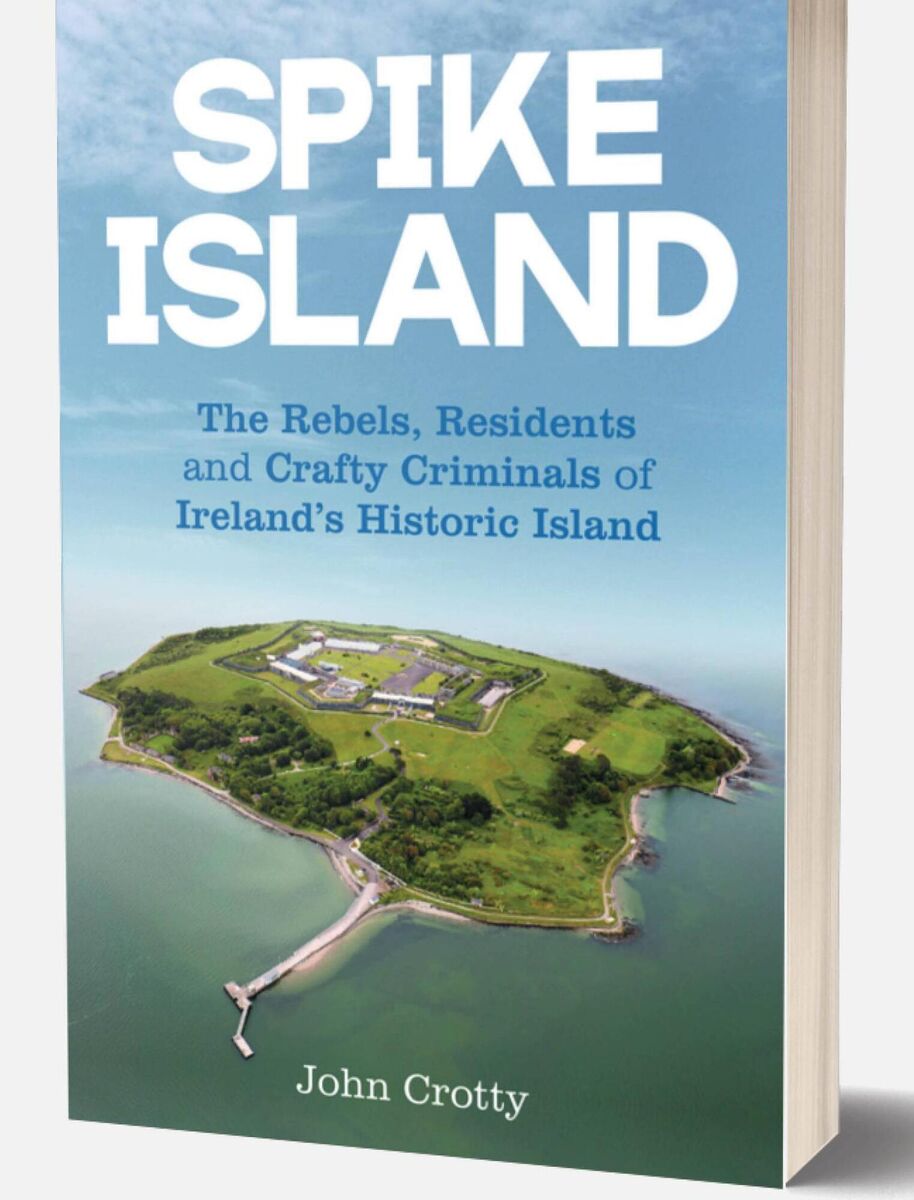
Book review: A colourful and detailed history of Spike Island

Author Crotty goes into comprehensive detail about how the island was used, and who it hosted, during our War of Independence and our Civil War
Book review: A colourful and detailed history of Spike Island

John Crotty.

  • Spike Island The Rebels, Residents and Crafty Criminals of Ireland’s Historic Island
  • John Crotty 
  • Merrion Press, €18.99

John Crotty did not lack ambition when he wrote this comprehensive history of Spike Island in Cork Harbour. His engaging book covers Ireland’s Robben Island from 9000 BC to just two decades ago, when the island prison finally closed.

In an almost grotesque irony, what was in effect a penal colony has become a place of entertainment, hosting day tours for tourists who wish to indulge a particular kind of voyeurism.

He uses it as a prism to tell far more than the story of this windswept outcrop in the Lee estuary. He goes as far back as 1427 to tell of changes in land ownership, the inevitable monks, Cromwell of course, pirates, and prisons.

He tells of General Charles Vallancey, “the Englishman who loved Ireland” who improved fortifications on the island in 1779 and installed a modest battery of 18 cannons during the American War of Independence. This was done in expectation of a French invasion.

It underlines the sweep of Crotty’s story that in the early 1940s, Irish troops on the island did not know whether they would be asked to fire on British or German troops, if they came to claim a harbour so essential to the safety of the food convoys sustaining Britain during the Second World War.

'A living death'

Between those bookends, Crotty tells the terrible stories of those assembled on the island when it was used as a departure lounge for those condemned to transportation to the Antipodes, a kind of living death unimaginable today.

He describes the island’s inhuman punishment block with its 28 dark, cold cells designed for solitary confinement. Those so punished were described by the prison chaplain, Reverend Charles Gibson, in his 1863 book Life Among Convicts, as “the men with bees in their bonnets”, which underlines the advances made in understanding and treating mental illnesses.

Those cruelties ran parallel to the island reign of “The Drunken Surgeon”, Dr Maurice Corr, who was appointed in 1852.

Addicted to a mixture of ether and “black drops” — a cocktail containing opium — Corr presided over a spectacular death rate, requiring two mass graves to bury those who died on his watch. Crotty tells us that in three years, from 1852 to 1855 that a staggering 750 prisoners died in the care of Crotty, a statistic that might be better known had the deaths not occurred during the Great Famine.

To lighten this mix, Crotty introduces us to Colonel Percy Fawcett, “unquestionably one of the most enigmatic, colourful and adventurous characters of the 20th century”.

Fawcett’s links with Spike are comparatively tentative — he lived there with his British navy father for just three years — but it is to the author’s credit that he included the character who, some believe, is the model for Spielberg’s Indiana Jones.

In 1925, Fawcett, along with his son Jack and his life-long friend Raleigh Rimell, and a number of Brazilians, went to search for a fabled lost city in the state of Mato Grosso. They were never seen or heard from again even though almost 100 lives were lost when rescue missions failed.

Crotty goes into comprehensive detail about how the island was used, and who it hosted, during our War of Independence and our Civil War. The fate of Clareman Patrick White, who was shot and killed by an over-zealous sentry when he went to retrieve a ball during a game of hurling, is particularly poignant. He tells of the great celebrations on July 11, 1938, when British troops finally left the island.

This is a well-written and researched publication, and its grand sweep makes a contribution towards forming an enlightening understanding of how our history can be seen through the lens of an important setting.

BOOKS & MORE

Check out our Books Hub where you will find the latest news, reviews, features, opinions and analysis on all things books from the Irish Examiner's team of specialist writers, columnists and contributors.


More in this section

Scene & Heard

Newsletter

From music and film to books and visual art, explore the best of culture in Munster and beyond. Selected by our Arts Editor and delivered weekly.

Cookie Policy Privacy Policy Brand Safety FAQ Help Contact Us Terms and Conditions

© Examiner Echo Group Limited