Life Hack: How to watch Wednesday’s solar eclipse — and why Munster will have the best view
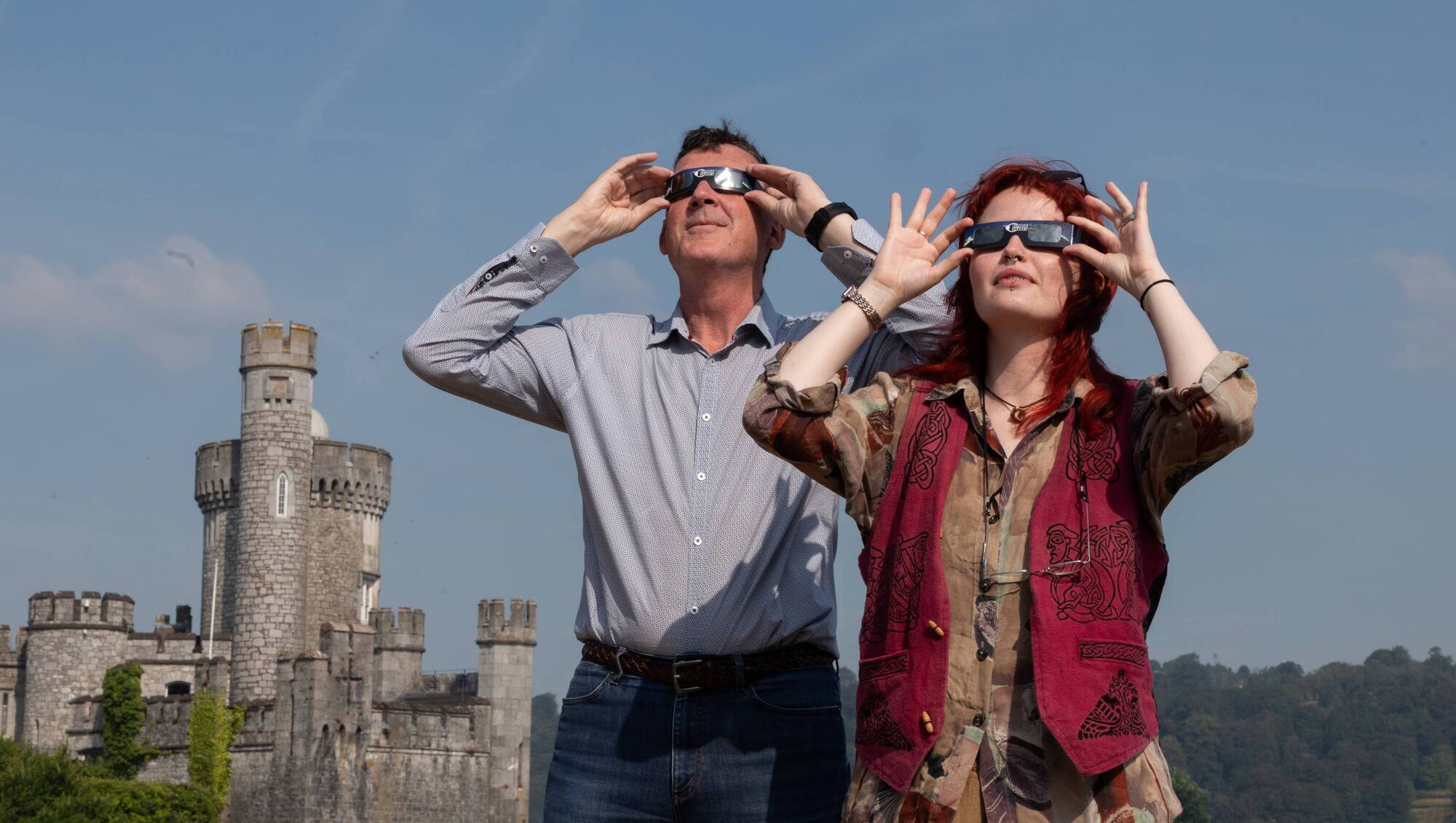
Dr Niall Smith, head of Research at Munster Technological University and head of MTU Blackrock Castle Observatory, and Caoimhe Lyons, a Mathematical Sciences and Physics graduate and science facilitator at MTU Blackrock Castle Observatory prepare for a once-in-a-generation deep partial solar eclipse on Wednesday. Picture: Darragh Kane
Read More
- Looking directly at the Sun without proper protection can cause permanent eye damage, even when most of the Sun is covered by the moon. Ordinary sunglasses do not provide sufficient protection. Never point a camera, telescope, binoculars, or mobile phone directly at the Sun without the appropriate solar filters. Doing so can damage equipment and pose a risk to eyesight.
- Anyone planning to view the eclipse directly should either use internationally certified solar eclipse glasses or make your own eclipse viewer, using cardboard and a small pin-sized hole. The cardboard projector projects an image of the Sun onto a surface, allowing you to safely observe the changing shape of the Sun as the Moon passes in front of it. Pinhole projectors are easy to make, completely safe, and a great way to get children involved in the event.
- The farther south-west you travel, the greater the percentage of the Sun that will be covered by the moon. Find a location with a clear, unobstructed view of the western horizon and try to arrive early if attending a public viewing event.
- The eclipse offers a fantastic opportunity to learn more about space science with family and friends. Many astronomy groups and observatories around Ireland will host public viewing events.
- During the eclipse, scientists will use a specially designed telescope known as E-CorMag to observe the outermost layer of the Sun’s atmosphere, called the corona. They will investigate the magnetic fields that shape this super-heated region of the solar atmosphere. The research will contribute to a better understanding of space weather and how activity on the Sun can affect technologies here on Earth.