Dr Colman Noctor: Our young people need to learn how to be carefree again
Picture: iStock
Most of the pandemic restrictions have been removed, but adjusting to the return to normal may prove more challenging than we think. Many pandemic habits have become a large part of what we do and who we are, and changing back to our pre-pandemic ways may not be as easy as flicking a switch, especially for children.
If you read any parenting advice, you are likely to come across the words ‘routine’ and ‘consistency’. This is based on American psychologist William James’s 1914 theory that repeating an action over and over in similar circumstances is crucial to habit development. Repetition is vital to becoming accustomed to a way of behaving or acting. At first, it may feel unfamiliar, which is to be expected, but over time the unfamiliarity lessens and the new way becomes the norm.
Habit formation can go deeper than just doing something repeatedly. Habitual behaviours can also create ‘cognitive pathways’ that over time become established. You may not realise it but the way you brush your teeth, dry yourself after a shower or put your socks on in the morning are almost always the same. Cognitive pathways can create automatic ways of thinking, which is more complex than just doing something a particular way.
What we do (our behaviour) also impacts what we think (our cognitive pathways), which in turn impacts how we feel (our emotions). So our pandemic habits will not simply affect what we do, they also have influenced how we think and feel.
As we readjust to the absence of social restrictions, we may be surprised to discover that we think and feel differently about the world now and it is not as easy to switch to our pre-pandemic way of seeing the world.
Let’s imagine that you and your family are attending an indoor basketball final in which one of your children is competing. Before March 2020, we would have entered the busy basketball arena and thought nothing of it, did nothing differently and felt nothing other than the pleasure of looking forward to the game.
With the events of the past two years, when we now re-enter a crowded indoor space, many of us may first check that we have our face masks, we might look for a sanitising station, then scan the room and assess the number of people and adjudicate on the capacity for maintaining safe social distance. The black and yellow markings on the floor and the warning posters on the wall will no longer be there, but they are imprinted in our minds. Our thoughts are impacted too. We might perceive the environment to be unsafe or too crowded. The lack of ventilation may make us feel fearful as we believe we are in danger.
Our emotional state is also different. The fact that a person next to us has their nose peeping over their mask makes us angry. We may be thinking about the extended family gathering planned for the following day and wondering whether we are being reckless by attending this event. Overall the whole experience bears little resemblance to the same event pre-March 2020.
Many of us can relate to this new way of being and it has become almost second nature to us. This is also true for children, especially for younger children. Without a baseline of pre-pandemic life, Covid social restrictions became their norm.
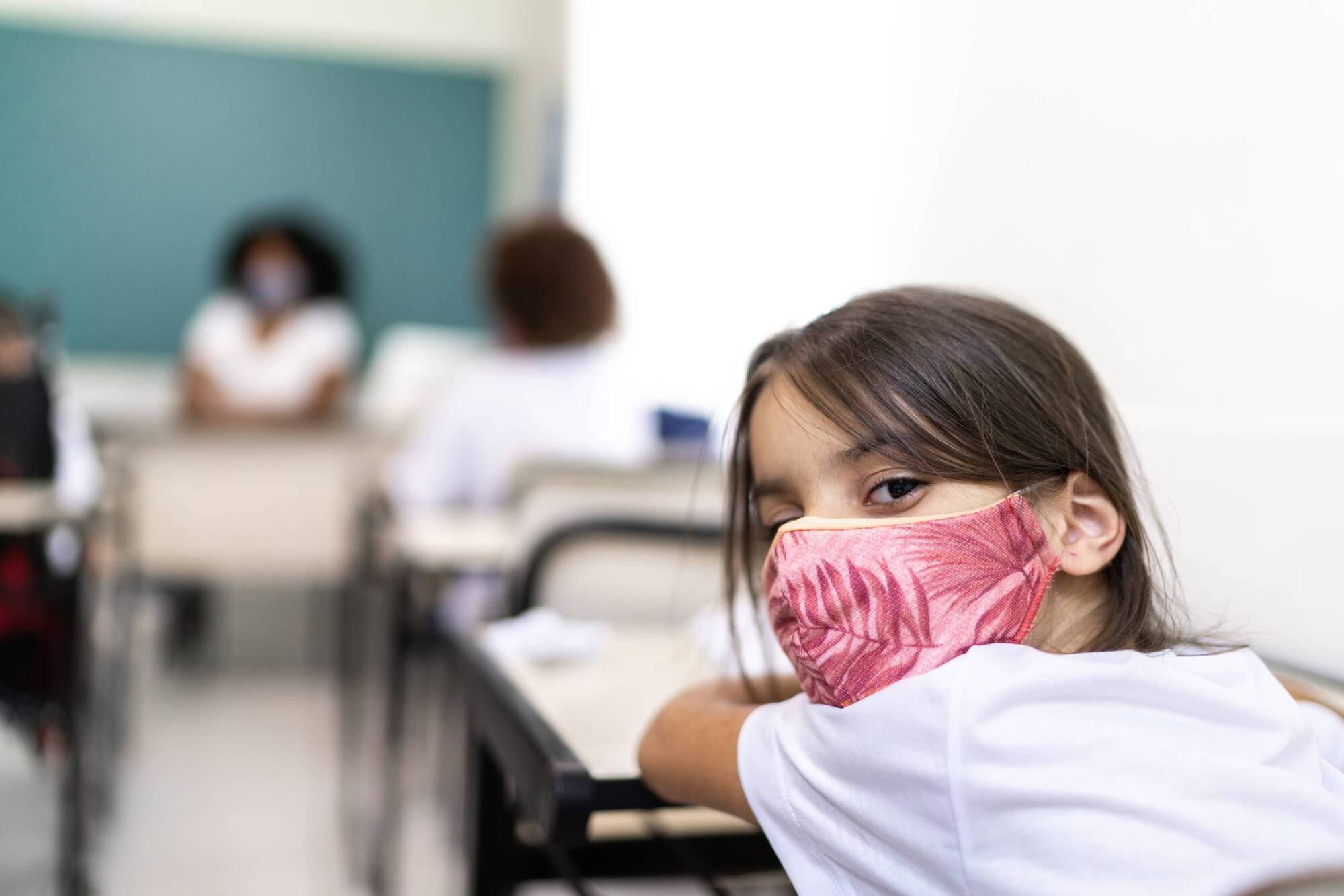
For many, their core developmental progress occurred in a time of anxiety, and this may have affected their sense of safety and influenced the way they see the world and themselves. Children have been constantly reminded to sanitise their hands, cough in their elbows and wear face coverings, which carries with it the message that they are vectors of disease and suggests they could inadvertently cause harm to older and vulnerable people. This is not just a behaviour, this is a mindset.
Fantasy and the wonder of magical thinking, a protective factor in childhood, has been contaminated by Covid. Feeling omnipotent through believing that you are a princess or a superhero or being convinced that you will be a famous singer or footballer is a necessary part of childhood. It protects children from the harsher realities of life, responsibilities and disappointment. The transition from imaginary fantasy to reality needs to be gradual and ideally not involve young children becoming accustomed to PCR and antigen tests or seeing themselves as vectors of disease.
When I listened to Taoiseach Michéal Martin describing the dramatic loosening of restrictions last Friday, my first question was similar to when I hear a budget speech. ‘What is in this for me?’. As it transpires, not a lot. I go out to a pub once a year and the last time I was in a nightclub, the national anthem was played at the night's end.
Then I thought about the children and young people whom I treat. What is in it for them? The realisation was similar. These new changes are not going to impact schoolgoing children or teenagers much. The mask-wearing and safety mitigations of pods etc in schools will remain in place, and questions regarding the state exams remain unanswered. I understand the rationale for the mitigation measures and the need to wait for the vaccine rollout for the under 11s and the booster for the older teens, but it still seems unfair. As the adults celebrate their newfound freedoms, children and young people are still being curtailed.
We need to create non-pandemic experiences so young people can learn to be carefree again. As well as injecting vaccines into their arms we need to inject fun into their lives. What our children need more than anything else now is hope, connection, meaning and purpose, and have put these things on hold for long enough.
We need to find a way in which our children can start living normally again. Being well is more than just the absence of disease and being alive is more than just the absence of death. We have repeatedly claimed to be ‘all in this together’ now we need to make sure children and young people are not left with the belief that they are ‘in this forever’.
- Dr Colman Noctor is a child psychotherapist


CONNECT WITH US TODAY



Be the first to know the latest news and updates