Darina Allen: Recipes to get your kids cooking
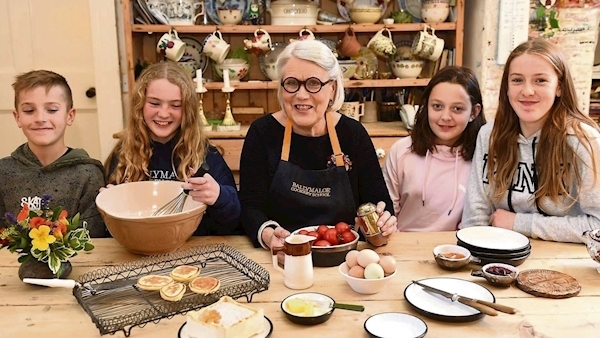
"It is absolutely vital to feed our children well. Their energy, vitality, and ability to concentrate all depends on the quality of the food we feed them. When I say ‘well’ I mean wholesome, nourishing naturally produced food, free of chemicals, additives and artificial colourings.
"Kids’ palettes are very sensitive and can pick up nuances of flavour or lack of much more acutely then we often can. I have observed this many times over with my own children and grandchildren.
"Good food habits are unquestionably laid down when children are young. If they are introduced early to a variety of foods, they seem to enjoy them as the norm.
"You can control their diet well when they are little but it becomes more of a challenge when they go to school. It’s a huge help to parents if the school has a healthy eating policy and refuse to allow fizzy drinks and bars into school lunch.
"Nonetheless, once they go to school they’ll get to taste all kinds of foods that include flavours specially formulated to stimulate a craving. If you have managed to foster good eating habits when they are little you are likely to experience less difficulty. I’m quite sure my grandchildren would tuck into a well-known brand of burger as good as the rest, but it’s a rare treat.
"Nourishing food does not have to be expensive, it is cheaper and tastes better when it is in season.”
■ Saturday 19th June, 2010
RACHEL’S DROP SCONES

Sift the flour and baking powder into a bowl, add the sugar and salt and stir to mix. Make a well in the centre, crack in the egg and whisk, gradually drawing in the flour from the edge.
Add the milk gradually, whisking all the time, to form a smooth batter.
Lightly grease a frying pan and warm it over a moderate heat. Drop 3 tablespoons (3 American tablespoons + 3 teaspoons) of the batter into the pan, keeping well apart so they don’t stick together. Cook for about 2 minutes or until bubbles appear on the surface and begin to burst and the drop scones are golden underneath, then flip them over and cook on the other side for a minute or until golden on this side as well.
Remove from the pan and serve warm with butter and jam, apple jelly, lemon curd or if you are like my children, chocolate spread!
(If you wish, wrap the drop scones in a clean tea towel to keep warm while you make the rest.)
GREAT GRANDMOTHER’S VICTORIA SPONGE
A buttery sponge cake was standard fare to serve with afternoon tea in my grandmother’s house at Donoghmore. When it was taken out of the oven of the Aga it was cooled on a wire rack by the window in the back kitchens. Thick yellow cream spooned off the top of the milk in the dairy was whipped and as soon as the cake was cool it was sandwiched together with homemade jam from the raspberries picked at the top of the haggard.

Preheat the oven to 180˚C/ gas mark 4. Grease and flour the tins and line the base of each with a round of greaseproof paper. Cream the butter and gradually add the caster sugar, beat until soft and light and quite pale in colour. Add the eggs one at a time and beat well between each
addition. (If the butter and sugar are not creamed properly and if you add the eggs too fast, the mixture will curdle, resulting in a cake with a heavier texture). Sieve the flour and baking powder and stir in gradually.
Mix all together lightly and add 1 tablespoon of milk to moisten.
Divide the mixture evenly between the two tins, hollowing it slightly in the centre. bake for 20-25 minutes or until cooked. Turn out onto a wire tray and allow to cool.
Sanwhich together with homemade raspberry jam and whipped cream. Sprinkle with sieved caster sugar. Serve on an old fashioned plate with a doyley.
AUNT ALICE’S RASPBERRY JAM
Raspberry jam is the easiest and quickest of all jams to make, and one of the most delicious. Loganberries, Boysenberries or Tayberries may also be used in this recipe.
Wash, dry and sterilise the jars in a moderate oven 180˚C/gas mark 4, for 15 minutes. Heat the sugar in a moderate oven for 5-10 minutes.
Put the raspberries into a wide stainless steel saucepan and cook for 3-4 minutes until the juice begins to run, then add the hot sugar and stir over a gentle heat until fully dissolved. Increase the heat and boil steadily for about five minutes, stirring frequently.
Test for a set by putting about a teaspoon of jam on a cold plate, leaving it for a few minutes in a cool place. It should wrinkle when pressed with a finger. Remove from the heat immediately.
Skim and pour into sterilised jam jars. Cover immediately. Hide the jam in a cool place or else put on a shelf in your kitchen so you can feel great every time you look at it! Anyway, it will be so delicious it won’t last long!
See in the dark soup
This soup may be served either hot or cold, don’t hesitate to put in a good pinch of sugar, it brings up the flavour.

Melt the butter and when it foams add the chopped vegetables, season with salt and freshly ground pepper and sugar.
Add a sprig of mint, cover with butter paper (to retain the steam) and a tight fitting lid.
Leave to sweat gently on a low heat for about 10 minutes. Remove the lid, add the stock and boil until the vegetables are soft. Pour the soup into the liquidiser. Add three teaspoons of freshly chopped mint, purée until smooth.
Add a little creamy milk if necessary. Taste and adjust seasoning Garnish with a swirl of lightly whipped cream or crème fraîche and a sprig of fresh mint.
Darina says...
“Some of you at least, will have heard me on my hobby horse about how our generation and the one before us has failed our children by letting them out of our houses without teaching them the basic life skills to feed themselves properly.
"It’s all very fine having degrees, masters and PhDs but one also needs to be able to scramble a few eggs or whip up a spontaneous meal for a couple of friends with a few inexpensive ingredients.
"There is no greater joy, that’s how bonds are formed and what memories are made of. If you can’t cook you simply cannot feed yourself or your family properly. It’s not rocket science.
"You don’t need to be a super chef – all that’s needed is a bit of basic kitchen kit and a few basic techniques and a few basic recipes that really work.”
■ Saturday 25th March, 2012
“What we put in our children’s mouths is much more important than what we put on their bodies or in their brains. In fact it is increasingly obvious that what they eat affects not only their physical growth and immune system but their behaviour and ability to concentrate.”
■ Saturday 4th September 2005
Mac and cheese
Macaroni cheese is one of my children’s favourite supper dishes. We often add some cubes of cooked bacon or ham to the sauce with the cooked macaroni. It also incorporates several techniques how to grate cheese, make roux and a basic béchamel white sauce which can be used as a basis for many other recipes.

Bring a large pot of water to the boil, add the salt. Sprinkle in the macaroni and stir to make sure it doesn’t stick together. Cook until just soft, 10 to 15 minutes drain well.
Meanwhile, melt the butter, add in the flour and cook on a medium heat, stirring occasionally for 1-2 minutes. Remove from the heat. Whisk in the milk gradually; bring back to the boil, stirring all the time.
Add the mustard, parsley if using and cheese, season with salt and freshly ground pepper to taste. Add the cooked macaroni, bring back to the boil, taste, correct seasoning and serve immediately.
Macaroni cheese reheats very successfully provided the pasta is not overcooked in the first place.
Turn into a pie dish, sprinkle grated cheese over the top. Reheat in a heated moderate oven: 180˚C/Gas mark 4 for 15-20 minutes. It is very good served with cold meat particularly ham.
Toad in the hole
This brilliant recipe can be used for a savoury or sweet filling. Kids love making their own sausages but of course you can buy tasty cocktail sausages instead.

First make the batter. Sieve the flour into a bowl, make a well in the centre and drop in the lightly beaten eggs.
Using a small whisk or wooden spoon, stir continuously, gradually drawing in flour from the sides, adding the milk in a steady stream at the same time.
When all the flour has been incorporated, whisk in the remainder of the milk and the cool melted butter. Allow to stand while you cook the sausages in a very little oil in a frying pan until pale golden on all sides.
Grease hot, deep patty tins with oil and half fill with the batter. Stick a cocktail sausage into each and bake in a preheated oven 230C/450F/ gas mark 8, for 20 minutes approx. Alternatively, put the sausages and their cooking fat into a small roasting tin.
Heat on the stove for a few seconds and when it begins to sizzle, pour batter over the sausages. Bake in a pre-heated oven as described for 20-25 minutes or until well risen and crisp. Sprinkle with chopped parsley and serve.
Carrot, coconut and sultana muffins
A lovely recipe which we have adapted from a super little book called Grow It Cook It written by Amanda Grant published by Rhyland Peters and Small.
Heat the oven to 180C/gas mark 4. Wash, peel and grate the carrots finely. Crack the eggs into a large bowl, whisk with a whisk until lightly beaten.
Add in the sugar and continue to whisk until light and creamy. Gradually add in the oil whisking all the time. Mix the flour, mixed spice, coconut, sultanas and carrots.
Then stir gradually into the base mixture until it is well incorporated. Use a tablespoon to divide the mixture as evenly as you can between the muffin cases.
Bake in the heated oven for 15-20 minutes or until firm and golden. Remove from the oven with oven gloves.
Cool the muffins on a wire rack. They are delicious as they are but even yummier with some cream cheese icing on top.
Mix all the ingredients together and spread over the top of the carrot muffins.
Sprinkle with toasted flaked almonds or pumpkin seeds, crystallised flowers if you fancy.