Meet the data-driven tech start-ups paving a greener future for farming
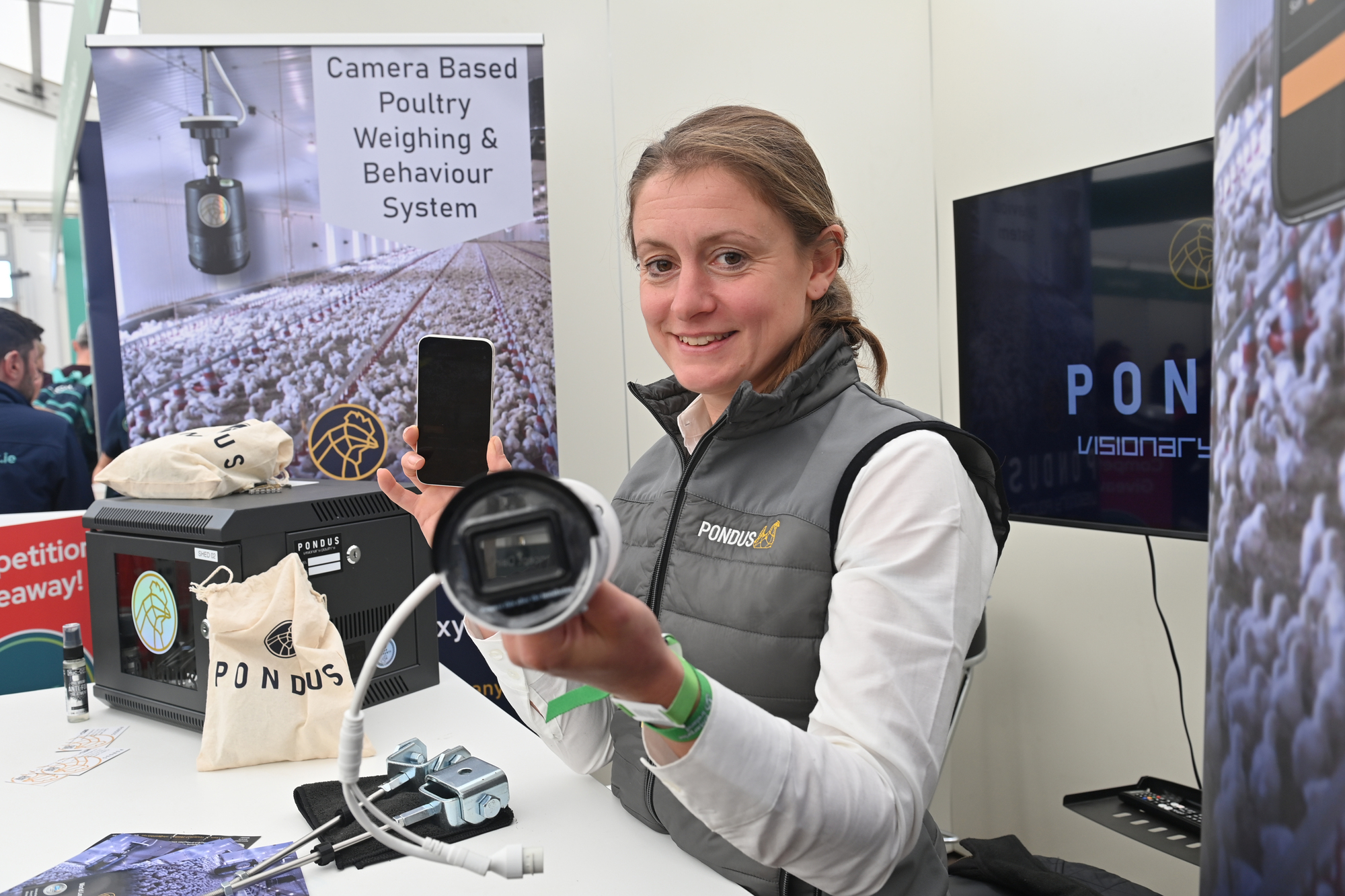
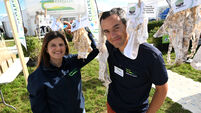
Claire Lewis, CEO and Founder of Pondus, at the the National Ploughing Championships at Ratheniska, Co Laois. Picture Dan Linehan
A delve through the Enterprise Ireland Innovation Arena is an essential part of any visit to 'the Ploughing' for me.
The competition recognises innovative and cutting-edge products and services from agri-tech entrepreneurs who are delivering forward-thinking solutions to address some of the toughest global challenges.
You didn't have to go too far to see that this year there was a notable trend towards innovations harnessing digital technologies and data-driven solutions to enhance efficiencies on-farm and improve sustainability across the wider industry.
Pondus is the type of technology truly capable of transforming an industry. It boasts a deep-tech camera-based weighing system for poultry farms designed to reduce labour for humans and stress for birds – while even being more accurate than manual weighting and sampling.
Founder and chief executive Claire Lewis told the : “It uses artificial intelligence and machine learning to weigh and carry out behaviour analysis of poultry.
“The three main benefits are labour saving and reducing biosecurity risk, and also producing more representative data.
“in the poultry industry, we tend to hand weigh – and you might weigh 50 birds a week, whereas, with this technology, we can weigh 5,000 a day.
The system also has massive potential benefits from a biosecurity perspective, which is critical given the effect of Avian influenza on poultry flocks across the UK and Ireland over the last two years.
“You can see a lot and do a lot without actually having to be on-site or in the shed," Lewis adds, explaining the technology uses a “very clever, very large” algorithm, which Lewis explained took four years to develop.
She’s brought her experience on her own farm in Northamptonshire and working in agri supplies, nutrition, and carbon footprinting as well as further down the agri-food supply chain with retailers.
A set, consisting of a communications box and five cameras, costs £3,200 (approx. €3,670), and will typically cover sheds up to 80x20m or 24x100m.
“It tends to work out at around a camera per 10,000 birds,” she said, adding that the system is fully scalable for any size of operation.
“One of the biggest stressors for birds is handling them – they don’t like it and will flap about. Stress on birds causes a lot of problems, so if you can take that out, you can improve other aspects of the business too.”
Lewis said she is also working to develop algorithms to alert flock keepers of certain behaviours, such as huddling, feeder and drinker and heat stress.
The software can track performance through daily KPIs, target weights and CV% - the Coefficient of Variation, which is a measurement of how close the bird weights are to the average flock body weight.
Milk tanker logistics firm Optahaul’s software collates and maps out the most efficient and cost and carbon-efficient routes for lorry drivers.
Co-founder Gary Gallagher said: “We are helping the dairy industry to reduce transport costs, fuel costs and vehicle greenhouse gas emissions.”
“And they have to do that every day or every second day. You can’t leave a note to say the farmer wasn’t in – the milk must be collected. So we help them to automate that complex task. We take in all the data – thousands of data points and our system creates the most cost-effective route plan.”
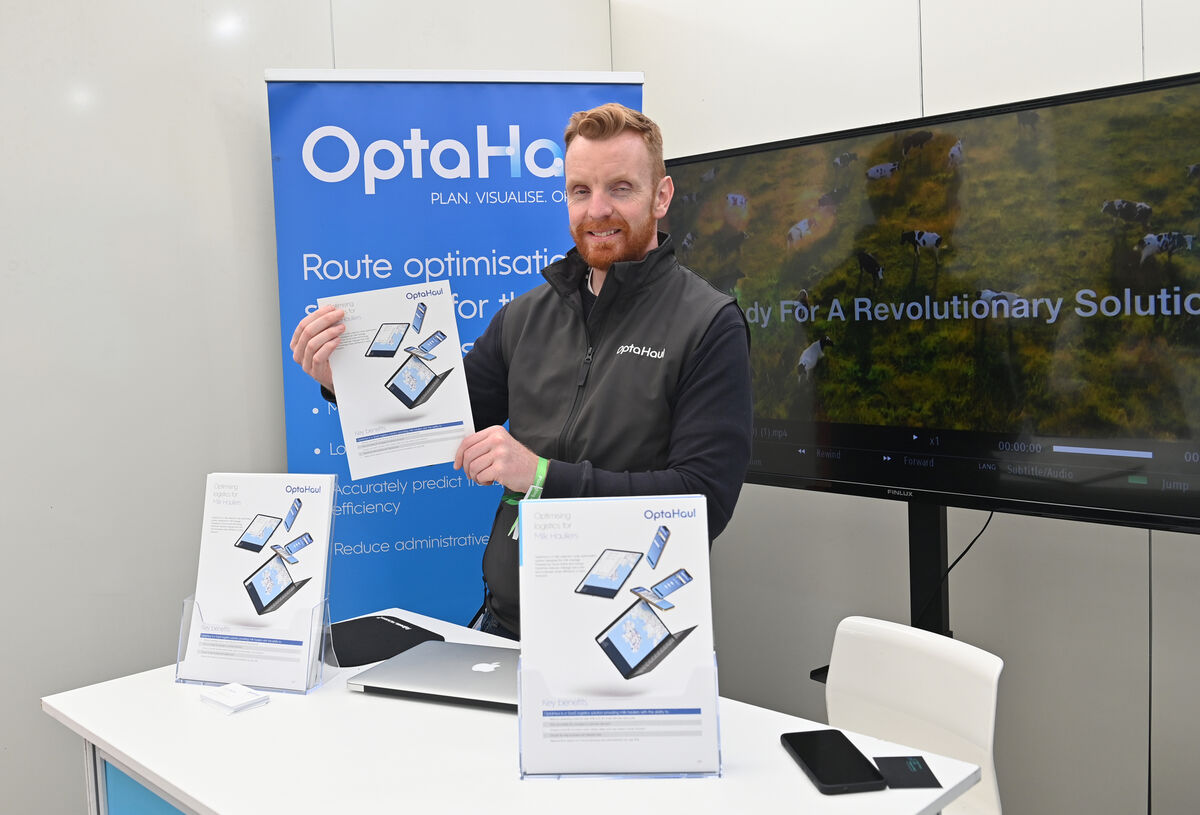
It's estimated there are 50-60 million km a year travelled transporting milk from farm to factory.
“That generates around 50 or 60,000t of CO2 and our system and help to reduce those numbers by 5-20%. Not only are we reducing transport costs but we are also reducing carbon emissions as well, which can either be scope 1 emissions if the dairy co-ops own their own trucks or scope 3 if they are using third-party hauliers.”
Gallagher, who is from the Midlands and has a background in tech rather than farming, said the opportunity was driven by demand from day one.
“My first customer came to me in my previous job and asked me to build a solution for them because they couldn’t find anything on the market which could do this. After that, we realised there were other companies we could help through this technology," he said.
Already, he has his sights on sales overseas.
“Our first customers were all international. We do have Irish customers too now, but we have just recently expanded into the US so that's where our focus is for growth right now.
“It’s a niche market, but it’s a big market,” Gallagher explained. “900 million tonnes of milk a year are transported from farm to factory every year across the globe.”
Agri Guardian’s safety device is designed to save lives by warning tractor drivers and those working on-farm when there are children in the yard – even when they are in your blind spot.
Kevin O’Flaherty said: “It’s an app on your phone, so if the kids have a smartphone, that’s all they need, but we also can use smartwatches for the younger ones that you mightn’t want to have a phone yet.
“James, our co-founder, has a dairy farm in Limerick, and he knows he can’t see the kids in the blind spots when he is on the tractor. So even though he might not be able to see the kids behind him in the barn, the watch is able to pick it up on the Bluetooth, and it sends him a notification to warn him that they are in the ‘danger zone’.”
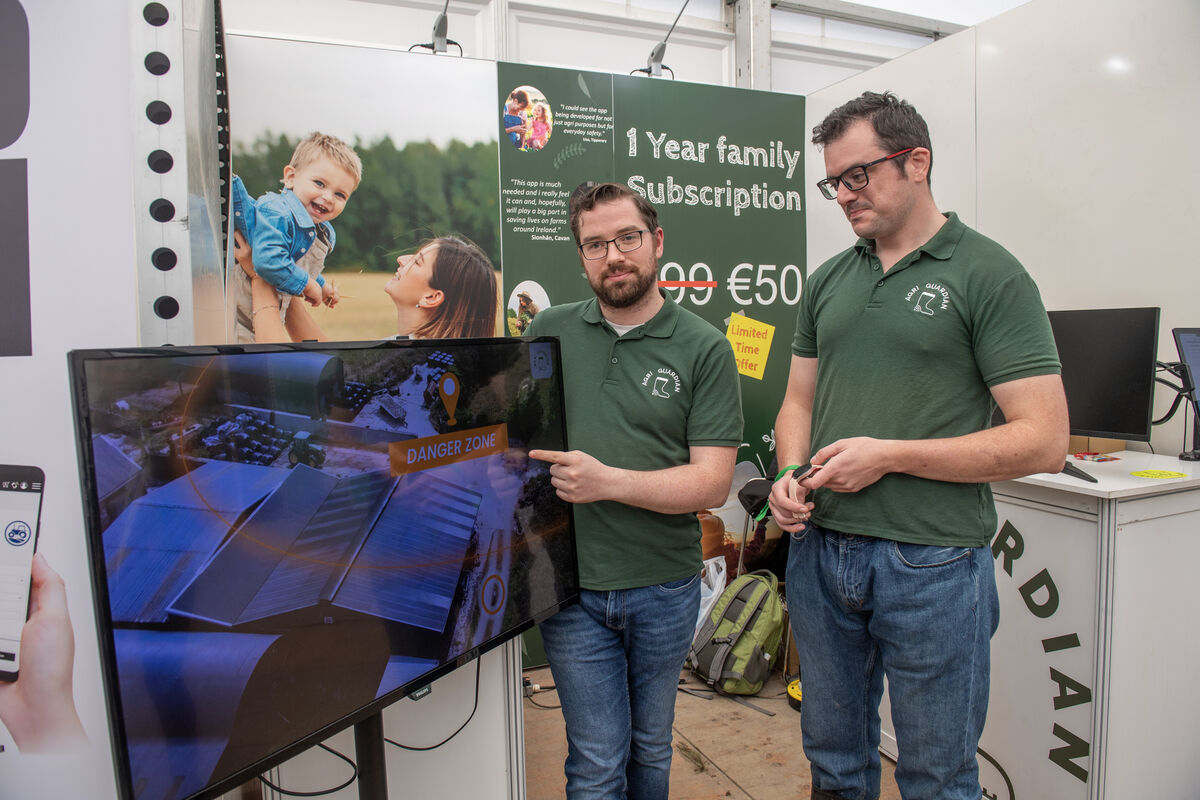
‘Danger zones’ can be set to encompass key areas on the farm – for example, near a slurry pit or a silo pit, where during the summer there might be tractors entering quickly, dumping a load, and reversing with a trailer.
The zones can also encompass the whole yard or, alternatively, can alert parents if their children go somewhere specific they’ve been told not to.
It also helps to give machine operators a helping hand to know when someone is in the yard so they can take extra care when manoeuvring.
“Children often will run straight to their parents on the farm. They don’t see the dangers around them. But if they aren’t expected to be there, that can create all kinds of dangerous situations,” he said.
It’s a tragic scenario we hear of all too frequently in farming. Even during Ploughing week, Flaherty said a visitor to the stand had told him he had recently had a near-miss with his mother, who had dementia.
“He was out on the farm, she wandered off, he was reversing the tractor, and there she was behind him. Thankfully, he spotted her in the reversing camera, but it could have easily been a different story, and there are so many others like it,” he said.
A further feature is the “anchoring” mode, which warns parents if a child strays too far from them.
“It moves with you. So, for example, if you’re at the show and have your children with you. You can say, “I’m speaking to these people, but you can go and pick up some pens from a stand nearby”.
"If they go too far and start to wander, you’ll get an alert so you know before they get too far away from you.”
But the developers are careful not to have the device tracking users.
“If you tell a 13-year-old you are live-tracking them, they will delete the app. It's only if you enter a danger zone or leave a safe area, that your location is then available. There is no point in having a safety feature no one uses,” he said.
Agri Guardian’s package costs €99 a year and will cover as many devices as you’d like to add.