Stephen Cadogan: EU dairy farmers thrown to the mercy of the markets
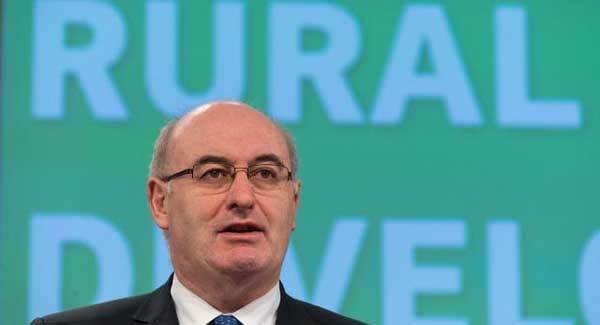
He said the dairy situation in virtually every member state is acute, and that dairy farmers must take responsibility for the continuing crisis, even if it is one not exclusively of the EU’s making, nor is it confined to Europe.
He made it clear he wants dairy farmers to cut back production, emphasising the availability of the never before used Article 222, allowing farmers who produce 85% of the EU’s milk to jointly plan their production — a choice which would previously have landed them in huge trouble with competition authorities .
There’s nothing more in in the CAP toolkit to help them, said Mr Hogan, who reminded dairy farmers it is in their hands to, if they so wish, join forces and collectively decide to reduce production.
Market fundamentals have not really changed, and an improvement in the supply-demand equation remains necessary, said Mr Hogan.
Nothing reveals how far the EU has moved away from farmer support as his effective throwing of dairy farmers to the mercy of market forces.
Unfortunately, these market forces vary hugely between the EU’s 28 member states, some of which are more exposed to the markets than others.
That’s why the milk production trend across the EU for the first quarter of this year, compared to 2015, varied from a 33% increase in Ireland to a 1% decline in Portugal.
It ranged from about 18% to 25% in the Netherlands, Belgium, Luxembourg, and Cyprus, to less than 5% growth in big producers like France and the UK.
Poland, Denmark, Italy, Germany, and Spain increased production by 7% to 10%.
Looking at those figures, one could conclude that the market has been best in Ireland, or farmers would not have expanded production.
Co-ops here have come out against the idea of voluntary milk supply reductions — even if farmers are paid 10c per litre of milk volume reduced, as suggested by ICMSA.
The thinking is that that milk supply reductions as proposed are not feasible here, and would leave our farmers behind when markets improve.
Irish exporters would have to withdraw from world markets, leaving the pitch clear for New Zealanders and Americans who can guarantee consistent supplies.
Also, €1bn of farmers’ money has been invested, and cutting back would do untold damage to the industry they have struggled to build up, according to the dairy co-ops.
So Ireland will have to ride out the market slump the best it can, aided by the impending increase in the EU intervention ceiling, rising to 350,000 tonnes.
That ceiling was doubled from 109,000 to 218,000 tonnes in April. But 73,500 tonnes was offered to public intervention in the next four weeks.
How long will the EU continue to expand its milk lake, while asking farmers to produce less?
How will other big producers react to market forces?
In percentage terms, the largest increases have been in Ireland, Cyprus, Luxembourg, Belgium and the Netherlands.
But the big tonnages come from the Netherlands and Germany, with respectively increased milk production in the first two months of 2016, compared to 2015, of 330,000 and 300,000 tonnes. Next came Poland with 140,000 tonnes extra, and Ireland with 110,000 tonnes extra.
Farmers in the Netherlands cannot expand cow numbers due to pollution fears.
So, like Ireland, they will probably not cut back. Farmers in Poland get €57 per cow from the EU for each dairy cow they keep, because their government opted for voluntary coupled support in the 2013 CAP reform.
Therefore they may be slow to cut back, like farmers in Italy, who get €31 to 39 per cow, and in Spain, getting €61 to 142 per cow.
The market will decide. And it may squeeze hardest in Germany, where the milk price collapse to as low as 20c per litre has left some farmers earning more from producing biogas from cow slurry than from milk, which sums up the state of the EU’s Common Agricultural Policy.