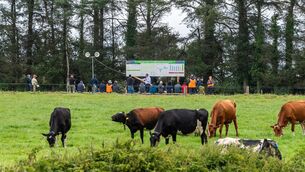
Stephen Cadogan: Only 1% of global milk output but making waves
The power of Irish dairy co-ops and of Dutch environmentalists is making waves in the global dairy industry.
Stephen Cadogan: Only 1% of global milk output but making waves

That’s the conclusion of Rabobank dairy analyst Matthew Johnson, in his recent attempt to explain what the leading global agri-bank calls “the perplexing persistence of EU milk production growth” .

All round the world, dairy industries are looking at Europe and wondering when its increasing flow of dairy products onto over-supplied markets will slow down.

Since 2014, global dairy product prices have fallen as much as 60%, and at levels last seen in 2009.

Too much supply is chasing easing demand, explained Mr Johnson.

That situation didn’t change significantly this week, with the first positive result of this year in the GDT auction boosting the selling price by only 1.4%, last Tuesday.

But the EU continues to pump out milk, in spite of the most difficult trading conditions in seven years.

European milk production registered its highest monthly increase in December, up 5.5% compared to the same month a year ago, according to new EU figures.

In December, Rabobank analysts concluded that EU production growth was dampening global dairy’s eventual recovery.

Now, Mr Johnson has had a closer look, and calculated that the EU-28 produced 3.1m tonnes more milk than it did in 2014: The equivalent of Austria’s entire production.

But Austria had little to do with it.

Instead, almost half of the extra milk came from two member states, Ireland and the Netherlands.

A further 25% of the extra milk was shared by the UK, Poland, and France.

With milk quotas ending, some farmers across the EU looked to expand production.

Their increasing production maintained their cash flow, even while global dairy product prices fell.

And some of their increased production was soaked up by export markets, because the fall of the euro versus the US dollar allowed European milk processors to grow exports during 2015, despite a Russian embargo on EU dairy products,

But Ireland and the Netherlands are special cases.

Matthew Johnson explains that Irish milk prices fell during 2015, but Irish co-ops supported their farmer members with milk price top-ups totalling almost €100m during 2015.

In the Netherlands, there are ongoing national negotiations on regulations limiting phosphates in the soil, and farmers have kept their dairy herd numbers as high as possible, producing more milk as a result.

They want their herds as big as possible ahead of a production “freeze” by an expected environmental agreement.

And Ireland?

April-to-December milk output was up 16.2% on the same period in 2015, November production alone was up 46%, and January production was up 19.5%.

But Mr Johnson of Rabobank poses the question: How much longer can Irish co-ops try to support milk prices?

Support from some of them will reduce, as their cash reserves run low, he says.

At Ireland’s largest farmer-owned dairy co-op, Dairygold, chief executive Jim Woulfe recently asked members for their full support for the agri-trading division in 2016.

He said this support will strengthen the overall business, helping it support stronger milk and grain prices.

He revealed that Dairygold Co-op supported milk prices in 2015 with more than €20m, worth an extra 1.75c per litre on all milk supplied during 2015.

If the co-ops can keep this up and support their milk suppliers through the price slump, the future could be bright.

So far, the industry has shown it can survive the downturn, and is the most expansion-minded in the EU.

With only 1% of global milk production, Ireland can motor on when prices recover, in stark contrast to the continuing environmental clampdown in the Netherlands.

More in this section

Farming

Newsletter

Stay ahead of the season. Sign up for insights, expert advice and stories shaping Irish agriculture.

Cookie Policy Privacy Policy Brand Safety FAQ Help Contact Us Terms and Conditions

© Examiner Echo Group Limited