Economy stabilising, bumpy ride for dairy farmers
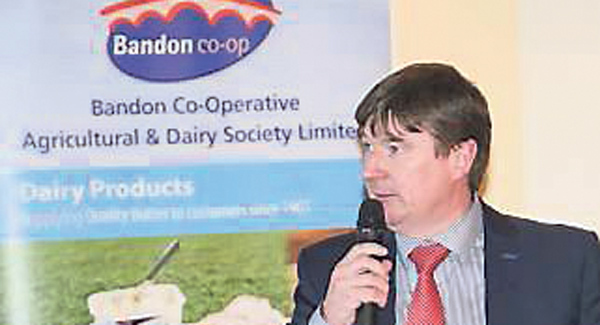
Both offered economic insights.
Although they were reluctant to engage in milk price forecasting, the dairy farmers in attendance received plenty of detail on current market sentiment and recent trends, from which they could draw their own conclusions.
Up first, Jim Power spoke succinctly of how Ireland has managed to stabilise its fairly dire financial position, over the past five years.
Although we as a nation are still borrowing a massive €7 billion to balance the books for the financial year, this is actually a relatively modest amount compared to the double digit borrowing of more recent years, such as the €18.4bn deficit of 2011, or the €16.4bn deficit of 2012.
Our national debt, standing at over €200bn, is now costing us over €8bn per year to service, although the interest rate attainable on new bond issuances is at record lows. This gives Ireland an opportunity to refinance our national debt at lower interest rates, which could generate a multi-billion euro saving in interest for Irish tax payers, over the longer term.
Jim Power also gave us a snapshot of how Ireland’s tax take has altered significantly over the last ten years, with income taxes now accounting for more than 40% of the total tax take of the exchequer (with middle income taxpayers suffering significantly over the last few years).
On interest rates, Jim Power suggested that over the medium term, interest rates would rise to more normal levels of 3-4%..
In that context, he suggested that entry of new competition into the Irish banking market would help alleviate some of the upward movement in interest rates. He agreed that Irish businesses are currently paying too much of a margin over the cost of funds, compared to EU counterparts.
Jim argued that the higher cost of borrowing for customers in the short term would help the remaining Irish banks return to profits, and this may be tolerated from a policy point of view, because a functioning, profitable banking system is needed for a functioning, profitable economic system.
On the dairy markets side, TJ Flanagan presented detail of the most recent dairy commodity auctions, and graphed the decline in dairy markets through 2014.
The high prices attained in 2013 were, in hindsight, the result of “a perfect alignment”, with production constrained either in that year or in the previous season in significant dairy producing markets. On top of this, speculative purchasing of powders drove prices to record highs.
As it turned out, it seems that those speculative buyers may now be supressing the milk market below its natural equilibrium, due to dumping of powders on the market, forced by their limited shelf life.
Meanwhile, 2014 seems to be a perfect storm at the other end of the spectrum, with a fall-off in demand globally, even as production powered ahead in all major milk production regions.
A variety of prophets are predicting milk prices in the order of 25 to 27 cent per litre. That would be a sharp drop compared to the averages of up to 39 cent attained in 2013, but such prices are significantly better than what was achieved by some farmers in 2009, when some suppliers earned milk prices of just 19 cent per litre.
TJ Flanagan further suggested that it may be the back end of next year before there is any lift in prices, when Chinese buyers return to the market, and when production may start tailing off in the US.
However, US farmers are better insulated from the current price drop, due to their own internal market system, and the significant fall in grain and maize prices.
Farmers in attendance were quick to point out that costs seem to have rocketed over recent years, and this was acknowledged by TJ Flanagan.
It was disappointing to hear that there seems to be no significant drop in prices of fertiliser on the cards, which seems difficult to fathom, given the significant drop in oil prices over the past year.
The Bandon Co-op event was an occasion for many of us suppliers to welcome Gerard Brickley as the new CEO.
We wish him well in his new role, and pay tribute to his predecessor Gus O’Brien, who served the Co-op so well for decades, and was presented yesterday with a well-deserved Plunkett Award for Co-operative Endeavour from the Irish Co-operative Organisation Society.