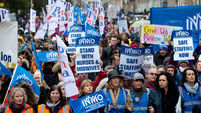
EU citizens trailing US and UK in pension ownership

Successful pensions model: Auto-enrolment has proven to be a great success in the UK, where 80% of employees are participating.
It is one thing to put in place a package of reforms; it is quite another thing to make sure that they are implemented.
This is a lesson that has been learned the hard way by the promoters of PEPP, the European personal pension product. PEPP was launched in 2022 by the regulatory body, EIOPA, the European Insurance & Occupational Pensions authority.
These clunky acronyms reflect that mixture of earnest goodwill and abiding dysfunction that has characterized project Europe over the years. What the EU appears to need is a group of clever Advertising execs adept at promotional techniques.
PEPP was designed with the intention of offering a simple, transparent and mobile retirement savings option aimed at supplementing State pensions. Auto-enrolment has fulfilled this function to a considerable degree in the UK, where 80% of employees are participating.
Across the EU, however, just 18% of Europeans own a personal pension product. Reliance on the pay-as-you-go state pension system remains high. Big question marks about the sustainability of the system overhang like a dark storm cloud.
The idea behind PEPP is that by promoting private pensions you sustain people in retirement without bankrupting national exchequers.
In the UK, standalone personal pensions are modest in number due to the success of the AE system in absorbing the mass market.
AE schemes have been developed in the EU, but it takes time for such schemes to gather momentum.
In the US, meanwhile, a large share-owning culture has developed. Almost half of households – 44% at the latest count – have individual retirement plans. Employers also sponsor retirement plans such as 401K plans.
Last year, the European Court of Auditors pointed to a failure on the EU’s part to strengthen occupational pensions and to establish a pan-European pension product.
By then, there was just one PEPP on the market. Uptake had been “extremely low” with fewer than 5,000 savers signed up.
Supporters of the plan accept that there has been a failure to bring the pensions industry with it. A cap of one per cent on fees was proposed. An excellent idea in principle. However, companies questioned the viability of such arrangements given the need for up-front investment in the new products and concerns that existing products could be ‘cannibalised.’ Demand has been curtailed due to a lack of awareness among possible customers and cost of living pressures.
A number of reforms have been suggested. These include: combining occupational and personal PEPPs into a single product. Focus on value for money as opposed to a hard fee ceiling. Developing EU-wide common rules, including EU-wide auto-enrolment.
Such rules would facilitate cross-border sales of product.
Juicing demand through the development of pension tracking systems that aim to provide savers with accessible information on pension performance.
The Court of Auditors highlights a lack of transparency when it comes to costs and they observe that pan-European pensions are simply not a viable option at present.
In their view, moves to boost transparency as part of an evolving capital markets union have simply not taken place.
The European Federation of Investors & Financial Services Users, ‘Better Finance ’, points to a “continuing lack of awareness among savers about the long-term impact of pension fees.”
They observe that annual fees of two per cent can cut final pension returns by nearly half over a working lifetime.
BF does acknowledge efforts by the EU to secure improvements in transparency via clearer pension benefit statements and better disclosure of cumulative costs.
It welcomes the introduction of an explicit duty of care for pension fund managers in the revised framework.
But the reality is that pension savers have “too little influence over how their money is managed.” There is much to play for. As of 2024, EU citizens collectively held around 34 billion euros in savings – around one third of which is held in bank deposits.
In mid 2026, the European Council proposed a revised PEPP model, one intended to be ‘more flexible, accessible and cost-effective.’ The aim is to streamline administration and improve governance. The goals are clear. Can they now be put into action?
The EU has fallen behind its rivals – the US in particular – when it comes to funding business expansion. The gap in performance between the two blocs has grown dramatically in the past twenty years.
Much of Europe’s savings pool is being siphoned off to support expanding US tech firms while many sectors in the EU fall behind for the want of financial sustenance. A stunted European capital market, leading to a tortoise-like economic growth trajectory, is to no one’s benefit, least of all that of future retirees.
It should be pointed out that at national level, some larger EU States have been taking action.
France launched a national retirement savings project aimed at consolidating the market, boosting inflows in the process. It has had some success, but the market remains small as a percentage of total savings. Likewise in Germany.
There, total retirement savings stood at €1.54 trillion (compared to a figure of €317 billion for France and just €243bn in Italy).
The UK Government, meanwhile, has recently introduced a new Value for Money framework.
It is being described as “the biggest pension reform in a generation”. Under the plan, schemes would be rated on investment performance, fee levels and service quality.
Poorly performing funds will be told to improve or face closure.
According to the Pensions Minister, Torsten Bell, the Pensions Scheme Act 2026 lays out a “major plank of reform”.
A key aim is the tackling of the “proliferation of small pension pots” and achieving a reduction in the level of complexity that financial decisions attract.
The Minister has highlighted the lack of coverage for the self-employed, many of whom are not saving for their later life.


CONNECT WITH US TODAY



Be the first to know the latest news and updates