Opportunities and risks abound as UK heads for the EU door
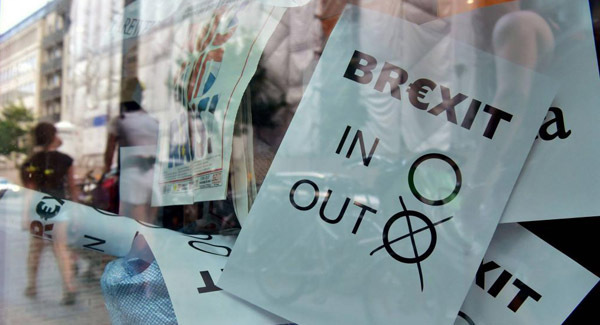
To be followed by the certainty of a second Scottish referendum. This is now a reality.
Ireland needs to accept that this is the case and face up to several realities.
First, the EU in whatever form remains will be less business friendly without the UK. It has been a strong voice for a more market-oriented approach since the days of Thatcher— a strong Europhile who managed to reform, unlike the Bullingdon Boys who have simply cocked it up wholesale. Ireland will have fewer friends than it had, and we need all the friends we can get.
Second, the EU will have to be restrained from cruel and unusual punishment of England and Wales.
The mandarinate must be keen to inflict exemplary and terrible punishment to keep the other countries in line.
This would be stupid, short-sighted, self-defeating and shoddy. But then that is how the EU has dealt with many countries over the crisis. We need to be a strong voice of reason, while remembering that we are between a rock (do we want to leave the EU and cleave to England and Wales) and a hard place (a vengeful and bureaucratic EU).
Third, we need to be nimble in our responses. While the UK as a whole is no longer our main export market overall, it remains so for many of our SMEs.
SMEs, not multinationals, are the employment engine of our, and other, economies.
They will face increased problems in selling into an England and Wales which have a depreciating currency and are likely to suffer a recession.
It takes time, and more importantly, capital, cultural and corporate, for SMEs to switch exports from Gloucester to Gelsinkirchen. So we need the IDA, Enterprise Ireland, and all bodies to be given carte blanche in staffing and resources to aid this effort.
Language skills will be paramount so we should be looking at somehow getting euro language native sales and marketing centres beefed up for SMEs.
Fourth, we need to see where we can gain an advantage. The old adage was that England’s difficulty was Ireland’s opportunity. Well, difficulties they have in plenty.
A country with a massive trade deficit kept afloat by a financial services centre which in large but unclear part depends on its membership of a club it has now left — that is a disaster waiting to happen.
Financial services are obvious targets for us to poach. But there are others. The UK has a very large education sector.
There will, today, be a lot of talent in Durham, Essex, Imperial College London, Manchester and elsewhere from the EU looking nervously at the job market.
It is not at all clear whether they will easily remain in situ after the invocation of Article 50 which pulls the trigger on leave. Even if they do, they will not have rights to move as easily as they now do.
They will be supplicants in a state which may well have as prime minister a man who dismissed experts as akin to nazi propagandists and who as education secretary displayed an attitude to learning that was ideological to the core.
Irish universities and ITs should be encouraged to target and hire, requiring, at a minimum, that the Department of Education and Higher Education Authority allow the Employment Control Framework controls to lapse.
We have a golden opportunity here also to increase our share of non-Irish students — we export education services to the tune of €1.3bn per annum — more than our total beverages exports — and England and Wales have shown a coolness to foreigners we should shamelessly exploit.
Fifth, we face two enormous challenges. The Scottish first minister has, more or less, set in motion a second independence referendum.
It appears that she is not even waiting for Westminster’s permission. They are heading out the door of the UK to stay in the EU. As for Northern Ireland, nobody, as usual, has a clue.
Either the EU has an external hard border at Swanlinbar or it has one at Larne. Either upsets the natives.
It would be a fool, or a DUP strategist, to think the Faragistes will happily continue fund the North when they could keep that cash at home.
All the pressure is for an ever-closer economic and political relationship. But the North is broke and while improving, still has poor economic prospects.
A border poll might well get a united Ireland but at what cost? Either way and bearing in mind the hit to global and regional economic prospects, the fiscal space just got a whole pile narrower.












