Brian Keegan: Rapid recovery and growing job market is a realistic possibility for 2021
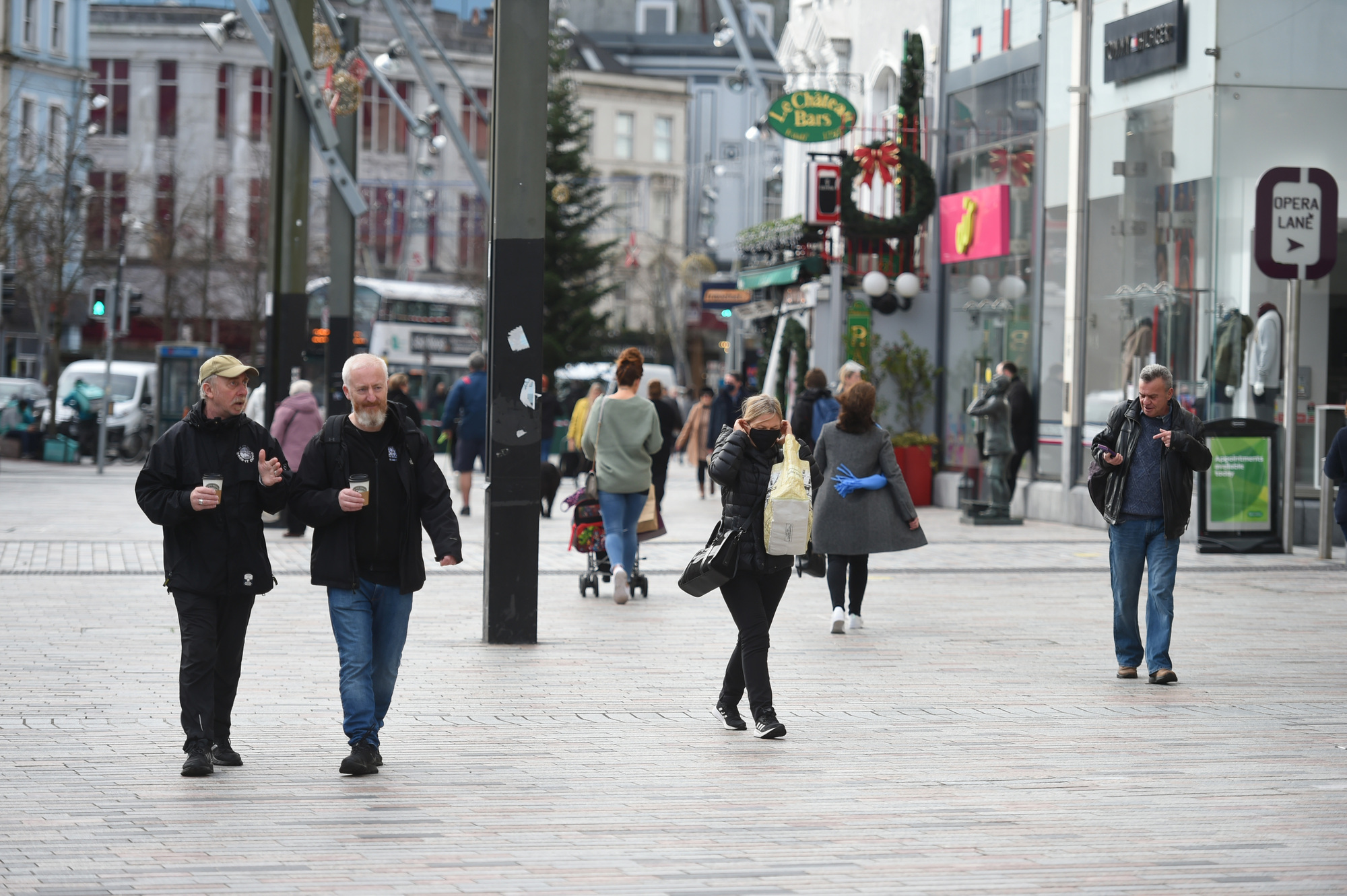
Shoppers on St Patrick’s Street, Cork. Exchequer receipts throughout the months of the pandemic and lockdown consistently pointed towards robust commercial performance. Picture:

This time last year, it was fair to say that 2019 was a year when not much happened. The same cannot be said of 2020.
Reports of the outbreak of a mysterious sickness in China at the start of 2020 coincided with the coverage of the general election campaign. Many politicians campaigned on a platform for change, but sometimes we all need to be careful what we wish for.
The February general election which removed the minority Fine Gael-Independents coalition from office was triggered by the prospect of a vote of no confidence in the then-health minister Simon Harris. But has any health minister, acting or otherwise, ever had such a position of responsibility as Mr Harris had in the first few months of the pandemic?
Despite the terrible deaths and isolation and loneliness and the pressure of the pandemic on our health service, there are things which were positive during 2020 and should give us reason for hope in 2021.
The tax system was in effect thrown into reverse, with the PAYE system being used as a mechanism not just to collect income tax, but to rapidly provide wage subsidies to employers.
This use of the tax system to deliver aid to business was not unique to Ireland, but the Revenue Commissioners were certainly among the first of their peers in other jurisdictions to achieve its practical implementation. This capacity for a rapid turnaround is a facet of working in a relatively small economy with a relatively small business population, but nevertheless, it took effort by Revenue and businesses alike.
Eligibility for the relief available under the temporary wage subsidy scheme introduced in March and for the employer wage subsidy scheme introduced in the autumn is not automatic.
Many businesses and those who advise them are currently dealing with eligibility issues, follow-ups, and enquiries. These are time-consuming and can be onerous for smaller organisations. In addition to the subsidies, the Government permitted the deferral of tax payments by business to help them with liquidity issues.
Some €2bn worth of income tax, PAYE, and Vat liabilities have been warehoused in this fashion and are due for payment in future years as businesses recover.
On balance, without the rapid government intervention of wage subsidies and tax-collection deferral, many businesses would possibly have gone to the wall already. Businesses remain reluctant to substitute a liquidity crisis with a debt crisis, and this in part explains the low take-up of Covid-19 loan supports.
Unlike previous recessions where money supply was the critical issue, this time the critical issue was the choking off of demand. Nevertheless, many Irish businesses managed to plough on. Forecasts in recent days, one from employers' group Ibec and another by the Economic and Social Research Institute, suggest that despite the pandemic, the Irish economy did not shrink but rather grew, albeit by a small amount, in 2020.
Exchequer receipts throughout the months of the pandemic and lockdown consistently pointed towards robust commercial performance, by multinationals in particular.
Considering the level of layoffs and redundancies, and the devastation of social, sporting, and cultural activity, this is a remarkable outcome which reflects the country’s strength in pharmaceutical and communications and information technology export markets.
These economic figures are of scant consolation to those businesses which have been disrupted, or to those who have lost their jobs, perhaps permanently, but they do suggest that a rapid recovery and growing job market is a realistic possibility in 2021. A widely adopted vaccination programme could allow commercial and social life to return to something approximating what we were used to.
Establishing future trading arrangements between the EU and the UK following Britain's departure finally from the EU single market and customs arrangements at the end of this month was always going to be difficult. When the challenges of the Covid-19 pandemic are put into that mix, a difficult task seemed to become well-nigh impossible.
Despite protestations to the contrary, especially from the British side, these trade talks have been constructed not for improvements but for damage limitation.
For the past several months, the stumbling blocks in the negotiations have been in the areas of fair competition, dispute resolution mechanisms, and fishing rights. These are all difficult and significant issues, impinging as they do on aspects of sovereignty and the sense of national identity for the British. The wonder should not be that they have crystallised as the sticking points in the talks now, but rather that for 50 years, the strength of the EU agreements and institutions was such that they had not been barriers to frictionless trade between the UK and its European allies.
Despite their prominence, Brexit and the pandemic were not the only issues of significance in 2020.
Though we would never have wished for it in the way it happened, the slowdown in world economic activity resulted in a cut to greenhouse gas emissions during 2020. The extent of the cut achieved, some 6% to 7% according to best estimates, would have to be repeated over many years to make a rapid difference.
Nevertheless, concerns over climate change did manage to find some space on national and international agendas. The seven-year budget of the EU to take us to 2027 — agreed in recent weeks though the agreement was practically drowned out of the news cycle by the pandemic — has a very strong green agenda element to it.
There is now a strong expectation that the US will rejoin the Paris climate accord under its new president, Joe Biden, next year. Even China has signalled its commitment to a significant reduction in greenhouse gas emissions over the next 40 years.
It is indeed rash to make forecasts at any time, but I think there is a reasonable expectation that in 2021 we will see the demise of coronavirus; the resolution, if only in part, of the Brexit negotiations; and perhaps a greater emphasis on detente among world powers following the inauguration of president-elect Mr Biden.
My wish for December 2021 is that, just as in December 2019, I can write that the year gone by was one where nothing much happened.
- Brian Keegan is director of public policy at Chartered Accountants Ireland