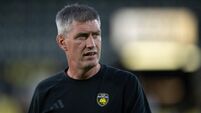
What made Anthony Foley such a good leader?
I was driving into Limerick last week when I heard the news on the radio. At just 42, Munster rugby head coach, Anthony Foley, had died.
The outpouring of emotion and grief from the rugby fraternity here and abroad was immediate.
I stopped by Thomond Park and jerseys and flags were up on the gates.
Grown men were weeping openly and cars were pulling up with entire families. In the hours that followed, there was, of course, great sorrow and shock.
However, what emerged from the grief was the image of a man who held every quality of a leader. To be strong and smart when needed; to be thoughtful and gracious the rest of the time.
For me, what emerged was a lesson in leadership and what it means to be a leader.
In business, we often see leaders as the figureheads, as the people who take responsibility for everything.
The owner is the leader, and that’s that, but being a leader is more than how people see you. It is how you act that makes a great leader.
That leadership defines the direction of the company. How it acts in times of tremendous pressure, and how it performs when things are going well.
If you look at all the great leaders in business or sport, it is not unusual to see great people emerge from under their guidance, skilled people who are leaders in their own right, or in their own position within that collective. It is that encouragement of the collective that sets leaders apart.
That it is not the few or the one that matters, but everybody. The belief that everybody shares that dream, that vision, and strives to achieve it.
But it is no lonely journey. It cannot be done by one person alone. Great leaders can inspire, but they also need others to believe in themselves. To believe that they are an essential part of the journey, too.
I turned to YouTube the day after hearing about ‘Axel’. I put on the ‘Miracle Match’ — Munster versus Gloucester in the Heineken Cup, in 2003.
Munster needed to win by a margin of at least 27 points and to score four tries. Foley led the team out for his 50th Heineken Cup match. Munster had only played 51 Heineken Cup games. They won 33-6.
Leaders are often the ones that people turn to when needed the most. They are leaders because, when everyone else falls away, they are always there, the constant in days when there seems to be nothing but bad news.
There is a common perception that leaders lead from the front, that they ask people to follow them.
In fact, the best leaders drive from behind, not the front. They move people out in front and push them to become greater. Whenever they see people falter, they pick them up, put their arm around them, and they say ‘let’s do it together.’
We also think that to lead is to be alone. Like a king in his empire, we are the sole rulers. The only ones whose choices matter.
But that isn’t true. The truth is you need people, just as much as people need you. Success can’t be made alone; you live and die together.
Many people would see Munster’s 2006 Heineken Cup win as destiny. That it was meant to be. I disagree. There is no such thing as a pre-ordained destination.
The truth, the real truth, is that they won it as a team. They drove each other on with a passion and desire which, on that day, said they would not be beaten.
Behind it all, driving it on, was Foley. I’ll never forget that look on his face, when he walked up to lift that trophy. He had a look that said ‘This, all of this, we earned this. We did this extraordinary thing.’
Every business is different. They require different styles of leaders, with the ability to react to situations.
When it comes down to it, it’s the company that matters more. Yes, the company means more than you.
People depend on getting paid, on having jobs. You are trying to help people through their lives and that includes your own.
That means when the times call for it, leaders lend a hand, too. They come to fill the gap, to keep the company going.
Survival outweighs personal feeling. When Foley took over as head coach at Munster, it was seen as a natural progression.
The leader on the field could now be the leader off it. But Munster was, and still is, going through a rebuilding exercise. What they needed was somebody to steady the ship, somebody to get stuck in and sort it out.
He felt the pressure like no-one else in that time. The success, which he helped to create, was now the shadow hanging over the club. How could they get back those glory days in Cardiff?
Handling that pressure is an essential part of being a leader. To be calm and see the vision when others can’t. That’s when getting people to move on that journey becomes essential.
They have to understand what you’re trying to do, to understand that there is no quick-fix to problems. It’s going to be tough, but we’re in this together.
That also requires the most important trait of all: honesty. Honesty is what all this rests upon. The belief, by people, that you are genuine in all that you do. If people don’t believe you, then all of this means nothing.
People connect with people whom they believe have the best of intentions.
That connection, that bond, is key in keeping the success going. People don’t work for bad bosses; they turn up to work and that’s about it. Why work hard for someone who won’t do the same for you?
Sport creates enduring memories of leaders like Anthony Foley. We feel like we’ve been on that journey with them. We see, in a very public way, how they lead.
That’s why Foley’s death hurts so many people so much. We came on the journey with him; we followed him.
Bring people on that journey with you; drive them from behind. Successful days in business require leaders who know their people and staff.
Marcus Horan remembered his friend on RTÉ Radio 1 on Saturday, just hours before they took to the field to play Glasgow Warriors.
He talked about winning the Heineken Cup in 2006.
“It’s something that we were pursuing for so many years. We were a group that was on a mission. My abiding memory will always be of him lifting the cup. We’ve lost our leader,” he said.