Global markets reel as Trump’s 104% China tariffs take effect with threats to pharma

Trump’s sweeping new tariffs trigger global sell-offs, threaten pharmaceutical imports, and reignite tensions with key trading partners

China has again vowed to “fight to the end” against US president Donald Trump’s tariffs.

Mr Trump's "reciprocal" tariffs on dozens of countries took effect on Wednesday, including massive 104% duties on Chinese goods, deepening his global trade war even as he prepared for negotiations with some nations.

In a length policy statement, Beijing argued that trade between the two countries is already in balance as a tax on the country’s exports to America came into effect.

The Chinese government declined to say whether it would negotiate with the White House.

Trump's punishing tariffs have shaken a global trading order that has persisted for decades, raised fears of recession and sent stocks around the world reeling.

The S&P 500 has shed nearly $6tn since Trump unveiled the tariffs a week ago, the deepest four-day loss since the benchmark's creation in the 1950s. The index is now nearing a bear market, defined as 20% below its most recent high.

A sell-off across Asian markets resumed on Wednesday with Japan's Nikkei (.N225), opens new tab down more than 3%, South Korea's currency hitting a 16-year low and government bonds suffering heavy losses as investors dashed for the safety of cash.

US stock futures also pointed to a fifth straight day of losses on Wall Street.

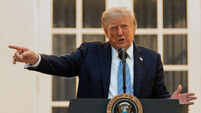
US president Donald Trump speaks during an event on energy production in the East Room of the White House on Tuesday. Picture: AP Photo/Alex Brandon

Trump has offered investors mixed signals about whether the tariffs will remain in the long term, describing them as "permanent" but also boasting that they are pressuring other leaders to ask for negotiations.

"We have a lot of countries coming in that want to make deals," he said at a White House event on Tuesday afternoon. He said at a later event that he expected China to pursue an agreement as well.

Plan to target pharmaceuticals

Speaking at the event, Mr Trump said the White House world soon be announcing a "major" tariff on pharmaceuticals.

"We're gonna tariff our pharmaceuticals, and once we do that, they're gonna come rushing back into our country because we're the big market. The advantage we have over everybody is that we're the big market," he said. 

"So we're going to be announcing very shortly a major tariff on pharmaceuticals, and when they hear that, they will leave China, they will leave other places, because most of their product is sold here."

'Ready to negotiate'

Tánaiste Simon Harris has travelled to Washington DC for a meeting with US commerce secretary Howard Lutnick, a key critic of the Government’s fiscal policies.

Over the course of Wednesday, he is due to hold several further meetings on Capitol Hill to discuss Ireland’s economic, trade and foreign policy priorities.

He will also meet with Mr Lutnick on trade and investment relations, mentioning the US-Irish economic relationship which sustains 400,000 jobs.

Pharmaceuticals were exempt from the sweeping 20% tariffs imposed on EU exports to the US earlier this month, but could be subject to further measures taken by the Trump administration.

Speaking about his US visit, the Tanaiste said: “We are here to keep the lines of communications open with US political and business leaders as well as share insights and engage.

“During the visit I will be emphasising our desire to find a negotiated solution between the EU and US on tariffs and that I am fully supportive of Commissioner Sefcovic’s work.

“I will make the point that the European Union is ready right now to negotiate."

Meanwhile, Trump's administration has scheduled talks with South Korea and Japan, two close allies and major trading partners, and Italian prime minister Giorgia Meloni is due to visit next week.

The deputy prime minister of Vietnam, the low-cost Asian manufacturing hub hit with some of the highest duties globally, is set to talk with Trump's Treasury Secretary Scott Bessent later on Wednesday.

The prospect of deals with other countries had pushed stock markets up earlier on Tuesday, but US stocks had ceded their gains by the end of the trading day.

China vows to fight

A woman reacts in front of an electronic screen displaying stock prices at a brokerage house in Hangzhou in east China's Zhejiang province on  Monday. Picture: Chinatopix Via AP

Trump nearly doubled duties on Chinese imports, which had been set at 54% last week, in response to counter-tariffs that Beijing announced last week. China has vowed to fight what it views as blackmail.

Top Chinese brokerages have pledged to work together to help steady domestic share prices in response to the tariff-induced turmoil.

Other nations are racing to protect key industries from the duties, with South Korea announcing a raft of emergency support measures for the auto sector, including tax cuts and subsidies.

Some economists have warned that ultimately US consumers are likely to bear the brunt of the trade war, facing higher prices on everything from sneakers to wine.

Nearly three-quarters of Americans expect the prices of everyday items to rise in the next six months, a new Reuters/Ipsos poll found.

The full effects of Wednesday's tariffs may not be felt for some time, as any goods already in transit as of midnight will be exempt from the new levies as long as they arrive in the US by May 27.

Trump's earlier across-the-board 10% tariffs on all imports from many countries began on Saturday.

The latest round of duties, which took effect at 12.01am. ET (4.01am GMT), are aimed at countries that are "ripping off" the US, according to Trump.

That list includes many of the United States' closest allies, including the European Union, which was hit with a 20% tariff as well as industry-specific duties. The 27-member bloc will vote on initial counter-measures later on Wednesday.

The New York Stock Exchange is seen in New York, Tuesday, April 8, 2025. Picture: AP Photo/Seth Wenig

Trump has said the tariffs are a response to barriers put on US goods that have stymied American businesses. He has also accused countries including Japan of devaluing their currencies to gain a trade advantage, something Tokyo denies.

Japan's finance minister on Wednesday said trade negotiations with Washington could include foreign exchange rates.

Trump has signaled he may not be finished on tariffs.

In remarks to Republican lawmakers on Tuesday evening, he said he would soon announce "major" tariffs on pharmaceutical imports, one of a handful of categories of goods that have been exempted from the new taxes.

- Reuters with additional reporting from PA

More in this section

Cookie Policy Privacy Policy Brand Safety FAQ Help Contact Us Terms and Conditions

© Examiner Echo Group Limited