Ukraine and Russia hold new talks in Turkey aimed at ending fighting
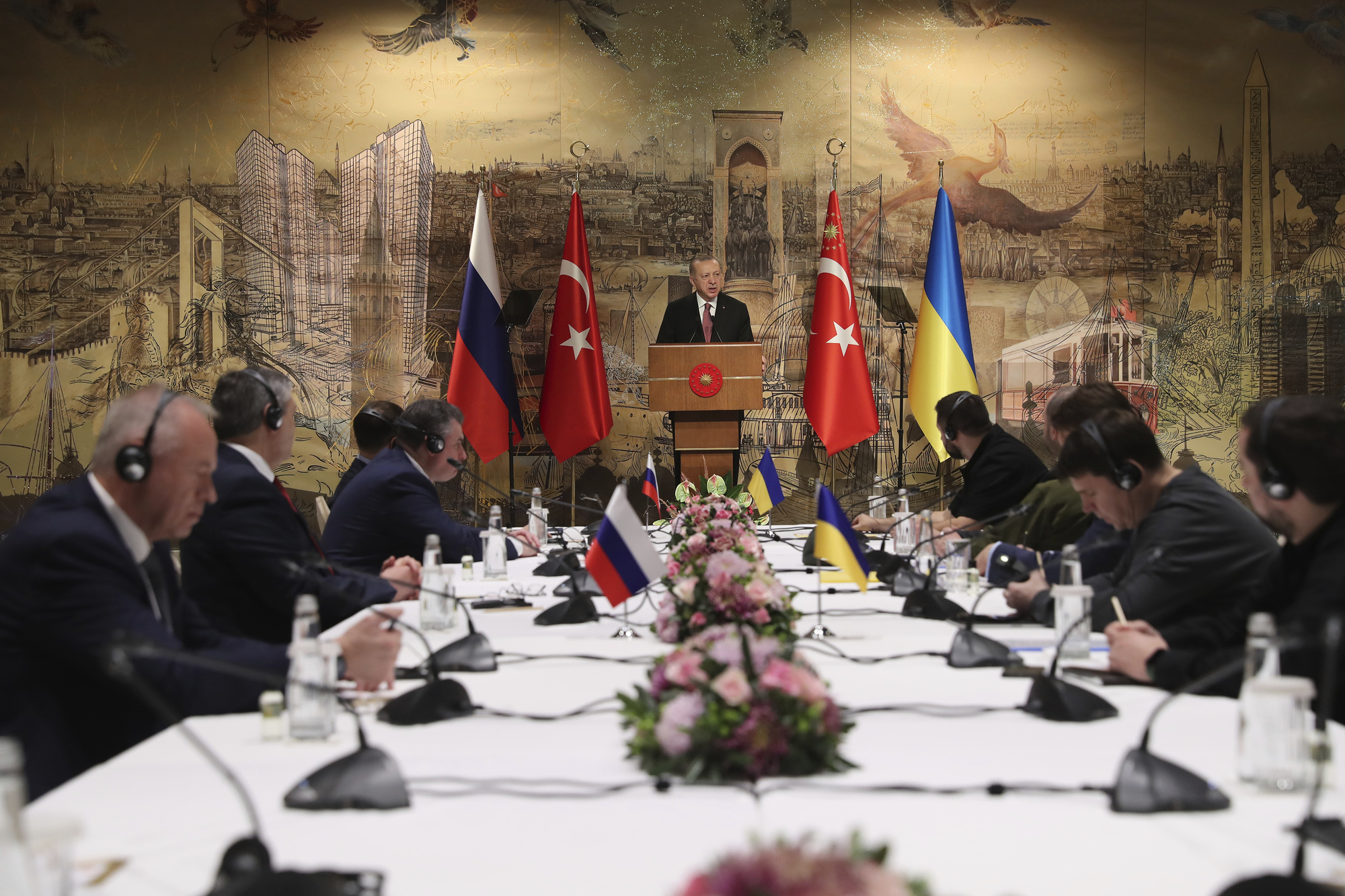
Turkish President Recep Tayyip Erdogan gives a speech to welcome the Russian and Ukrainian delegations in Istanbul (Turkish Presidency via AP)
Chelsea FC owner Roman Abramovich is present at the first face-to-face talks in two weeks between Russia and Ukraine in Turkey, as hopes rise that the negotiations can spur progress towards ending the war.
Mr Abramovich, a long-standing ally of Russian President Vladimir Putin, is playing an unspecified mediating role at the summit in Istanbul.
Ahead of the talks, Ukrainian President Volodymyr Zelenskyy said his country is prepared to declare its neutrality, as Moscow has demanded, and is open to compromise over the contested eastern region of Donbas – comments that might lend momentum to negotiations.
But Mr Zelenskyy warned the “ruthless war” continues, and that Ukrainians are paying for the West’s hesitancy on imposing tougher sanctions on Moscow with their lives.
Turkish President Recep Tayyip Erdogan told the two sides gathered for talks that they had a “historic responsibility” to stop the fighting.
“We believe that there will be no losers in a just peace,” he said.
“Prolonging the conflict is not in anyone’s interest.”
Mr Putin’s aim of a quick military victory has been thwarted by stiff Ukrainian resistance – but hopes are not high for a breakthrough.
In fighting that has devolved into a stalemate, Ukrainian forces retook Irpin, a key suburb north-west of the capital, Kyiv, Mr Zelenskyy said late on Monday.
But he warned that Russian troops are regrouping to take the area back.

“We still have to fight, we have to endure,” Mr Zelenskyy said in his night-time video address to the nation.
“This is a ruthless war against our nation, against our people, against our children.”
Earlier talks between the sides, held in person in Belarus or by video, failed to make progress on ending the month-long war that has killed thousands of people and driven more than 10 million Ukrainians from their homes – including almost four million who have fled the country entirely.
Russia has long demanded that Ukraine should drop any hopes of joining Nato, which Moscow sees as a threat.
Mr Zelenskyy indicated over the weekend he was open to that idea, saying Ukraine was ready to declare its neutrality. But he has stressed that the country needs security guarantees of its own as part of any deal.

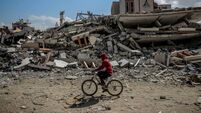
As well as Irpin, Ukrainian forces also seized back control of Trostyanets, south of Sumy in the north-east, after weeks of Russian occupation that has left a landscape devastated by war.
In his overnight address, Mr Zelenskyy emphasised the situation remains tense in Ukraine’s north-east around Kharkiv, the nearest large city, and other areas, as he pressed Western countries to do more to support Ukraine, including levying harsher sanctions on Russia and providing more weapons.
“If someone is afraid of Russia, if he or she is afraid to make the necessary decisions that are important to us, in particular for us to get planes, tanks, necessary artillery, shells, it makes these people responsible for the catastrophe created by Russian troops in our cities, too,” he said.
“Fear always makes you an accomplice.”
But the returned presence of Ukrainian forces in Trostyanets was a relief for a country hoping that Russian forces are pulling back as they encounter fierce resistance.
Mr Putin’s ground forces have become bogged down because of the stronger-than-expected Ukrainian resistance, combined with what Western officials say are Russian tactical mis-steps, poor morale, shortages of food, fuel and cold weather gear, among other problems.
In response, Russia appears to be concentrating more on the Donbas, the predominantly Russian-speaking region where Moscow-backed rebels have been waging a separatist war for eight years, officials said.
While that raised a possible face-saving exit strategy for Mr Putin, it has also raised Ukrainian fears the Kremlin aims to split the country, forcing it to surrender a swathe of its territory.

However, Mr Zelenskyy’s comments that he was open to compromise on the region indicated a possible pathway for negotiations.
The Ukrainian military said Russia has destroyed more than 60 religious buildings across the country in just over a month of war, with most of the damage concentrated near Kyiv and in the east.
It said the Orthodox church – the country’s majority religion – was the mostly affected, but mosques, synagogues, Protestant churches and religious schools were also destroyed.
Meanwhile, UN Secretary-General Antonio Guterres has launched an effort to achieve a humanitarian ceasefire that would allow aid to be brought in and let people move around safely.

In the besieged southern port of Mariupol, the mayor said half the pre-war population of more than 400,000 has fled, often under fire, during weeks of shooting and shelling.
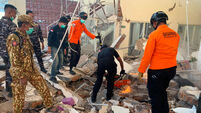
Alina Beskrovna, who escaped the city in a convoy of cars and made it to Poland, said desperate people are melting snow for water and cooking on open fires despite the risk of bombardment, “because if you don’t, you will have nothing to eat”.
She said: “A lot of people are just, I think, starving to death in their apartments right now with no help.
“It’s a mass murder that’s happening at the hands of the Russians.”

CONNECT WITH US TODAY



Be the first to know the latest news and updates