UK and US join in warning of consequences for Russia over Ukraine
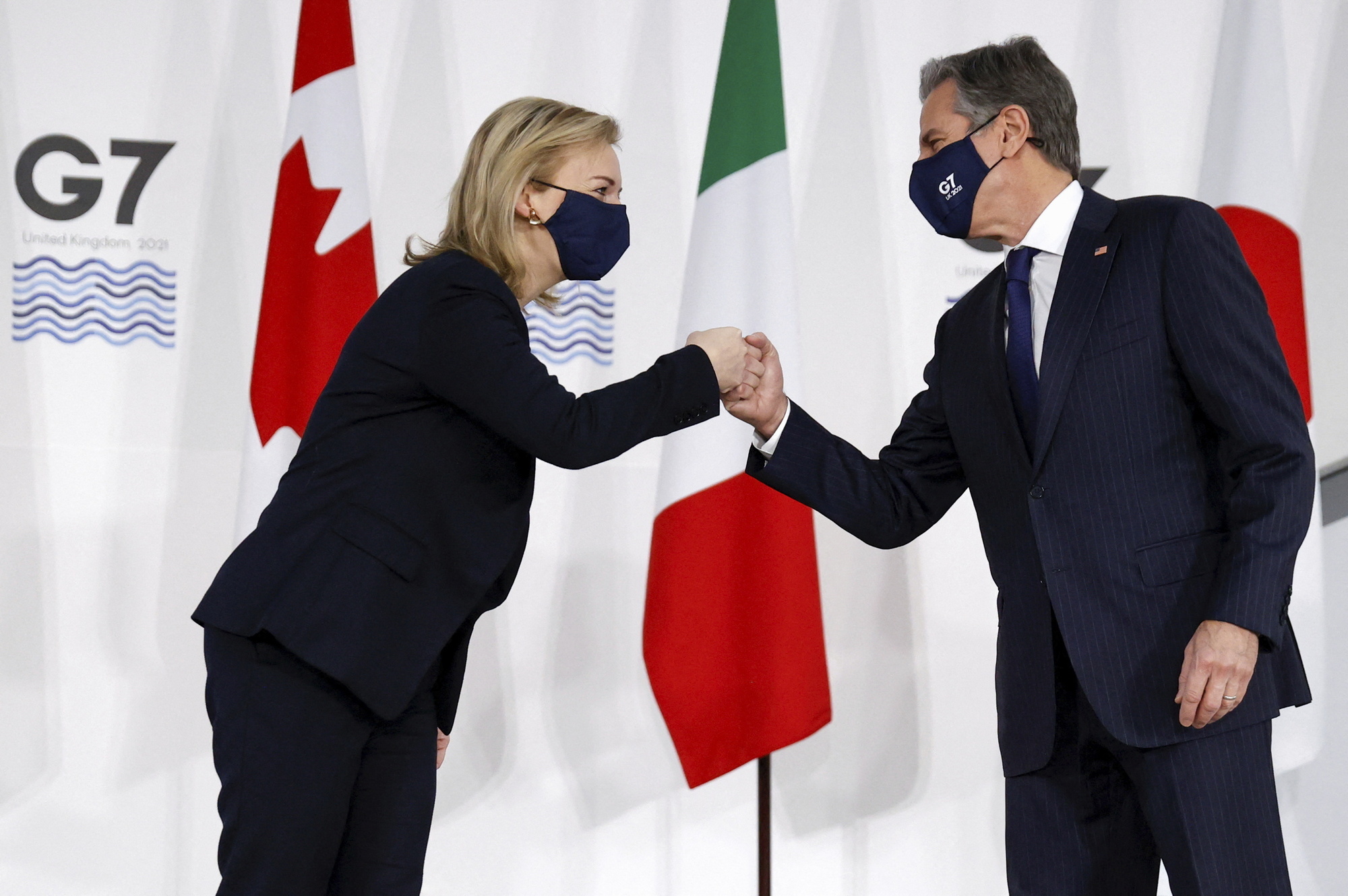
UK Foreign Secretary Liz Truss welcomes US secretary of state Antony Blinken (Phil Noble/Pool/AP)
The UK and US have expressed âdeep concernâ that Russia has amassed tens of thousands of troops at the Ukraine border, as the allies warned of consequences if there is an invasion.
UK Foreign Secretary Liz Truss discussed the threat of a Russian incursion into Ukraine during talks with her US and German counterparts before a G7 foreign ministers meeting in Liverpool on Saturday.
With US secretary of state Antony Blinken, she agreed there would be âserious consequencesâ for Moscow if troops were sent across the border.
According to US intelligence, Russia has stationed about 70,000 troops near its border with Ukraine and has begun planning for a possible invasion as soon as early next year.
US president Joe Biden has spoken to British Prime Minister Boris Johnson and the leaders of Germany, Italy and France â dubbed the Nato âquintâ â twice this week as they discuss how to deal with the threat.
A spokesman for the Foreign, Commonwealth and Development Office (FCDO) said Ms Truss and Mr Blinken âboth agreed their support for Ukraineâ and âexpressed deep concern about the build-up of Russian troops on Ukraineâs borderâ.
âIn addition, they said that any incursion by Russia would be a strategic mistake for which there would be serious consequences,â he said.
âThe Foreign Secretary and secretary Blinken both agreed on the importance of defending and promoting freedom and democracy, and the need for a unity of purpose from the G7 to achieve this.â
Ms Truss spoke to the new German foreign minister Annalena Baerbock about the âneed to stand up to autocratic regimes that threaten the free worldâ, and unity in the face of Russiaâs âthreatâ to Ukraine.
Speaking to broadcasters ahead of the meeting, Ms Truss said she was working to make sure there would be âsevere economic consequencesâ if Moscow mobilised against Kiev.
With the UK on Friday recording the highest number of Covid-19 infections since January 9, the Foreign Secretary chose to greet fellow ministers with fist and elbow bumps during their discussions at the Museum of Liverpool.
She told allies from the US, Canada, France, Germany, Italy and Japan they needed to âdefend ourselves against the growing threats from hostile actorsâ.
Opening the main plenary as part of the UKâs year-long G7 presidency, she said: âWe need to come together strongly to stand up to aggressors who are seeking to limit the bounds of freedom and democracy.
âTo do this, we need to have a strongly united voice, we need to work to expand our economic and security partnerships around the world, bringing more into the sphere of countries who stand up for the values we believe in.â
Ms Truss also spoke about âgrowing economic tiesâ to ensure âall nations have alternatives to dealing with authoritarian regimesâ, with the UK looking to convince major economic powers to wean themselves off reliance on cheap Russian gas.
Along with the US and German talks, Ms Truss is expected to hold bilateral meetings on Saturday with other G7 counterparts and the European Union, as well as guest countries such as Australia and South Korea.
On Sunday she will host plenary sessions on global health security as well as the Indo-Pacific region, with foreign ministers from the Association of Southeast Asian Nations joining the G7 meeting for the first time.
It comes after the UKâs integrated review on foreign policy announced a âtiltâ towards the Indo-Pacific, in a move seen as aiming to counter Chinaâs growing influence in the region.