Protestors attack headquarters of ruling party as five die in Egypt
Hundreds of thousands thronged the streets of Cairo and cities around the country and marched on the presidential palace, in an attempt to force out the Islamist president with the biggest protests Egypt has seen in two years of turmoil.
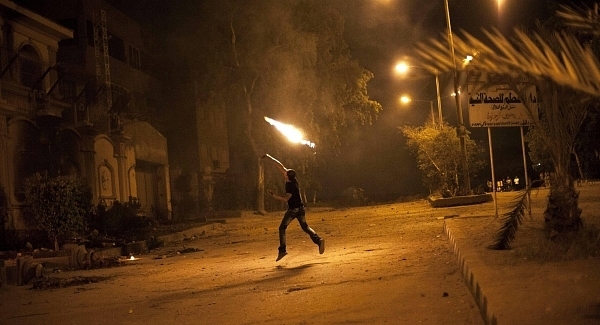
In a sign of the explosive volatility of the country’s divisions, young protesters pelted the main headquarters of President Mohammed Morsi’s Muslim Brotherhood with stones and firebombs, and at one point a fire erupted at the gates of the walled villa.
During clashes, Brotherhood supporters barricaded inside opened fire on the attackers, and activists said at least five protesters were killed.
At least five more anti-Morsi protesters were killed yesterday in clashes and shootings in southern Egypt.
Fears were widespread that the collisions between the two sides could grow more violent in coming days.
Mr Morsi made clear through a spokesman that he would not step down and his Islamist supporters vowed not to allow protesters to remove one of their own, brought to office in a legitimate vote.
During the day yesterday, thousands of Islamists massed not far from the presidential palace in support of Mr Morsi, some of them prepared for a fight with makeshift armour and sticks.
The protesters aimed to show by sheer numbers that the country has irrevocably turned against Mr Morsi, a year to the day after he was inaugurated as Egypt’s first freely elected president.
But throughout the day and even up to midnight local time at the main rallying sites, fears of rampant violence did not materialise.
Instead the mood was largely festive as protesters at giant anti-Morsi rallies in Cairo’s central Tahrir Square and outside the Ittihadiya palace spilled into side streets and across boulevards, waving flags, blowing whistles and chanting.
The massive outpouring against Mr Morsi raises the question of what is next. Protesters have vowed to stay on the streets until he steps down, and organisers called for widespread strikes starting today.
The president, in turn, appears to be hoping protests wane.
It is unclear now whether the opposition, which for months has demanded Mr Morsi form a national unity government, would now accept any concessions short of his removal.
The anticipated deadlock raises the question of whether the army, already deployed on the outskirts of cities, will intervene. Protesters believe the military would throw its weight behind them, tipping the balance against Mr Morsi.
The fire at the Brotherhood headquarters sent smoke pouring in the air. Witnesses said it was caused when the youths hurled a gas canister at the heavily barricaded gate and it exploded.
For several hours after, Brotherhood supporters inside fired on stone-throwing youths outside. At least five on the anti-Morsi side were shot to death, and 60 were wounded, an activist who monitored casualties at the hospital, Nazli Hussein, said.
Southern Egypt saw deadly attacks on anti-Morsi protests, and five people were killed. Two protesters were shot to death during clashes outside offices of the Brotherhood’s Freedom and Justice Party, one in Beni Suef, the other in Fayoum.
In the city of Assiut, a stronghold of Islamists, gunmen on a motorcycle opened fire on a protest in which tens of thousands were participating, killing one person, wounding four others and sending the crowd running.
The enraged protesters then marched on the nearby Freedom and Justice offices, where gunmen inside opened fire, killing two more, security officials said. Clashes erupted, with protesters and security forces fighting side by side against Morsi’s supporters.
At least 400 people were injured nationwide, the Health Ministry said.
Mr Morsi, who has three years left in his term, said street protests cannot be used to overturn the results of a free election.
“There is no room for any talk against this constitutional legitimacy,” he told The Guardian, rejecting early elections.
The protests emerge from a petition campaign by a youth activist group known as Tamarod, Arabic for “Rebel.” For several months, the group has been collecting signatures on a call for Mr Morsi to step down.
On Saturday, the group announced it had more than 22 million signatures - proof, it claims, that a broad sector of the public no longer wants Mr Morsi in office.
It was not possible to verify the claim. If true, it would be nearly twice the some 13 million people who voted for Mr Morsi in last year’s presidential run-off election, which he won with around 52% of the vote.
Tamarod organisers said they discarded about 100,000 signed forms because they were duplicates.
Mr Morsi’s supporters have questioned the authenticity of the signatures, but have produced no evidence of fraud.
CONNECT WITH US TODAY



Be the first to know the latest news and updates