Baghdad suffers as bombers strike again

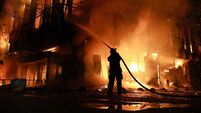
A co-ordinated al Qaida bombing attack on apartment buildings across Baghdad killed at least 39 people today in the latest sign Iraq’s fragile security could dissolve in the chaos of its unresolved election.

A co-ordinated al Qaida bombing attack on apartment buildings across Baghdad killed at least 39 people today in the latest sign Iraq’s fragile security could dissolve in the chaos of its unresolved election.

It was the fourth attack with multiple casualties across Iraq in five days, a spate of violence that has claimed more than 100 lives since Friday.

The attacks have grown as political leaders try to secure enough support to form a government after the March 7 parliamentary elections failed to produce a clear winner.

Ayad Allawi, whose bloc came out ahead in the vote by two seats over Prime Minister Nouri al-Maliki’s, said the political deadlock caused the recent wave of violence.

“This is blamed on the power vacuum, of course,” he said adding that “extreme forces” were trying to exploit the political uncertainty.

Maj. Gen. Qassim al-Moussawi, an Iraqi military spokesman for Baghdad’s operations command centre, said the attackers detonated blasts using homemade bombs and, in one case, a car packed with explosives.

He said there were at least seven blasts.

“There are casualties, and we are counting them right now with the Health Ministry,” said al-Moussawi, who blamed al Qaida for the explosions and said Iraq was in a “state of war” with terrorists.

He said most of the buildings were two storeys, but one in the central Allawi district had five floors.

Police and medical officials said the death toll was at least 39, and that women and children were among the dead.

The explosions started at about 9.30am at a residential building in the Shula area of north-west Baghdad. Then a car bomb struck at a junction about a mile away, damaging nearby buildings.

At 9.45am a bomb left in a plastic bag exploded at a restaurant in the Allawi district, near the government’s Culture Ministry. Dozens of people gathered at the site in the hours after the explosion, digging through bricks in the hopes of finding survivors.

College student Ali Hussein, 22, was on the bus to school when one of the Shula bombs exploded.

He described “people running in different directions with fear.”

“Cars began to collide with one another in street because of fear,” said Hussein, who fled home after the blast. “We saw a cloud of fire and black smoke raising from a building at the explosion site, and while we were terrified by this explosion, another one took place.”

Yesterday a Shiite couple and four of their children were gunned down in their home outside Baghdad, while more than 40 were killed on Sunday after suicide attackers detonated three car bombs near embassies in Baghdad. On Friday, gunmen went house-to-house in a Sunni area south of Baghdad, killing 24 villagers execution-style.

Many fear such violence and a drawn-out political dispute could allow insurgents to regroup in the political vacuum left after the elections.

Nearly a month after the national vote, Iraq still finds itself in a political deadlock.

Allawi’s secular Iraqiya bloc won 91 of the 325 parliament seats to 89 for the mainly Shiite list of Prime Minister al-Maliki. But both parties are far short of the necessary majority needed to govern alone, which has forced them into bargaining with other smaller blocs to muster the support needed to form a governing coalition.

x

More in this section

Cookie Policy Privacy Policy Brand Safety FAQ Help Contact Us Terms and Conditions

© Examiner Echo Group Limited