Scotland could block Brexit, says Nicola Sturgeon
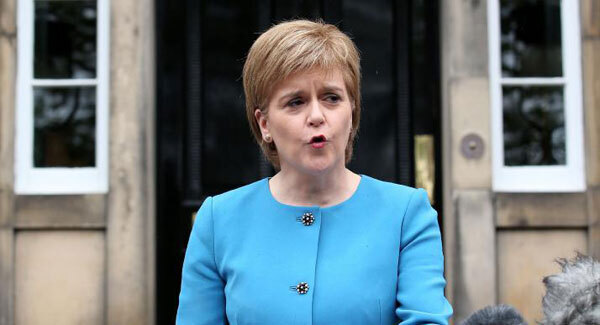
Nicola Sturgeon has warned she would consider asking Holyrood to block the UK’s departure from Europe if MSPs are required to give formal backing for Brexit.
Scotland could block Brexit, says Nicola Sturgeon

The first minister said if the Scottish Parliament has to give its consent, she would “of course” consider asking MSPs not to do this.

In Scotland 62% of people voted to stay in the EU, a situation in stark contrast with the result of the UK-wide vote, which saw 52% opt to leave.

With the UK now “in turmoil”, the SNP leader said she would “find it hard to believe” that Holyrood would not be required to back the UK leaving the EU.

Scottish secretary David Mundell said he did not think the Scottish parliament would be “in a position to block Brexit”.

Ms Sturgeon, however, stressed that the UK was in “uncharted territory” in the wake of the referendum result and “all of the complexities that have been thrown up by the vote on Thursday”.

With laws passed by Holyrood required to comply with European legislation on human rights, she was pressed on the issue on BBC’s Sunday Politics Scotland.

Ms Sturgeon said: “The issue you’re talking about is whether there would require to be a legislative consent motion, or motions in the Scottish Parliament for the legislation that extricates the UK from the European Union.

"Looking at it from a logical perspective I find it hard to believe that there wouldn’t be that requirement, I suspect the UK Government will take a very different view on that and we’ll have to see where that discussion ends up.”

When asked if she would consider asking the Scottish Parliament not to back a motion for legislative consent, she stated: “Of course, if the Scottish Parliament was judging this on the basis of what’s right for Scotland then the option of saying we’re not going to vote for something that is against Scotland’s interests, of course that is on the table.”

She continued: “I care about the rest of the UK, I care about England, that’s why I’m so upset at the UK- wide decision that’s been taken. But my job as first minister, the Scottish parliament’s job, is to judge these things on the basis of what’s in the interests of people in Scotland.”

She said she could imagine the “fury” such a move could spark in England, but added: “It is perhaps similar to the fury of many people in Scotland right now as we face the prospect of being taken out of the European Union against our will.”

But Mr Mundell insisted: “We have to respect the result on Thursday, even if we don’t like it.” The UK Government minister, who had campaigned for the UK to remain in Europe, added: “I personally don’t believe the Scottish parliament is in a position to block Brexit.”

Scottish Conservative MSP and law professor Adam Tomkins also said that MSPs had “no such power”.

Ms Sturgeon also warned David Cameron’s successor it would be “unacceptable” for Westminster to veto a second referendum on Scottish independence in the wake of the vote for Brexit.

She stressed Scotland had voted “overwhelmingly” to stay part of the EU and her priority is now to have talks with Brussels with the aim of keeping the country in. No talks have taken place as yet, she said, but added she would be doing so “in the next few days”.

No need to write formal letter of exit, impatient EU tells Cameron

Alastair Macdonald 

Britain need not send a formal letter to the European Union to trigger a two-year countdown to its exit from the bloc, EU officials said, implying British Prime Minister David Cameron could start the process when he speaks at a summit tomorrow.

“‘Triggering’ ... could either be a letter to the president of the European Council or an official statement at a meeting of the European Council duly noted in the official records of the meeting,” a spokesman for the council of EU leaders said.

A second EU official, asked about mounting frustration among leaders with the British prime minister’s delay in delivering the formal notification required to launch divorce proceedings, said: “It doesn’t have to be written. He can just say it.”

Cameron will brief the other 27 national leaders over dinner at a European Council summit in Brussels on Tuesday on the outcome of Thursday’s referendum at which Britons voted to leave the EU, prompting him to announce he will resign.

On Friday, he said he would leave it to his successor as Conservative party leader and premier to trigger Article 50 of the EU treaty, which sets out a two-year process to quit the bloc. That appeared to be a reversal of a pledge to launch the process immediately after the vote. It has angered EU leaders who want a quick settlement to limit uncertainty.

Some European leaders still expect Cameron himself to start the process in the coming days or weeks, officials said on Saturday. British officials were not immediately available.

Some Brexit campaigners have said that Britain should aim to negotiate a comprehensive new relationship with the EU, seeking access to markets without submitting to EU rules or open migration, before binding itself into the two-year timetable that would be fixed for talks if Article 50 is triggered.

Such talk worries EU officials and leaders who fear that a prolonged haggling with London will further increase the risk of a domino effect of nationalist-led demands for exit from other states.

They do not see a legal way to force Britain to start the process but have piled political pressure on Cameron to honour his pledge to launch Article 50 negotiations and respect the popular vote.

“The notification of Article 50 is a formal act and has to be done by the British government to the European Council,” the spokesman said. “It has to be done in an unequivocal manner with the explicit intent to trigger Article 50.

“Negotiations of leaving and the future relationship can only begin after such a formal notification".

Kerry urges responsible management of ‘divorce’

Bradley Klapper

US secretary of state John Kerry has urged Britain and the EU to manage their divorce responsibly for the sake of global markets and citizens, a day before he was to become the first senior American official to visit London and Brussels since the referendum.

He emphasised the importance of thoughtful co-operation at a time of economic uncertainty and fears about crumbling European unity. He said he would bring a message of US support to both capitals.

But he offered no concrete suggestions for how the two sides should make good on the decision by British voters to leave the 28-nation bloc.

“The most important thing is that all of us, as leaders, work together to provide as much continuity, as much stability, as much certainty as possible,” he said as he met in Rome with Italian foreign minister Paolo Gentiloni.

Responsible handling of the situation, he said, will help “the marketplace understand there are ways to minimise disruption, there are ways to smartly move ahead in order to protect the values and interests that we share.”

Mr Kerry had scheduled talks in Rome with Israeli prime minister Benjamin Netanyahu later yesterday. But confronted with the gravity of Britain’s vote on Thursday, he set up a frantic, four-nation schedule for today.

After gathering again with Mr Netanyahu, he planned to fly to Brussels to meet EU foreign policy chief Federica Mogherini.

Later, he was to meet foreign secretary Philip Hammond . In London, Mr Kerry intended to echo last week’s immediate US response, which focused on the unchanged nature of the allies’ “special relationship”.

“We will continue, the United States, to have a very close and special relationship with Great Britain,” he said on the rooftop of a hotel overlooking the Pantheon. “We value that relationship. That does not change because of this vote.”

In Brussels, Mr Kerry planned to emphasise US backing for the EU amid speculation other countries could follow Britain’s lead.

He stressed the importance of political unity among 27 remaining countries that still represent a market of 450m people, and help the US provide security to unstable places in North Africa and the Middle East, and areas of conflict such as Afghanistan.

More in this section

Cookie Policy Privacy Policy Brand Safety FAQ Help Contact Us Terms and Conditions

© Examiner Echo Group Limited