Legal victory for gay marriage lobby in US
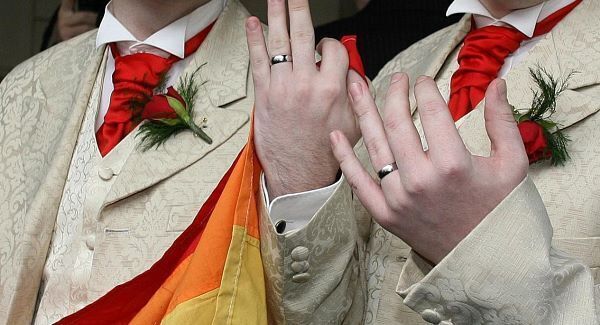
The court, however, fell short of a landmark ruling endorsing a fundamental right for gay people to marry.
The two cases, both decided on 5-4 votes, concerned the constitutionality of a key part of a federal law, the Defence of Marriage Act (DOMA), that denied benefits to same-sex married couples and a California state law enacted in 2008, called Proposition 8, that banned gay marriage.
The Supreme Court rulings come amid rapid progress for advocates of gay marriage in recent months and years in the US and internationally.
Opinion polls show a steady increase in US public support for gay marriage.
Gay marriage is an issue that stirs cultural, religious and political passions in the US and gay marriage advocates celebrated outside the courthouse. An enormous cheer went up as word arrived DOMA had been struck down. “DOMA is dead!” the crowd chanted, as couples celebrated.
“Our marriage has not been recognised until today,” said Patricia Lambert, 59, who held her wife, Kathy Mulvey, 47. A South African, Lambert said she no longer would have to worry about being forced to leave the country if her work visa expired.
The court struck down the federal law as a violation of the US Constitution’s guarantee of equal protection under the law but ducked a ruling on Proposition 8 by finding that supporters of the law did not have standing to appeal a federal district court ruling that struck the law down.
While the ruling on DOMA was clear-cut, questions remained about what exactly the Proposition 8 ruling will mean on the ground. There is likely to be more litigation over whether the district court ruling applies statewide.
After hearing of the California ruling outside the courthouse, Anthony Romero, the executive director of the American Civil Liberties Union, said the fight for gay marriage would head back to the states.
“We take it to the states — state by state, legislature by legislature, governor by governor, and constitutional amendment by constitutional amendment,” he said.
In the DOMA case, Justice Anthony Kennedy wrote for the majority that the federal law, as passed by Congress in 1996, violated the US Constitution’s guarantee of equal protection.
“The federal statute is invalid, for no legitimate purpose overcomes the purpose and effect to disparage and to injure those whom the state, by its marriage laws, sought to protect in personhood and dignity,” Kennedy wrote.
Kennedy, often the court’s swing vote in close decisions, also said the law imposes “a stigma upon all who enter into same-sex marriages made lawful by the unquestioned authority of the states”
Chief Justice John Roberts and Justice Antonin Scalia both wrote dissenting opinions. Roberts himself wrote the Proposition 8 opinion, ruling along procedural lines with the court split in an unusual way.
Twelve of the 50 states and the District of Columbia recognise gay marriage. Three of those dozen, Delaware, Minnesota and Rhode Island, legalised gay marriage this year.
As a result of yesterday’s ruling, Edith Windsor of New York, who was married to a woman and sued the government to get the federal estate tax deduction available to heterosexuals when their spouses pass away, will be able to claim a $363,000 tax refund.
President Barack Obama is the first sitting US president to endorse gay marriage but he had long asserted same-sex marriage was a matter for the states to handle. At the last minute, however, his administration decided to enter the California dispute and argue that federal guarantees of constitutional equality forbid states from limiting marriage to heterosexuals.
CONNECT WITH US TODAY



Be the first to know the latest news and updates